Faculty of Life Sciences, Wellcome Trust Centre for Cell-Matrix Research, Manchester, United Kingdom.
PLoS One. 2012;7(4):e36339. doi: 10.1371/journal.pone.0036339. Epub 2012 Apr 30.
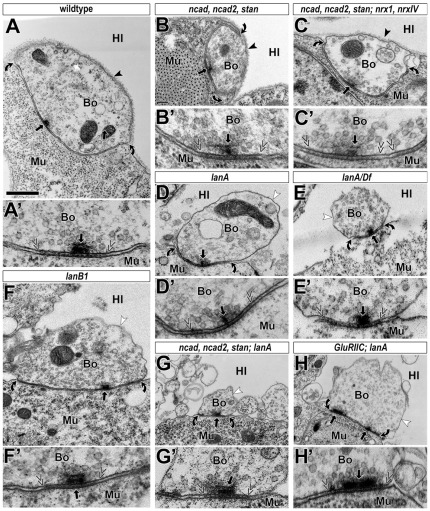
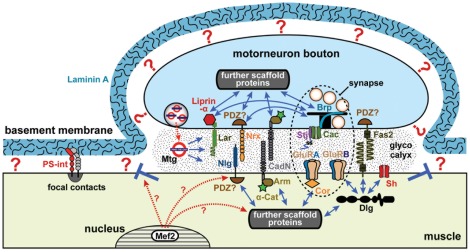
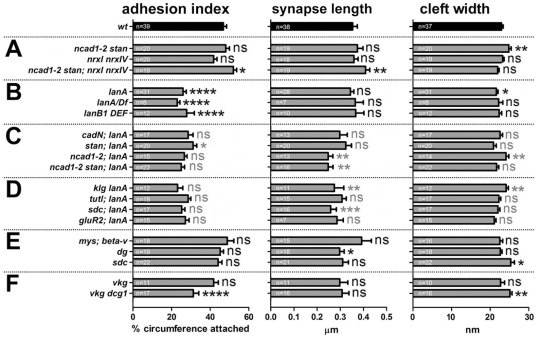
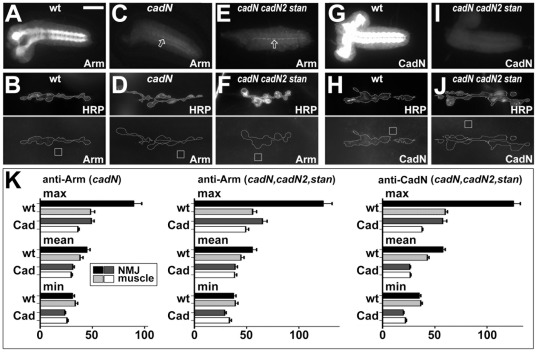
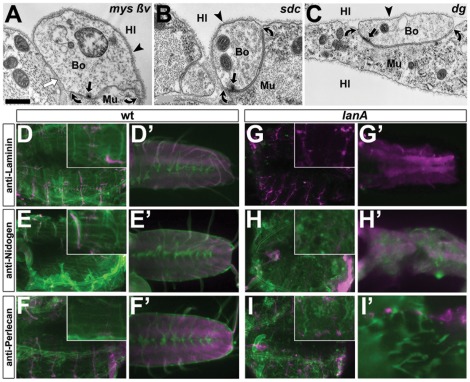
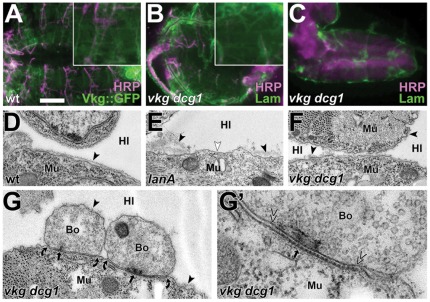
Synapse formation and maintenance crucially underlie brain function in health and disease. Both processes are believed to depend on cell adhesion molecules (CAMs). Many different classes of CAMs localise to synapses, including cadherins, protocadherins, neuroligins, neurexins, integrins, and immunoglobulin adhesion proteins, and further contributions come from the extracellular matrix and its receptors. Most of these factors have been scrutinised by loss-of-function analyses in animal models. However, which adhesion factors establish the essential physical links across synaptic clefts and allow the assembly of synaptic machineries at the contact site in vivo is still unclear. To investigate these key questions, we have used the neuromuscular junction (NMJ) of Drosophila embryos as a genetically amenable model synapse. Our ultrastructural analyses of NMJs lacking different classes of CAMs revealed that loss of all neurexins, all classical cadherins or all glutamate receptors, as well as combinations between these or with a Laminin deficiency, failed to reveal structural phenotypes. These results are compatible with a view that these CAMs might have no structural role at this model synapse. However, we consider it far more likely that they operate in a redundant or well buffered context. We propose a model based on a multi-adaptor principle to explain this phenomenon. Furthermore, we report a new CAM-independent adhesion mechanism that involves the basement membranes (BM) covering neuromuscular terminals. Thus, motorneuronal terminals show strong partial detachment of the junction when BM-to-cell surface attachment is impaired by removing Laminin A, or when BMs lose their structural integrity upon loss of type IV collagens. We conclude that BMs are essential to tie embryonic motorneuronal terminals to the muscle surface, lending CAM-independent structural support to their adhesion. Therefore, future developmental studies of these synaptic junctions in Drosophila need to consider the important contribution made by BM-dependent mechanisms, in addition to CAM-dependent adhesion.
突触的形成和维持是大脑在健康和疾病状态下发挥功能的关键。这两个过程都被认为依赖于细胞黏附分子(CAMs)。许多不同类型的 CAM 定位于突触,包括钙黏蛋白、原钙黏蛋白、神经黏附素、神经连接蛋白、整合素和免疫球蛋白黏附蛋白,细胞外基质及其受体也有进一步的贡献。这些因素中的大多数都在动物模型的功能丧失分析中进行了仔细研究。然而,哪些黏附因子在突触裂中建立了必要的物理连接,并允许在体内接触部位组装突触机制,目前仍不清楚。为了研究这些关键问题,我们使用果蝇胚胎的神经肌肉接头(NMJ)作为一种具有遗传可操作性的模型突触。我们对缺乏不同类型 CAM 的 NMJ 的超微结构分析表明,丧失所有神经连接蛋白、所有经典钙黏蛋白或所有谷氨酸受体,以及这些蛋白的组合缺失,或与层粘连蛋白缺乏的组合缺失,都未能揭示结构表型。这些结果与以下观点一致,即这些 CAM 在这个模型突触中可能没有结构作用。然而,我们认为它们在冗余或缓冲良好的环境中运作的可能性更大。我们提出了一个基于多接头原理的模型来解释这一现象。此外,我们报告了一种新的 CAM 独立的黏附机制,该机制涉及覆盖神经肌肉末端的基底膜(BM)。因此,当层粘连蛋白 A 缺失或 IV 型胶原缺失导致 BM 失去结构完整性时,运动神经元末梢的连接会出现强烈的部分分离。我们得出结论,BM 对于将胚胎运动神经元末梢与肌肉表面连接至关重要,为它们的黏附提供了 CAM 独立的结构支持。因此,在果蝇中对这些突触连接进行未来的发育研究时,除了考虑 CAM 依赖的黏附之外,还需要考虑 BM 依赖的机制的重要贡献。