Department of Ecology & Evolutionary Biology, University of Toronto, Toronto, Ontario, Canada.
PLoS Biol. 2012;10(5):e1001317. doi: 10.1371/journal.pbio.1001317. Epub 2012 May 1.
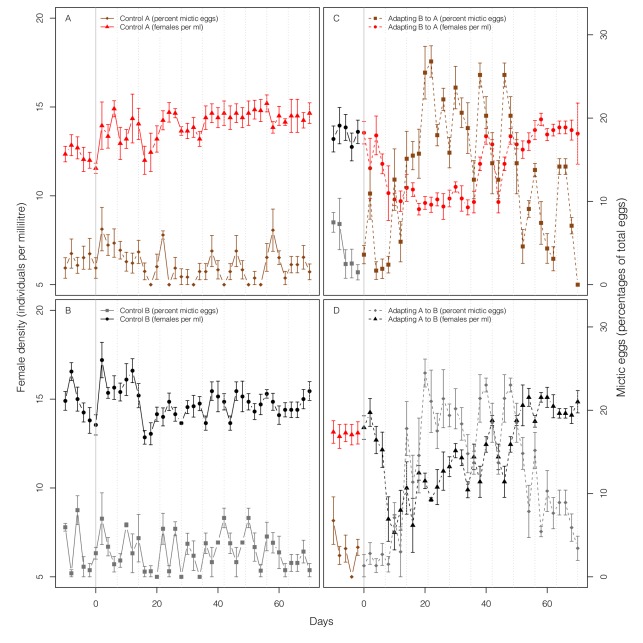
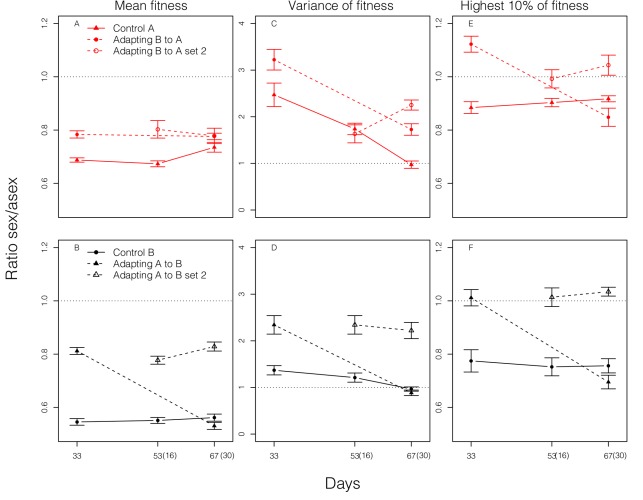
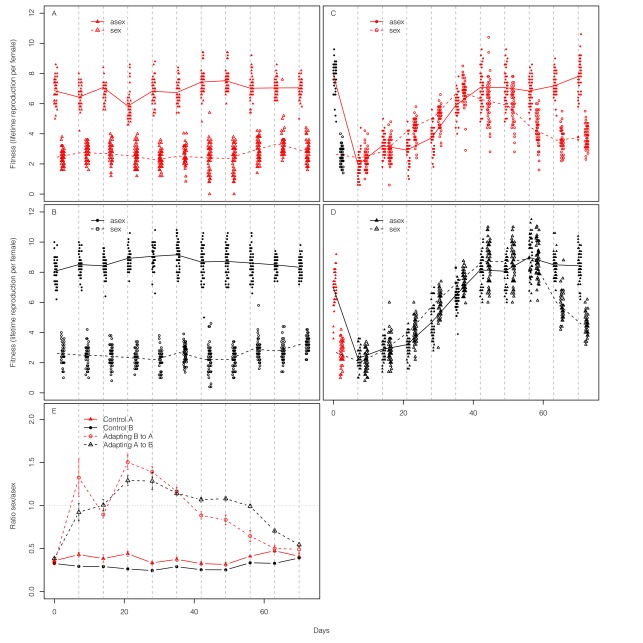
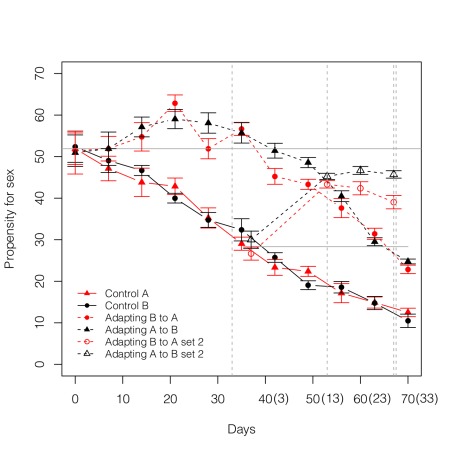
Both theory and experiments have demonstrated that sex can facilitate adaptation, potentially yielding a group-level advantage to sex. However, it is unclear whether this process can help solve the more difficult problem of the maintenance of sex within populations. Using experimental populations of the facultatively sexual rotifer Brachionus calyciflorus, we show that rates of sex evolve to higher levels during adaptation but then decline as fitness plateaus. To assess the fitness consequences of genetic mixing, we directly compare the fitnesses of sexually and asexually derived genotypes that naturally occur in our experimental populations. Sexually derived genotypes are more fit than asexually derived genotypes when adaptive pressures are strong, but this pattern reverses as the pace of adaptation slows, matching the pattern of evolutionary change in the rate of sex. These fitness assays test the net effect of sex but cannot be used to disentangle whether selection on sex arises because highly sexual lineages become associated with different allele combinations or with different allele frequencies than less sexual lineages (i.e., "short-" or "long-term" effects, respectively). We infer which of these mechanisms provides an advantage to sex by performing additional manipulations to obtain fitness distributions of sexual and asexual progeny arrays from unbiased parents (rather than from naturally occurring, and thereby evolutionarily biased, parents). We find evidence that sex breaks down adaptive gene combinations, resulting in lower average fitness of sexual progeny (i.e., a short-term disadvantage to sex). As predicted by theory, the advantage to sex arises because sexually derived progeny are more variable in fitness, allowing for faster adaptation. This "long-term advantage" builds over multiple generations, eventually resulting in higher fitness of sexual types.
理论和实验都表明,性别可以促进适应,可能会给群体带来优势。然而,目前尚不清楚这一过程是否有助于解决更困难的问题,即在种群中维持性别。我们使用兼性有性轮虫 Brachionus calyciflorus 的实验种群,表明在适应过程中,性的发生频率会进化到更高的水平,但随着适应的停滞,频率会下降。为了评估遗传混合的适应度后果,我们直接比较了在我们的实验种群中自然发生的有性和无性衍生基因型的适应度。当适应性压力很强时,有性衍生的基因型比无性衍生的基因型更适合,但随着适应速度的放缓,这种模式发生了逆转,与性发生频率的进化变化模式相匹配。这些适应度测定检验了性的净效应,但不能用于区分性选择是因为高度有性的谱系与不同的等位基因组合相关联,还是与不太有性的谱系相比具有不同的等位基因频率(即分别为“短期”或“长期”效应)。我们通过对无偏见的亲本进行额外的操作,获得有性和无性后代的适应度分布,从而推断出哪种机制为性提供了优势(而不是从自然发生的、因此具有进化偏见的亲本中推断)。我们发现有证据表明,性打破了适应性基因组合,导致有性后代的平均适应度降低(即性的短期劣势)。正如理论预测的那样,性的优势在于有性后代在适应度上的变异性更大,从而允许更快的适应。这种“长期优势”在多代中逐渐建立,最终导致性类型的适应度更高。