Helen Wills Neuroscience Institute, University of California, Berkeley, California, United States of America.
PLoS One. 2012;7(4):e34937. doi: 10.1371/journal.pone.0034937. Epub 2012 Apr 26.
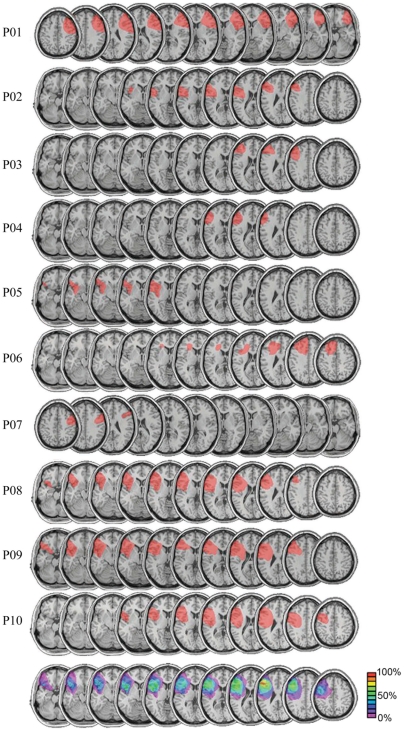
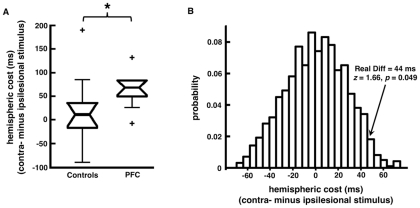
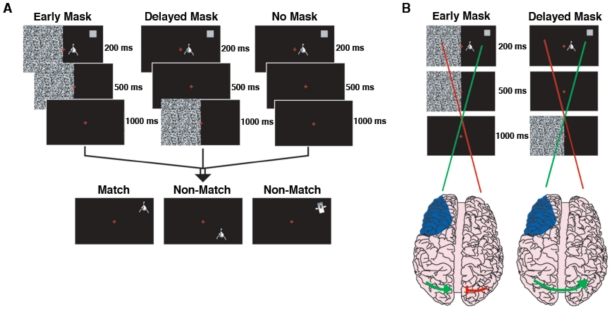
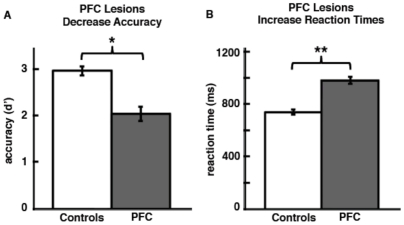
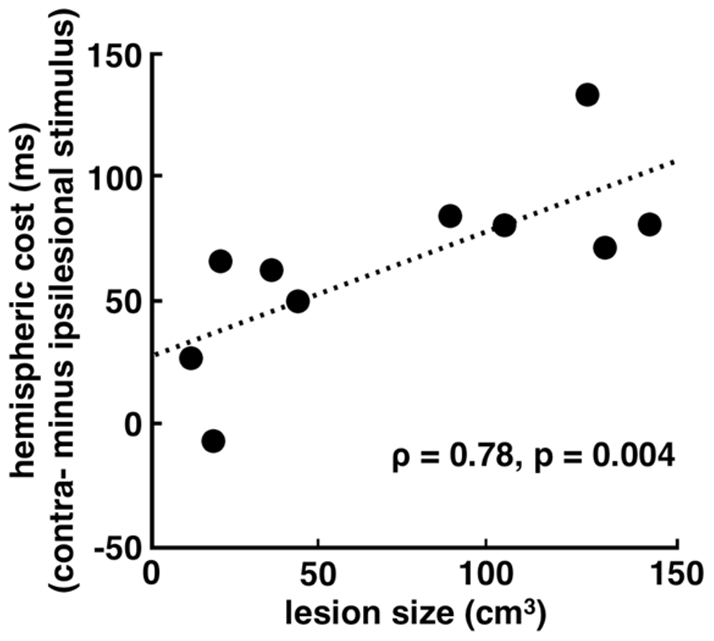
How and where object and spatial information are perceptually integrated in the brain is a central question in visual cognition. Single-unit physiology, scalp EEG, and fMRI research suggests that the prefrontal cortex (PFC) is a critical locus for object-spatial integration. To test the causal participation of the PFC in an object-spatial integration network, we studied ten patients with unilateral PFC damage performing a lateralized object-spatial integration task. Consistent with single-unit and neuroimaging studies, we found that PFC lesions result in a significant behavioral impairment in object-spatial integration. Furthermore, by manipulating inter-hemispheric transfer of object-spatial information, we found that masking of visual transfer impairs performance in the contralesional visual field in the PFC patients. Our results provide the first evidence that the PFC plays a key, causal role in an object-spatial integration network. Patient performance is also discussed within the context of compensation by the non-lesioned PFC.
大脑中如何以及在何处对物体和空间信息进行感知整合是视觉认知中的一个核心问题。单细胞生理学、头皮 EEG 和 fMRI 研究表明,前额叶皮层(PFC)是物体-空间整合的关键部位。为了测试 PFC 在物体-空间整合网络中的因果参与,我们研究了 10 名单侧 PFC 损伤患者执行侧化物体-空间整合任务的情况。与单细胞和神经影像学研究一致,我们发现 PFC 损伤导致物体-空间整合的显著行为障碍。此外,通过操纵物体-空间信息的半球间转移,我们发现视觉转移掩蔽会损害 PFC 患者对侧视野的表现。我们的结果首次提供了证据,证明 PFC 在物体-空间整合网络中起着关键的、因果的作用。还在非损伤 PFC 代偿的背景下讨论了患者的表现。