Department of Genetics, University of Dublin, Trinity College, Dublin, Ireland.
PLoS One. 2012;7(4):e35659. doi: 10.1371/journal.pone.0035659. Epub 2012 Apr 26.
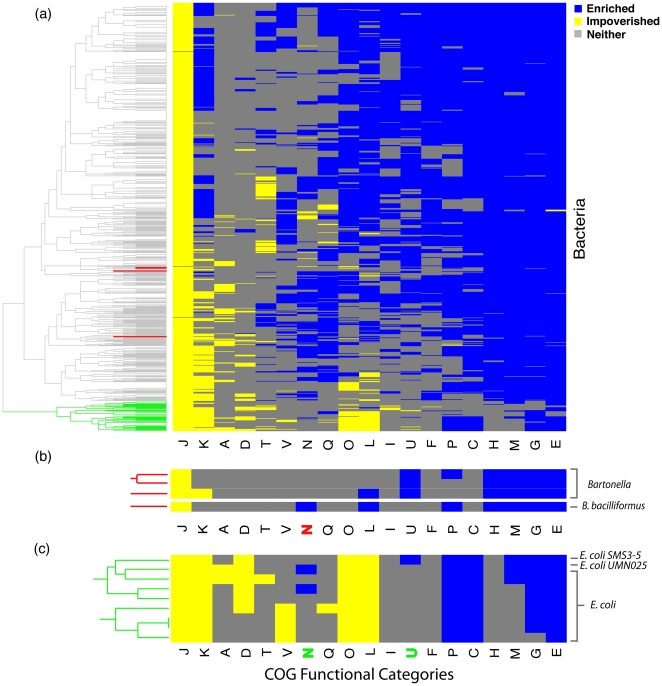
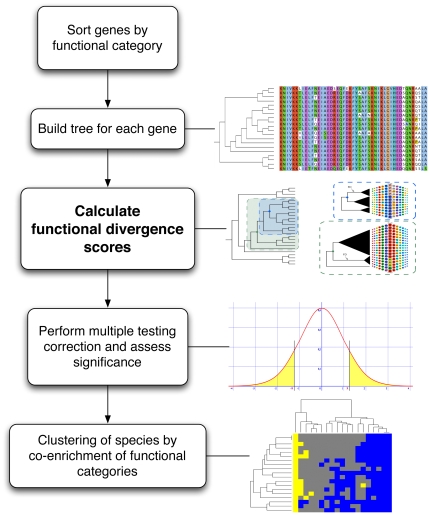
Functional divergence is the process by which new genes and functions originate through the modification of existing ones. Both genetic and environmental factors influence the evolution of new functions, including gene duplication or changes in the ecological requirements of an organism. Novel functions emerge at the expense of ancestral ones and are generally accompanied by changes in the selective forces at constrained protein regions. We present software capable of analyzing whole proteomes, identifying putative amino acid replacements leading to functional change in each protein and performing statistical tests on all tabulated data. We apply this method to 750 complete bacterial proteomes to identify high-level patterns of functional divergence and link these patterns to ecological adaptations. Proteome-wide analyses of functional divergence in bacteria with different ecologies reveal a separation between proteins involved in information processing (Ribosome biogenesis etc.) and those which are dependent on the environment (energy metabolism, defense etc.). We show that the evolution of pathogenic and symbiotic bacteria is constrained by their association with the host, and also identify unusual events of functional divergence even in well-studied bacteria such as Escherichia coli. We present a description of the roles of phylogeny and ecology in functional divergence at the level of entire proteomes in bacteria.
功能分化是指新基因和功能通过对现有基因的修饰而产生的过程。遗传和环境因素都影响新功能的进化,包括基因复制或生物体生态需求的变化。新功能的出现是以牺牲祖先功能为代价的,通常伴随着约束蛋白质区域选择压力的变化。我们提供了一种能够分析整个蛋白质组的软件,能够识别导致每个蛋白质功能变化的潜在氨基酸替换,并对所有表格数据进行统计检验。我们将这种方法应用于 750 个完整的细菌蛋白质组,以确定功能分化的高级模式,并将这些模式与生态适应联系起来。对具有不同生态的细菌进行的功能分化的全蛋白质组分析表明,信息处理(核糖体生物发生等)相关的蛋白质与依赖于环境(能量代谢、防御等)的蛋白质之间存在分离。我们表明,致病菌和共生菌的进化受到与宿主的联系的限制,即使在像大肠杆菌这样研究充分的细菌中,也能识别出异常的功能分化事件。我们提出了一种描述细菌中整个蛋白质组水平上的系统发育和生态在功能分化中的作用的描述。