Department of Laboratory Medicine & Genetics, Samsung Medical Center, Sungkyunkwan University School of Medicine, Seoul, Korea.
Ann Lab Med. 2012 May;32(3):238-41. doi: 10.3343/alm.2012.32.3.238. Epub 2012 Apr 18.
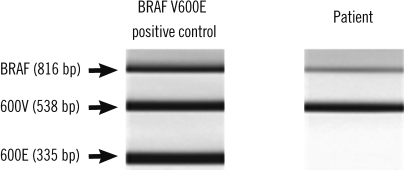
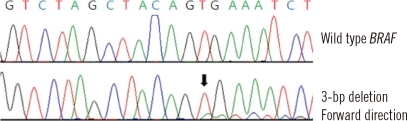
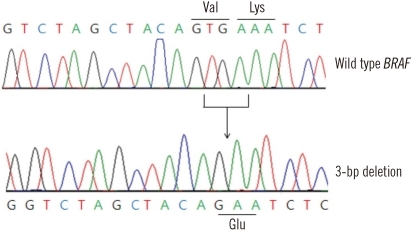
Papillary thyroid carcinoma (PTC) is the most common malignant thyroid tumor, and 36-69% of PTC cases are caused by mutations in the BRAF gene. The substitution of a valine for a glutamic acid (V600E) comprises up to 95-100% of BRAF mutations; therefore, most diagnostic methods, including allele-specific PCR and real-time PCR, are designed to detect this mutation. Nevertheless, other mutations can also comprise the genetic background of PTC. Recently, a novel and sensitive technique called mutant enrichment with 3'-modified oligonucleotides (MEMO) PCR has been introduced. When we applied allelespecific PCR and MEMO-PCR for the detection of the BRAF V600E mutation, we found an unusual 3' bp deletion mutation (c.1799_1801delTGA) only when using MEMO-PCR. This deletion results in the introduction of a glutamic acid into the B-Raf activation segment (p.V600_K601delinsE), leading to an elevated basal kinase activity of BRAF. This is the first report of a rare 3 bp BRAF deletion in a PTC patient that could not be detected by allele-specific PCR.
甲状腺乳头状癌 (PTC) 是最常见的恶性甲状腺肿瘤,约 36-69%的 PTC 病例由 BRAF 基因突变引起。BRAF 基因的缬氨酸取代谷氨酸(V600E)构成高达 95-100%的 BRAF 突变;因此,大多数诊断方法,包括等位基因特异性 PCR 和实时 PCR,都是为检测这种突变而设计的。然而,其他突变也可能构成 PTC 的遗传背景。最近,一种称为 3' 修饰寡核苷酸(MEMO)PCR 的突变富集的新的敏感技术已经问世。当我们应用等位基因特异性 PCR 和 MEMO-PCR 检测 BRAF V600E 突变时,我们仅在使用 MEMO-PCR 时发现了一种异常的 3' bp 缺失突变(c.1799_1801delTGA)。这种缺失导致在 B-Raf 激活片段中引入一个谷氨酸(p.V600_K601delinsE),从而导致 BRAF 的基础激酶活性升高。这是首例在 PTC 患者中发现的罕见 3 bp BRAF 缺失,无法通过等位基因特异性 PCR 检测到。