Department of Evolutionary Ecology, Max Planck Institute for Evolutionary Biology, August-Thienemann-Strasse 2, 24306 Plön, Germany.
Parasit Vectors. 2012 May 7;5:90. doi: 10.1186/1756-3305-5-90.
For parasites with complex life cycles, size at transmission can impact performance in the next host, thereby coupling parasite phenotypes in the two consecutive hosts. However, a handful of studies with parasites, and numerous studies with free-living, complex-life-cycle animals, have found that larval size correlates poorly with fitness under particular conditions, implying that other traits, such as physiological or ontogenetic variation, may predict fitness more reliably. Using the tapeworm Schistocephalus solidus, we evaluated how parasite size, age, and ontogeny in the copepod first host interact to determine performance in the stickleback second host.
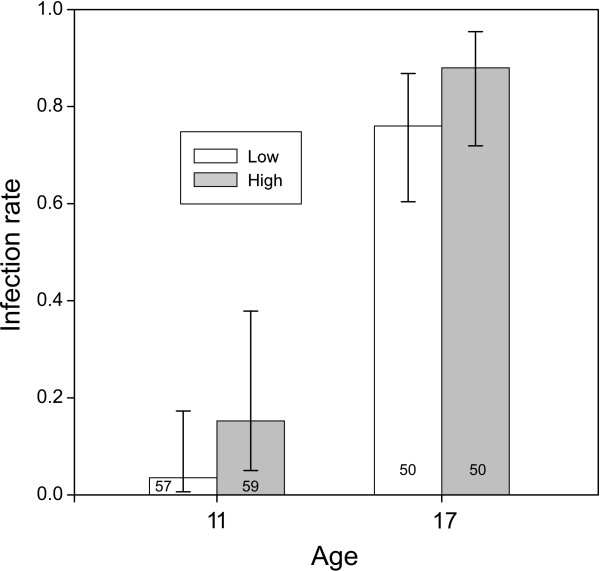
We raised infected copepods under two feeding treatments (to manipulate parasite growth), and then exposed fish to worms of two different ages (to manipulate parasite ontogeny). We assessed how growth and ontogeny in copepods affected three measures of fitness in fish: infection probability, growth rate, and energy storage.
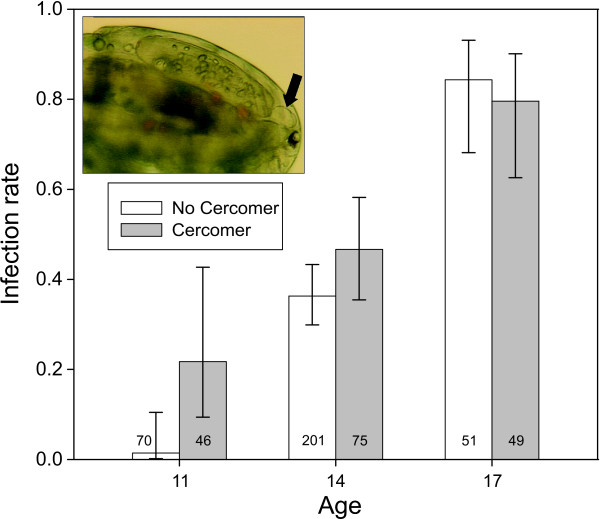
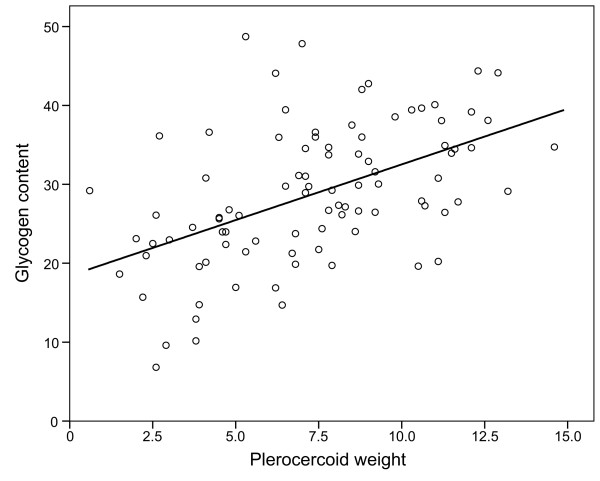
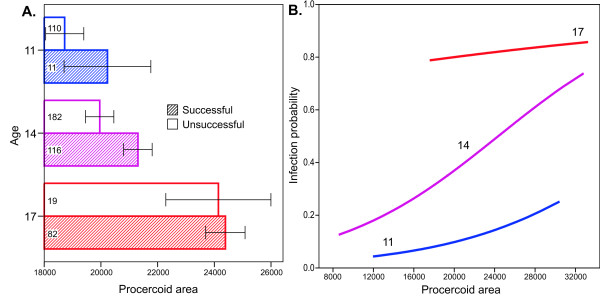
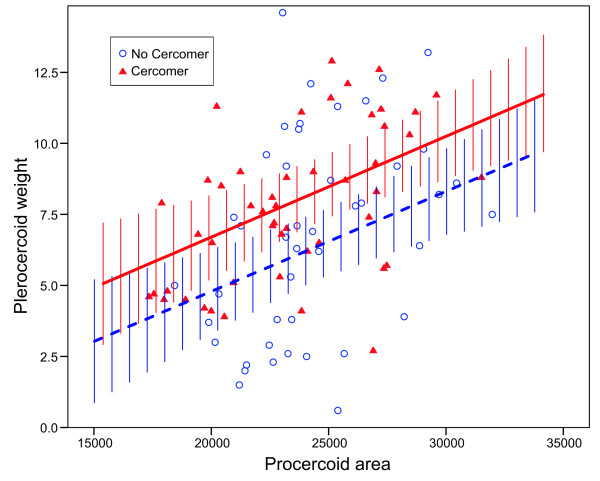
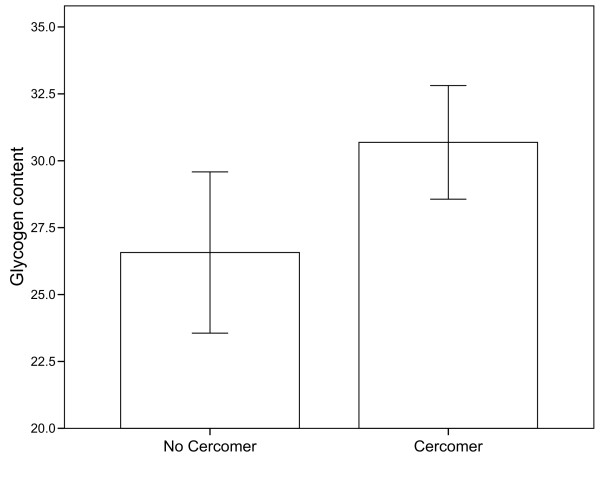
Our main, novel finding is that the increase in fitness (infection probability and growth in fish) with larval size and age observed in previous studies on S. solidus seems to be largely mediated by ontogenetic variation. Worms that developed rapidly (had a cercomer after 9 days in copepods) were able to infect fish at an earlier age, and they grew to larger sizes with larger energy reserves in fish. Infection probability in fish increased with larval size chiefly in young worms, when size and ontogeny are positively correlated, but not in older worms that had essentially completed their larval development in copepods.
Transmission to sticklebacks as a small, not-yet-fully developed larva has clear costs for S. solidus, but it remains unclear what prevents the evolution of faster growth and development in this species.
对于具有复杂生命周期的寄生虫来说,在传播时的大小可能会影响其在下一个宿主中的表现,从而将两个连续宿主中的寄生虫表型联系起来。然而,少数针对寄生虫的研究以及大量针对具有复杂生命周期的自由生活动物的研究发现,在特定条件下,幼虫大小与适应性的相关性很差,这意味着其他特征,如生理或个体发育变化,可能更可靠地预测适应性。本研究使用带绦虫 Schistocephalus solidus,评估了寄生虫在桡足类第一宿主中的大小、年龄和个体发育如何相互作用,从而决定其在刺鱼第二宿主中的表现。
我们在两种饲养处理下(以操纵寄生虫的生长)饲养感染的桡足类,并使鱼类暴露于两种不同年龄的蠕虫(以操纵寄生虫的个体发育)。我们评估了桡足类中的生长和个体发育如何影响鱼类的三种适应性衡量标准:感染概率、生长率和能量储存。
我们的主要新发现是,在以前关于 S. solidus 的研究中观察到的幼虫大小和年龄与适应性增加之间的关系,似乎在很大程度上是由个体发育变化介导的。快速发育(在桡足类中 9 天后出现 Cercomer)的蠕虫能够更早地感染鱼类,并且它们在鱼类中生长到更大的体型,具有更大的能量储备。鱼类的感染概率随着幼虫大小的增加而增加,主要发生在幼虫较小、大小和个体发育呈正相关的早期,但在发育基本完成的较大幼虫中则没有增加,这些幼虫已经在桡足类中完成了幼虫发育。
作为一个小的、尚未完全发育的幼虫传播到刺鱼身上对 S. solidus 有明显的代价,但目前尚不清楚是什么阻止了该物种更快生长和发育的进化。