Kansai Electric Power Hospital, Osaka, Japan.
Diabetes Obes Metab. 2012 Oct;14(10):910-7. doi: 10.1111/j.1463-1326.2012.01618.x. Epub 2012 May 30.
To assess the efficacy and safety of once-daily lixisenatide versus placebo in Asian patients with type 2 diabetes insufficiently controlled on basal insulin ± sulfonylurea.
In this 24-week, randomized, double-blind, placebo-controlled, parallel-group, multicentre study, participants (mean baseline HbA(1c) 8.53%) from Japan, Republic of Korea, Taiwan and the Philippines received lixisenatide (n = 154) or placebo (n = 157) in a stepwise dose increase to 20 µg once daily. The primary endpoint was HbA(1c) change from baseline to week 24.
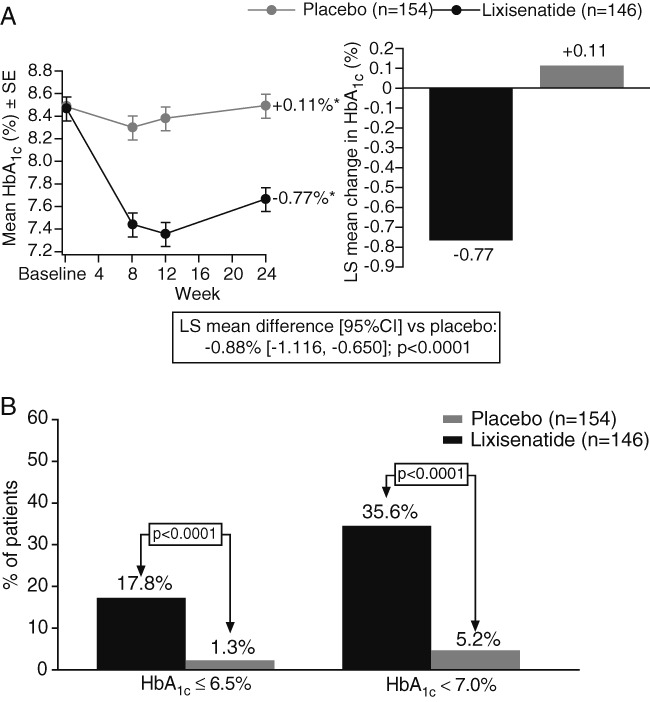
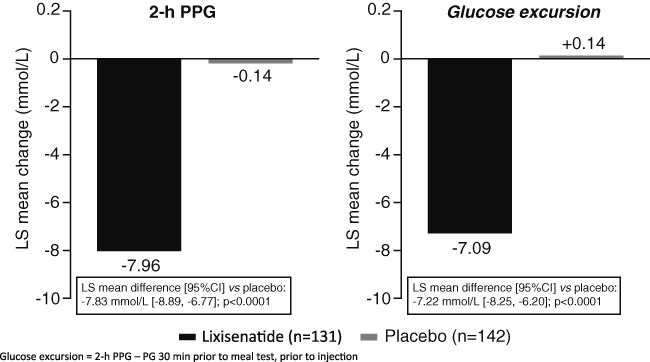
Once-daily lixisenatide significantly improved HbA(1c) versus placebo (LS mean difference vs. placebo = -0.88% [95%CI= -1.116, -0.650]; p < 0.0001), and allowed more patients to achieve HbA(1c) <7.0% (35.6 vs. 5.2%) and ≤ 6.5% (17.8 vs. 1.3%). Lixisenatide also significantly improved 2-h postprandial plasma glucose and glucose excursion, average 7-point self-monitored blood glucose and fasting plasma glucose. Lixisenatide was well tolerated; 86% of patients on lixisenatide completed the study versus 92% on placebo. Ten (6.5%) lixisenatide and 9 (5.7%) placebo patients experienced serious adverse events. More lixisenatide patients [14 (9.1%)] discontinued for adverse events versus placebo [5 (3.2%)], mainly with gastrointestinal causes. Nausea and vomiting were reported in 39.6 and 18.2% of patients on lixisenatide versus 4.5 and 1.9% on placebo. Symptomatic hypoglycaemia was more frequent with lixisenatide (42.9%) versus placebo (23.6%), but was similar between groups (32.6 vs. 28.3%, respectively), in those not receiving sulfonylureas. No severe hypoglycaemia was reported.
In an Asian type 2 diabetes population insufficiently controlled by basal insulin ± sulfonylurea, once-daily lixisenatide significantly improved glycaemic control, with a pronounced postprandial effect, and was well tolerated.
评估每日一次利西那肽对比安慰剂在基础胰岛素联合磺脲类药物血糖控制不佳的亚洲 2 型糖尿病患者中的疗效和安全性。
这是一项为期 24 周、随机、双盲、安慰剂对照、平行分组、多中心研究,来自日本、韩国、中国台湾和菲律宾的参与者(平均基线 HbA1c 8.53%)接受了利西那肽(n=154)或安慰剂(n=157)治疗,剂量逐步递增至每日一次 20μg。主要终点为治疗 24 周时 HbA1c 自基线的变化。
与安慰剂相比,每日一次利西那肽显著改善了 HbA1c(LS 均值差值 vs. 安慰剂=-0.88%[95%CI=-1.116,-0.650];p<0.0001),并使更多患者达到 HbA1c<7.0%(35.6% vs. 5.2%)和≤6.5%(17.8% vs. 1.3%)。利西那肽还显著改善了餐后 2 小时血糖和血糖波动、平均 7 点自我监测血糖和空腹血糖。利西那肽耐受性良好;利西那肽组 86%的患者完成了研究,安慰剂组为 92%。10 例(6.5%)利西那肽和 9 例(5.7%)安慰剂患者发生严重不良事件。更多的利西那肽患者(14[9.1%])因不良事件而停药,安慰剂组为 5(3.2%),主要是胃肠道原因。利西那肽组恶心和呕吐的发生率分别为 39.6%和 18.2%,安慰剂组分别为 4.5%和 1.9%。与安慰剂组(分别为 32.6%和 28.3%)相比,未使用磺脲类药物的患者中,利西那肽组(42.9%)低血糖症状更为频繁,但两组间无显著差异。未报告严重低血糖事件。
在基础胰岛素联合磺脲类药物血糖控制不佳的亚洲 2 型糖尿病患者中,每日一次利西那肽可显著改善血糖控制,具有明显的餐后作用,且耐受性良好。