Medstar Research Institute and Georgetown University Medical School, Washington, DC, USA.
Diabet Med. 2010 Sep;27(9):1024-32. doi: 10.1111/j.1464-5491.2010.03020.x.
To evaluate the dose-response relationship of lixisenatide (AVE0010), a glucagon-like peptide-1 (GLP-1) receptor agonist, in metformin-treated patients with Type 2 diabetes.
Randomized, double-blind, placebo-controlled, parallel-group, 13 week study of 542 patients with Type 2 diabetes inadequately controlled [glycated haemoglobin (HbA(1c)) > or = 7.0 and < 9.0% (> or = 53 and < 75 mmol/mol)] on metformin (> or = 1000 mg/day) treated with subcutaneous lixisenatide doses of 5, 10, 20 or 30 microg once daily or twice daily or placebo. The primary end-point was change in HbA(1c) from baseline to 13 weeks in the intent-to-treat population.
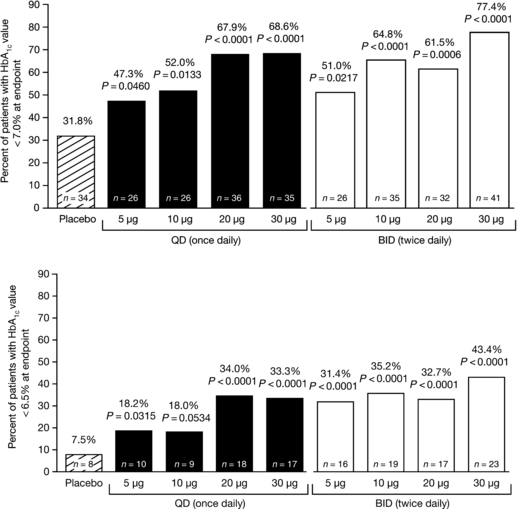
Lixisenatide significantly improved mean HbA(1c) from a baseline of 7.55% (59.0 mmol/mol); respective mean reductions for 5, 10, 20 and 30 microg doses were 0.47, 0.50, 0.69 and 0.76% (5.1, 5.5, 7.5 and 8.3 mmol/mol), on once-daily and 0.65, 0.78, 0.75 and 0.87% (7.1, 8.5, 8.2 and 9.5 mmol/mol) on twice-daily administrations vs. 0.18% (2.0 mmol/mol) with placebo (all P < 0.01 vs. placebo). Target HbA(1c) < 7.0% (53 mmol/mol) at study end was achieved in 68% of patients receiving 20 and 30 microg once-daily lixisenatide vs. 32% receiving placebo (P < 0.0001). Dose-dependent improvements were observed for fasting, postprandial and average self-monitored seven-point blood glucose levels. Weight changes ranged from -2.0 to -3.9 kg with lixisenatide vs. -1.9 kg with placebo. The most frequent adverse event was mild-to-moderate nausea.
Lixisenatide significantly improved glycaemic control in mildly hyperglycaemic patients with Type 2 diabetes on metformin. Dose-response relationships were seen for once- and twice-daily regimens, with similar efficacy levels, with a 20 microg once-daily dose of lixisenatide demonstrating the best efficacy-to-tolerability ratio. This new, once-daily GLP-1 receptor agonist shows promise in the management of Type 2 diabetes to be defined further by ongoing long-term studies.
评估艾塞那肽(AVE0010),一种胰高血糖素样肽-1(GLP-1)受体激动剂,在二甲双胍治疗的 2 型糖尿病患者中的剂量反应关系。
这是一项 542 例 2 型糖尿病患者的随机、双盲、安慰剂对照、平行分组、13 周研究。这些患者在接受二甲双胍(>或= 1000mg/天)治疗的情况下血糖控制不佳[糖化血红蛋白(HbA1c)>或= 7.0 且<9.0%(>或= 53 且<75mmol/mol)],并接受皮下给予 5、10、20 或 30μg 艾塞那肽,每天一次或两次,或安慰剂治疗。主要终点为在意向治疗人群中从基线到 13 周的 HbA1c 变化。
艾塞那肽可显著改善平均 HbA1c,从基线的 7.55%(59.0mmol/mol);5、10、20 和 30μg 剂量的相应平均降低值分别为 0.47、0.50、0.69 和 0.76%(5.1、5.5、7.5 和 8.3mmol/mol),每天一次和 0.65、0.78、0.75 和 0.87%(7.1、8.5、8.2 和 9.5mmol/mol),每天两次,而安慰剂组为 0.18%(2.0mmol/mol)(所有 P<0.01 与安慰剂)。在研究结束时,20μg 和 30μg 艾塞那肽每天一次治疗的患者中有 68%达到了目标 HbA1c<7.0%(53mmol/mol),而安慰剂组为 32%(P<0.0001)。空腹、餐后和平均自我监测七点血糖水平均观察到剂量依赖性改善。体重变化范围为使用艾塞那肽治疗的患者为-2.0 至-3.9kg,而安慰剂组为-1.9kg。最常见的不良事件是轻度至中度恶心。
艾塞那肽可显著改善二甲双胍治疗的轻度高血糖 2 型糖尿病患者的血糖控制。一日一次和一日两次方案均观察到剂量反应关系,疗效水平相似,20μg 艾塞那肽一日一次剂量显示出最佳的疗效-耐受性比。这种新的、每日一次的 GLP-1 受体激动剂在 2 型糖尿病的治疗中显示出了前景,有待进一步通过正在进行的长期研究来确定。