Molecular and Cellular Radiation Oncology, Beth Israel Deaconess Medical Center, Harvard Medical School Boston, MA, USA.
Front Immunol. 2012 Mar 30;3:63. doi: 10.3389/fimmu.2012.00063. eCollection 2012.
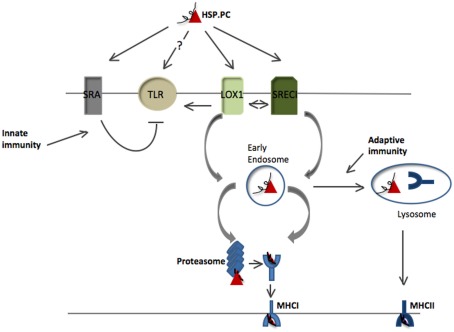
Heat shock proteins (HSPs) are molecular chaperones that bind tumor antigens and mediate their uptake into antigen presenting cells. HSP-antigen complexes are then directed toward either the MHC class I pathway through antigen cross presentation or the conventional class II pathway, leading to activation of T cell subsets. Uptake of HSP-chaperoned polypeptides can involve both receptor-mediated and receptor-independent routes, and mechanisms of antigen sorting between the Class I and II pathways after uptake are currently under investigation. The processes involved in internalization of HSP-antigen complexes differ somewhat from the mechanisms previously determined for (unchaperoned) particulate and free soluble antigens. A number of studies show that HSP-facilitated antigen cross presentation requires uptake of the complexes by scavenger receptors (SR) followed by processing in the proteasome, and loading onto MHC class I molecules. In this review we have examined the roles of HSPs and SR in antigen uptake, sorting, processing, cell signaling, and activation of innate and adaptive immunity.
热休克蛋白(HSPs)是分子伴侣,可结合肿瘤抗原并介导其摄取到抗原呈递细胞中。HSP-抗原复合物随后通过抗原交叉呈递或传统的 II 类途径定向到 MHC 类 I 途径,导致 T 细胞亚群的激活。HSP 伴侣多肽的摄取可以涉及受体介导和非受体依赖的途径,并且摄取后抗原在 I 类和 II 类途径之间的分类机制目前正在研究中。与以前确定的(无伴侣)颗粒和游离可溶性抗原的内化机制相比,HSP-抗原复合物的内化过程略有不同。许多研究表明,HSP 促进的抗原交叉呈递需要通过清道夫受体(SR)摄取复合物,然后在蛋白酶体中进行处理,并加载到 MHC 类 I 分子上。在这篇综述中,我们研究了 HSP 和 SR 在抗原摄取、分类、加工、细胞信号转导以及先天和适应性免疫激活中的作用。