Department of Experimental and Clinical Pharmacology, Pomeranian Medical University, Powstancow Wlkp. 72, 70-111, Szczecin, Poland.
Eur J Clin Pharmacol. 2012 Dec;68(12):1587-94. doi: 10.1007/s00228-012-1292-8. Epub 2012 May 9.
New-onset diabetes after transplantation (NODAT) is a major complication after kidney transplantation. The risk factors for NODAT include the use of calcineurin inhibitors as part of the immunosuppressive regimen, among which tacrolimus has the most pronounced diabetogenic effect. Both NODAT and type 2 diabetes mellitus (T2DM) share several risk factors. Recent studies have identified a number of common genetic variants associated with increased risk of T2DM. Here we report the results of our study on the potential effect of single nucleotide polymorphisms (SNPs) previously associated with T2DM on the risk of NODAT in kidney transplant patients medicated with tacrolimus.
Seven SNPs in six genes known to increase the risk of T2DM in Caucasians were genotyped by means of TaqMan assays in 235 kidney transplant patients medicated with tacrolimus: rs4402960 and rs1470579 in IGF2BP2; rs1111875 in HHEX; rs10811661 upstream of CDKN2A/B; rs13266634 in SLC30A8; rs1801282 in PPARG; rs5215 in KCNJ11. The TCF7L2 rs7903146 SNP was also included in the multivariate analysis.
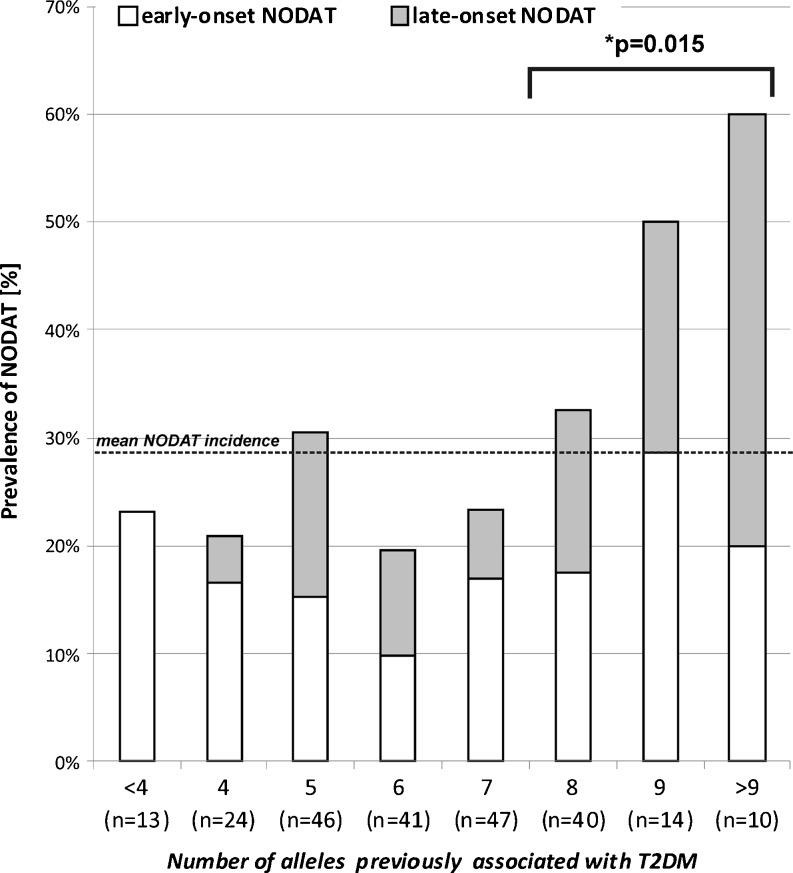
None of the analyzed SNPs was significantly associated with the risk of NODAT. However, the IGF2BP2 rs4402960 T allele was present significantly more frequently among patients diagnosed with NODAT more than 2 weeks after transplantation (p = 0.048). Mean (± standard deviation) number of the analyzed alleles tended to be lower in patients without NODAT (6.19 ± 1.71) than in NODAT patients (6.58 ± 1.1.95; p = 0.09) and significantly lower compared to late-onset NODAT patients (7.03 ± 1.88; p = 0.018). Multivariate analysis confirmed the significance of 'diabetogenic' allele number in late-onset NODAT development [odds ratio (OR) 1.37, 95 % confidence interval (CI) 1.05-1.78; p = 0.017]. Additionally, individuals carrying >7 of the analyzed 'diabetogenic' alleles were at a significantly higher risk of NODAT (OR 2.17, 95 % CI 1.18-3.99; p = 0.015).
Complex analysis of genotypes increasing the risk of diabetes may lead to the identification of NODAT susceptibility predictors.
移植后新发糖尿病(NODAT)是肾移植后的主要并发症。NODAT 的风险因素包括使用钙调神经磷酸酶抑制剂作为免疫抑制方案的一部分,其中他克莫司具有最明显的致糖尿病作用。NODAT 和 2 型糖尿病(T2DM)有几个共同的风险因素。最近的研究已经确定了一些与 T2DM 风险增加相关的常见遗传变异。在这里,我们报告了我们在使用他克莫司治疗的肾移植患者中,先前与 T2DM 相关的单核苷酸多态性(SNP)对 NODAT 风险的潜在影响的研究结果。
通过 TaqMan 分析对 235 名接受他克莫司治疗的肾移植患者的六个已知增加 T2DM 风险的基因中的七个 SNP 进行基因分型:IGF2BP2 中的 rs4402960 和 rs1470579;HHEX 中的 rs1111875;CDKN2A/B 上游的 rs10811661;SLC30A8 中的 rs13266634;PPARG 中的 rs1801282;KCNJ11 中的 rs5215。多变量分析还包括 TCF7L2 rs7903146 SNP。
没有分析的 SNP 与 NODAT 的风险显著相关。然而,与移植后 2 周以上诊断为 NODAT 的患者相比,IGF2BP2 rs4402960 T 等位基因在患者中更为常见(p = 0.048)。无 NODAT 患者的平均(±标准差)分析等位基因数(6.19±1.71)低于 NODAT 患者(6.58±1.195;p=0.09),明显低于晚发性 NODAT 患者(7.03±1.88;p=0.018)。多变量分析证实了“致糖尿病”等位基因数量在晚发性 NODAT 发展中的重要性[比值比(OR)1.37,95%置信区间(CI)1.05-1.78;p=0.017]。此外,携带>7 个分析“致糖尿病”等位基因的个体患 NODAT 的风险显著增加(OR 2.17,95%CI 1.18-3.99;p=0.015)。
对增加糖尿病风险的基因型进行复杂分析可能会确定 NODAT 易感性预测因子。