Laboratory of Plant Physiology, Faculty of Biotechnology, Agricultural University of Athens, Iera Odos 75, 11855 Athens, Greece; E-Mail:
Sensors (Basel). 2009;9(3):2176-86. doi: 10.3390/s90302176. Epub 2009 Mar 25.
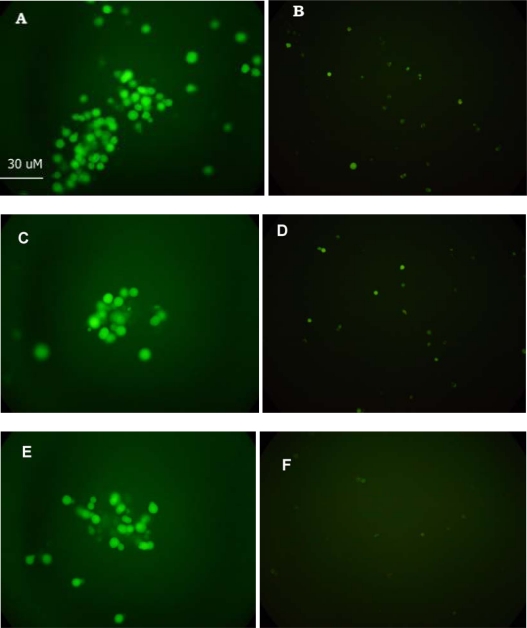
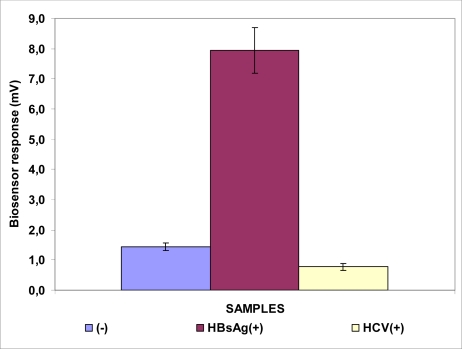
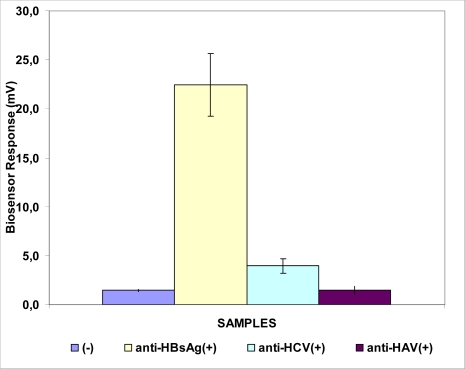
A novel miniature cell biosensor detection system for the detection of Hepatis B virus (HBV)-associated antigens and anti-HBV is described. The biosensor is based on "membrane-engineered" Vero fibroblast cells immobilized in an alginate matrix. The membrane-engineering process involved the electroinsertion of anti-HBV specific antibodies (anti-HBs, anti-HBe) or antigens (HBsAg) in the membranes of the Vero cells. The attachment of a homologous antigen to the electroinserted antibody (or, respectively, of the antibody to the electroinserted antigen) triggered specific changes to the cell membrane potential that were measured by appropriate microelectrodes, according to the principle of the Bioelectric Recognition Assay (BERA). The sensor was used for screening 133 clinical blood serum samples according to a double-blind protocol. Considerably higher sensor responses were observed against HBV-positive samples, compared with responses against negative samples or samples positive for heterologous hepatitis viruses such as Hepatitis C (HCV) virus. Detection of anti-HBs antibodies was made possible by using a biosensor based on immobilized Vero cells bearing the respective antigen (HBsAg). The observed response was rapid (45 sec) and quite reproducible. Fluorescence microscopy observations showed that attachment of HBV particles to cells membrane-engineered with anti-HBs was associated with a decrease of [Ca(2+)]cyt. The perspectives for using the novel biosensor as a qualitative, rapid screening, high throughput assay for HBV antigens and anti-HBs in clinical samples is discussed.
一种用于检测乙型肝炎病毒(HBV)相关抗原和抗 HBV 的新型微型细胞生物传感器检测系统。该生物传感器基于固定在藻酸盐基质中的“膜工程化”Vero 成纤维细胞。膜工程化过程涉及将抗 HBV 特异性抗体(抗 HBs、抗 HBe)或抗原(HBsAg)电插入 Vero 细胞的膜中。同源抗原与电插入抗体(或分别为抗体与电插入抗原)的附着会触发细胞膜电势的特异性变化,根据生物电识别分析(BERA)的原理,这些变化可以通过适当的微电极进行测量。根据双盲方案,该传感器用于筛选 133 份临床血清样本。与针对阴性样本或针对丙型肝炎(HCV)等异源肝炎病毒呈阳性的样本相比,针对 HBV 阳性样本的传感器响应明显更高。通过使用基于固定有相应抗原(HBsAg)的 Vero 细胞的生物传感器,可以检测抗 HBs 抗体。观察到的响应快速(45 秒)且相当可重复。荧光显微镜观察表明,HBV 颗粒与用抗 HBs 工程化的细胞膜的附着与 [Ca(2+)]cyt 的减少有关。讨论了将新型生物传感器作为定性、快速筛选、高通量临床样本中 HBV 抗原和抗 HBs 的检测方法的前景。