Queensland Brain Institute, The University of Queensland, Brisbane QLD, Australia.
Front Mol Neurosci. 2012 May 7;5:60. doi: 10.3389/fnmol.2012.00060. eCollection 2012.
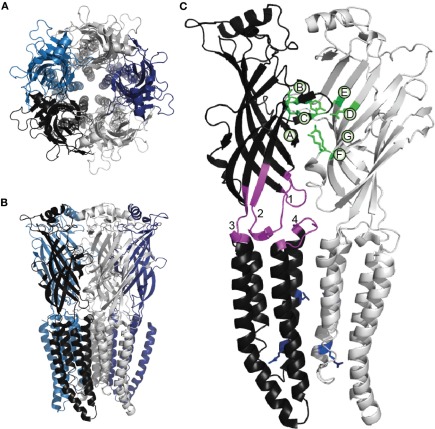
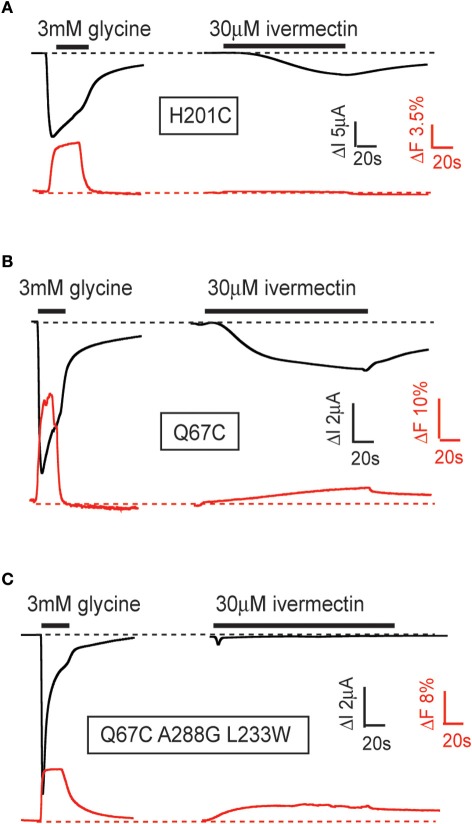
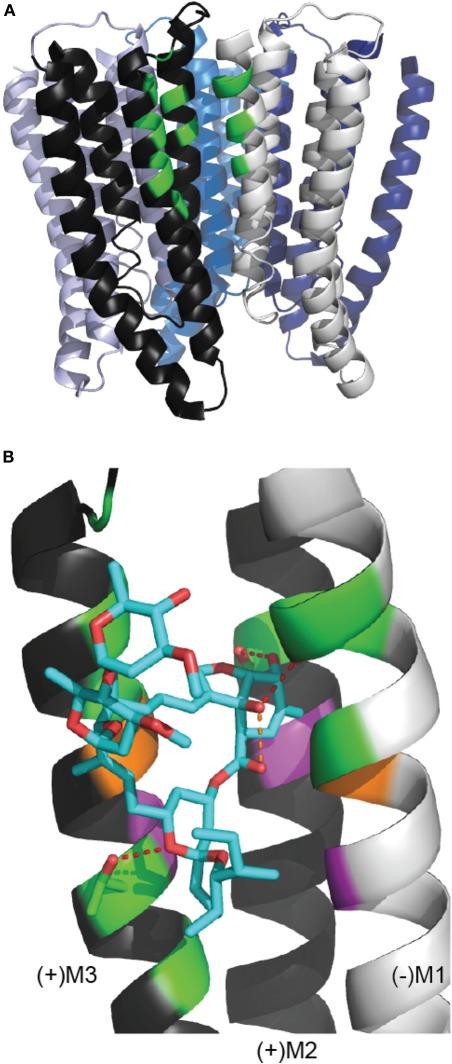
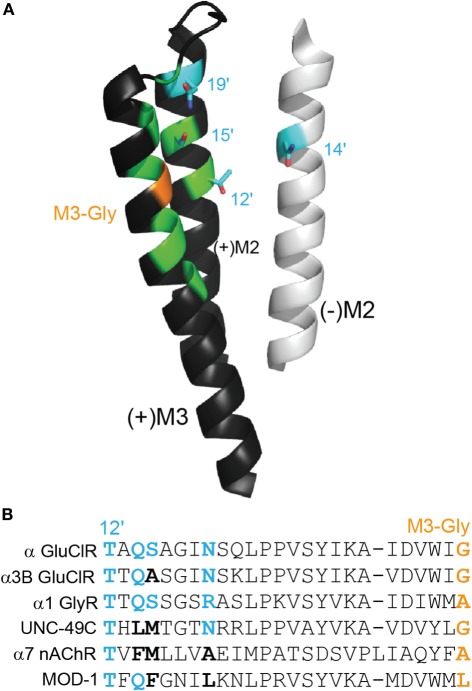
Ivermectin is an anthelmintic drug that works by inhibiting neuronal activity and muscular contractility in arthropods and nematodes. It works by activating glutamate-gated chloride channels (GluClRs) at nanomolar concentrations. These receptors, found exclusively in invertebrates, belong to the pentameric Cys-loop receptor family of ligand-gated ion channels (LGICs). Higher (micromolar) concentrations of ivermectin also activate or modulate vertebrate Cys-loop receptors, including the excitatory nicotinic and the inhibitory GABA type-A and glycine receptors (GlyRs). An X-ray crystal structure of ivermectin complexed with the C. elegans α GluClR demonstrated that ivermectin binds to the transmembrane domain in a cleft at the interface of adjacent subunits. It also identified three hydrogen bonds thought to attach ivermectin to its site. Site-directed mutagenesis and voltage-clamp electrophysiology have also been employed to probe the binding site for ivermectin in α1 GlyRs. These have raised doubts as to whether the hydrogen bonds are essential for high ivermectin potency. Due to its lipophilic nature, it is likely that ivermectin accumulates in the membrane and binds reversibly (i.e., weakly) to its site. Several lines of evidence suggest that ivermectin opens the channel pore via a structural change distinct from that induced by the neurotransmitter agonist. Conformational changes occurring at locations distant from the pore can be probed using voltage-clamp fluorometry (VCF), a technique which involves quantitating agonist-induced fluorescence changes from environmentally sensitive fluorophores covalently attached to receptor domains of interest. This technique has demonstrated that ivermectin induces a global conformational change that propagates from the transmembrane domain to the neurotransmitter binding site, thus suggesting a mechanism by which ivermectin potentiates neurotransmitter-gated currents. Together, this information provides new insights into the mechanisms of action of this important drug.
伊维菌素是一种抗寄生虫药物,通过抑制节肢动物和线虫的神经元活动和肌肉收缩起作用。它通过在纳摩尔浓度下激活谷氨酸门控氯通道 (GluClR) 起作用。这些受体仅存在于无脊椎动物中,属于五聚体 Cys 环受体家族的配体门控离子通道 (LGICs)。较高 (微摩尔) 浓度的伊维菌素还可激活或调节脊椎动物 Cys 环受体,包括兴奋性烟碱型和抑制性 GABA 型 A 和甘氨酸受体 (GlyRs)。伊维菌素与 C. elegans α GluClR 复合物的 X 射线晶体结构表明,伊维菌素结合在相邻亚基界面的跨膜结构域中的裂隙中。它还确定了三个氢键,认为这些氢键将伊维菌素连接到其位点上。定点突变和电压钳电生理学也被用于探测 α1 GlyRs 中伊维菌素的结合位点。这些研究对氢键是否对伊维菌素的高效力至关重要提出了质疑。由于其亲脂性,伊维菌素很可能在膜中积累并可逆 (即,弱) 结合到其位点。有几条证据表明,伊维菌素通过不同于神经递质激动剂诱导的结构变化来打开通道孔。可以使用电压钳荧光法 (VCF) 探测远离孔的位置发生的构象变化,该技术涉及定量分析共价连接到感兴趣的受体结构域的环境敏感荧光团的激动剂诱导荧光变化。该技术表明,伊维菌素诱导从跨膜结构域到神经递质结合位点传播的全局构象变化,从而提出了伊维菌素增强神经递质门控电流的机制。这些信息共同为这种重要药物的作用机制提供了新的见解。