Department of Neurobiology, Faculty of Natural Sciences, University of Haifa, Haifa, Israel.
PLoS One. 2012;7(5):e35853. doi: 10.1371/journal.pone.0035853. Epub 2012 May 7.
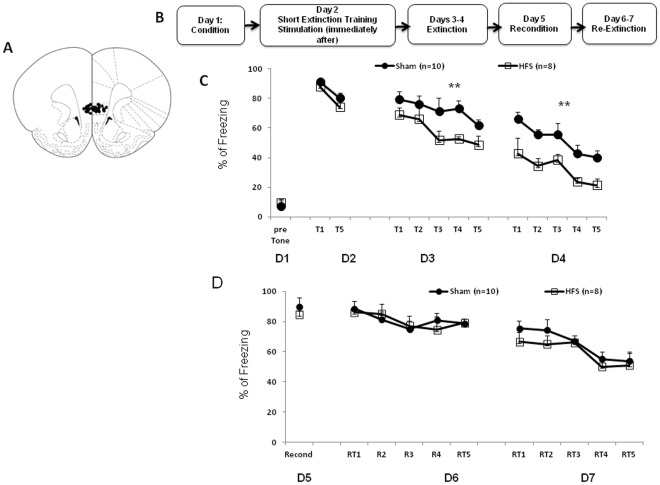
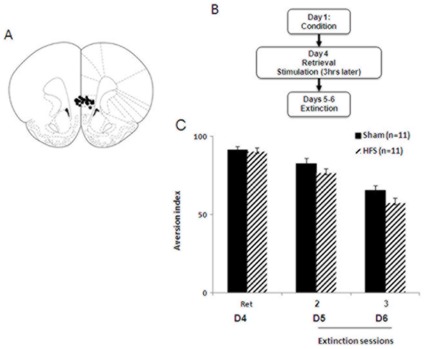
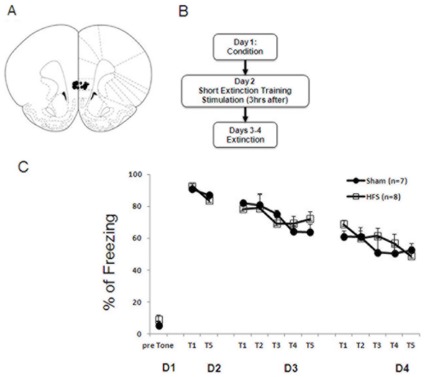
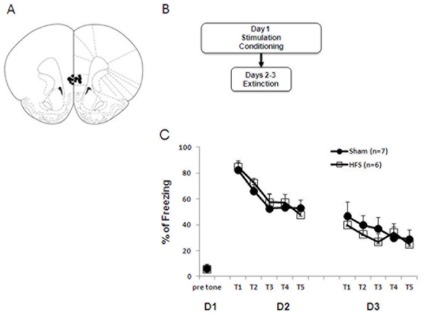
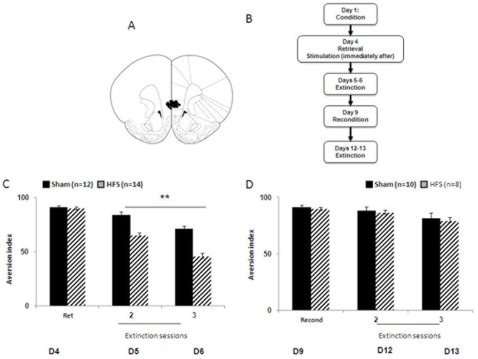
Electrical stimulation of the rodent medial prefrontal cortex (mPFC), including the infralimbic cortex (IL), immediately prior to or during fear extinction training facilitates extinction memory. Here we examined the effects of high-frequency stimulation (HFS) of the rat IL either prior to conditioning or following retrieval of the conditioned memory, on extinction of Pavlovian fear and conditioned taste aversion (CTA). IL-HFS applied immediately after fear memory retrieval, but not three hours after retrieval or prior to conditioning, subsequently reduced freezing during fear extinction. Similarly, IL-HFS given immediately, but not three hours after, retrieval of a CTA memory reduced aversion during extinction. These data indicate that HFS of the IL may be an effective method for reducing both learned fear and learned aversion.
在进行恐惧消退训练之前或期间对啮齿动物的内侧前额叶皮层(mPFC)进行电刺激,包括边缘下皮层(IL),可以促进消退记忆。在这里,我们研究了在条件作用之前或在条件记忆提取后对大鼠 IL 进行高频刺激(HFS)对 Pavlovian 恐惧和条件味觉厌恶(CTA)的消退的影响。在恐惧记忆提取后立即施加 IL-HFS,但不是在提取后三小时或在条件作用之前施加,随后会减少恐惧消退期间的冻结。同样,在提取 CTA 记忆后立即给予 IL-HFS,而不是在提取后三小时给予,会减少消退期间的厌恶。这些数据表明,IL 的 HFS 可能是减少习得性恐惧和习得性厌恶的有效方法。