Fundación Instituto Leloir and Instituto de Investigaciones Bioquímicas-Conicet, Buenos Aires, Argentina.
PLoS One. 2012;7(5):e36457. doi: 10.1371/journal.pone.0036457. Epub 2012 May 9.
Self-assembly is a common theme in proteins of unrelated sequences or functions. The human papillomavirus E7 oncoprotein is an extended dimer with an intrinsically disordered domain, that can form large spherical oligomers. These are the major species in the cytosol of HPV transformed and cancerous cells. E7 binds to a large number of targets, some of which lead to cell transformation. Thus, the assembly process not only is of biological relevance, but represents a model system to investigate a widely distributed mechanism.
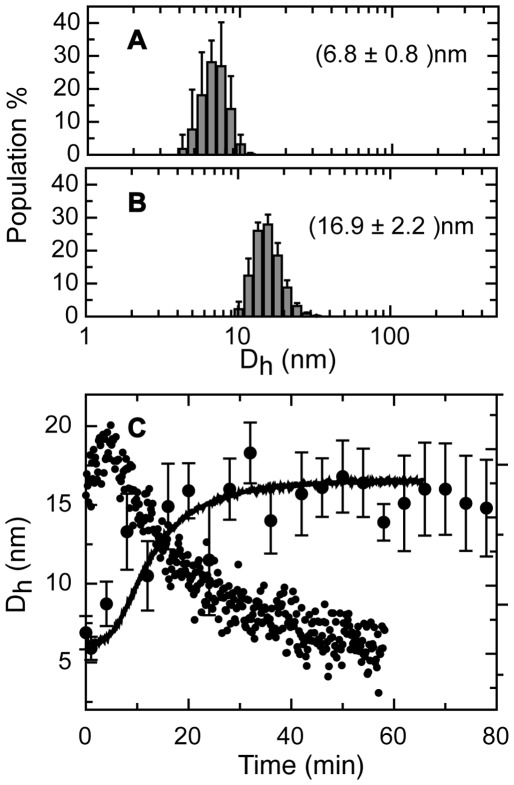
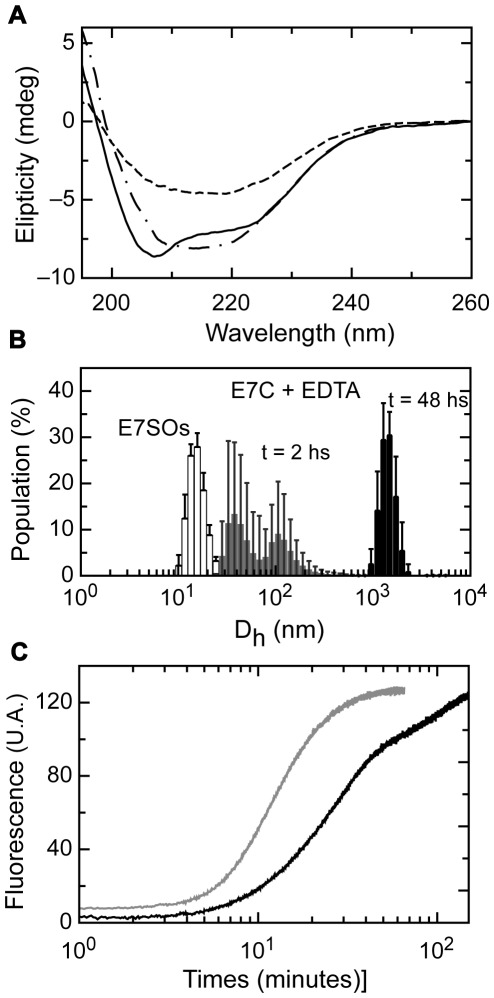
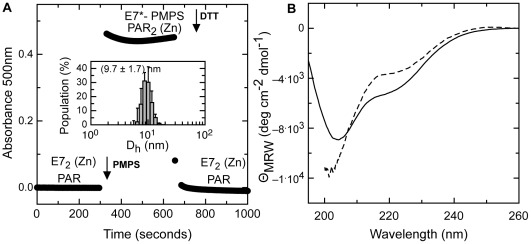
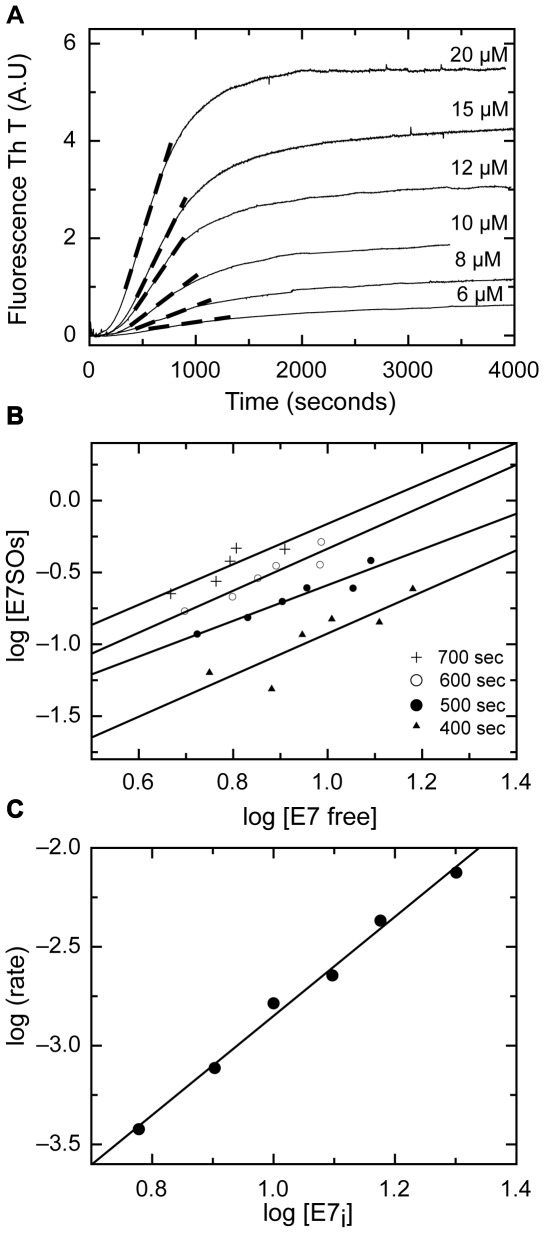
METHODOLOGY/PRINCIPAL FINDINGS: Using various techniques, we monitored changes in secondary, tertiary and quaternary structure in a time course manner. By applying a robust kinetic model developed by Zlotnik, we determined the slow formation of a monomeric "Z-nucleus" after zinc removal, followed by an elongation phase consisting of sequential second-order events whereby one monomer is added at a time. This elongation process takes place at a strikingly slow overall average rate of one monomer added every 28 seconds at 20 µM protein concentration, strongly suggesting either a rearrangement of the growing complex after binding of each monomer or the existence of a "conformation editing" mechanism through which the monomer binds and releases until the appropriate conformation is adopted. The oligomerization determinant lies within its small 5 kDa C-terminal globular domain and, remarkably, the E7 N-terminal intrinsically disordered domain stabilizes the oligomer, preventing an insoluble amyloid route.
We described a controlled ordered mechanism with features in common with soluble amyloid precursors, chaperones, and other spherical oligomers, thus sharing determining factors for symmetry, size and shape. In addition, such a controlled and discrete polymerization reaction provides a valuable tool for nanotechnological applications. Finally, its increased immunogenicity related to its supramolecular structure is the basis for the development of a promising therapeutic vaccine candidate for treating HPV cancerous lesions.
自组装是不相关序列或功能的蛋白质中的常见主题。人乳头瘤病毒 E7 癌蛋白是一种具有内在无序结构域的伸展二聚体,可形成大的球形寡聚体。这些是 HPV 转化和癌细胞细胞质中的主要物种。E7 与大量靶标结合,其中一些靶标导致细胞转化。因此,组装过程不仅具有生物学意义,而且代表了一个研究广泛分布机制的模型系统。
方法/主要发现:使用各种技术,我们以时间进程的方式监测二级、三级和四级结构的变化。通过应用 Zlotnik 开发的稳健动力学模型,我们确定在锌去除后形成单体“Z-核”的缓慢形成,随后是由连续二级事件组成的伸长阶段,其中一次添加一个单体。在 20 µM 蛋白质浓度下,这个伸长过程以惊人的缓慢总平均速率进行,每个单体每 28 秒添加一个,强烈表明在每个单体结合后,生长复合物发生重新排列,或者存在“构象编辑”机制,通过该机制,单体结合并释放,直到采用适当的构象。寡聚化决定因素位于其 5 kDa 小的 C 端球状结构域内,令人惊讶的是,E7 N 端内在无序结构域稳定寡聚体,防止不溶性淀粉样途径。
我们描述了一种具有与可溶性淀粉样前体、伴侣蛋白和其他球形寡聚体共同特征的受控有序机制,因此具有共同的对称、大小和形状决定因素。此外,这种受控离散聚合反应为纳米技术应用提供了有价值的工具。最后,与其超分子结构相关的免疫原性增加是开发用于治疗 HPV 癌性病变的有前途的治疗性疫苗候选物的基础。