National Institute of Plant Genome Research, Aruna Asaf Ali Marg, New Delhi, India.
PLoS One. 2012;7(5):e36918. doi: 10.1371/journal.pone.0036918. Epub 2012 May 11.
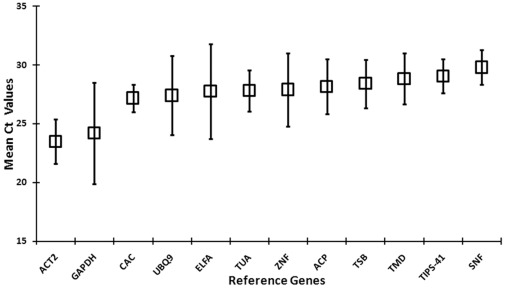
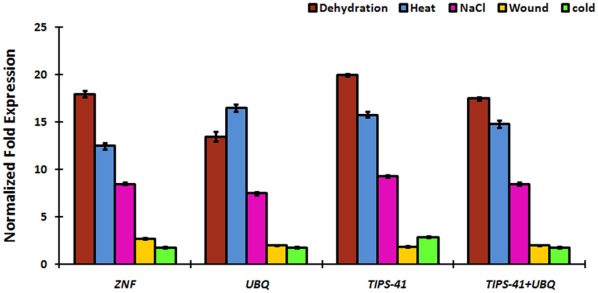
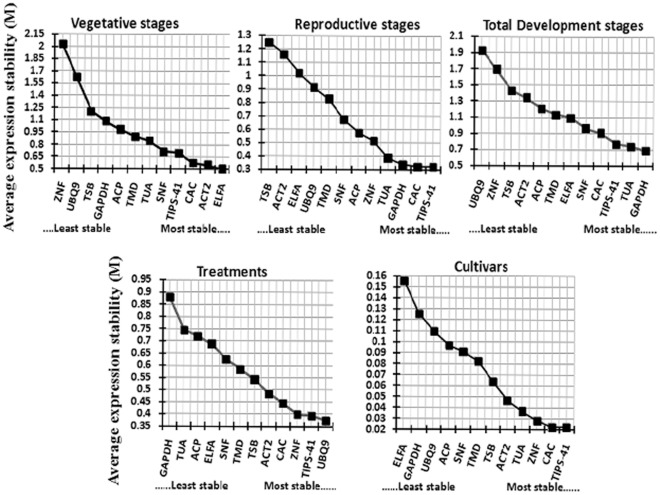
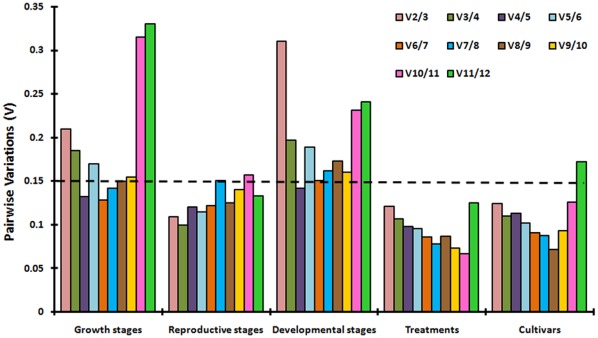
The real time quantitative reverse transcription PCR (qRT-PCR) is becoming increasingly important to gain insight into function of genes. Given the increased sensitivity, ease and reproducibility of qRT-PCR, the requirement of suitable reference genes for normalization has become important and stringent. It is now known that the expression of internal control genes in living organism vary considerably during developmental stages and under different experimental conditions. For economically important Brassica crops, only a couple of reference genes are reported till date. In this study, expression stability of 12 candidate reference genes including ACT2, ELFA, GAPDH, TUA, UBQ9 (traditional housekeeping genes), ACP, CAC, SNF, TIPS-41, TMD, TSB and ZNF (new candidate reference genes), in a diverse set of 49 tissue samples representing different developmental stages, stress and hormone treated conditions and cultivars of Brassica juncea has been validated. For the normalization of vegetative stages the ELFA, ACT2, CAC and TIPS-41 combination would be appropriate whereas TIPS-41 along with CAC would be suitable for normalization of reproductive stages. A combination of GAPDH, TUA, TIPS-41 and CAC were identified as the most suitable reference genes for total developmental stages. In various stress and hormone treated samples, UBQ9 and TIPS-41 had the most stable expression. Across five cultivars of B. juncea, the expression of CAC and TIPS-41 did not vary significantly and were identified as the most stably expressed reference genes. This study provides comprehensive information that the new reference genes selected herein performed better than the traditional housekeeping genes. The selection of most suitable reference genes depends on the experimental conditions, and is tissue and cultivar-specific. Further, to attain accuracy in the results more than one reference genes are necessary for normalization.
实时荧光定量逆转录聚合酶链反应(qRT-PCR)对于深入了解基因功能变得越来越重要。鉴于 qRT-PCR 的灵敏度提高、易于操作和重现性,合适的内参基因的需求对于标准化变得非常重要。现在已经知道,在发育阶段和不同的实验条件下,生物体内的内参基因的表达变化很大。对于经济上重要的芸薹属作物,迄今为止仅报道了少数几个内参基因。在这项研究中,在代表不同发育阶段、应激和激素处理条件以及芸薹属芥菜品种的 49 个组织样本中,验证了 12 个候选内参基因(包括 ACT2、ELFA、GAPDH、TUA、UBQ9(传统管家基因)、ACP、CAC、SNF、TIPS-41、TMD、TSB 和 ZNF(新候选内参基因)的表达稳定性。对于营养生长阶段的归一化,ELFA、ACT2、CAC 和 TIPS-41 的组合是合适的,而 TIPS-41 与 CAC 的组合则适合生殖阶段的归一化。GAPDH、TUA、TIPS-41 和 CAC 的组合被确定为总发育阶段最适合的内参基因。在各种应激和激素处理的样本中,UBQ9 和 TIPS-41 的表达最稳定。在 5 个芸薹属芥菜品种中,CAC 和 TIPS-41 的表达没有显著差异,被鉴定为表达最稳定的内参基因。本研究提供了全面的信息,即本文选择的新内参基因的表现优于传统管家基因。最适合的内参基因的选择取决于实验条件,并且是组织和品种特异性的。此外,为了在结果中获得准确性,归一化需要不止一个内参基因。