Medicine and Health Sciences School, Universitat Internacional de Catalunya, Barcelona, Spain.
PLoS One. 2012;7(5):e37117. doi: 10.1371/journal.pone.0037117. Epub 2012 May 14.
There is a need for an in-depth approach to the meaning of the wish to hasten death (WTHD). This study aims to understand the experience of patients with serious or incurable illness who express such a wish.
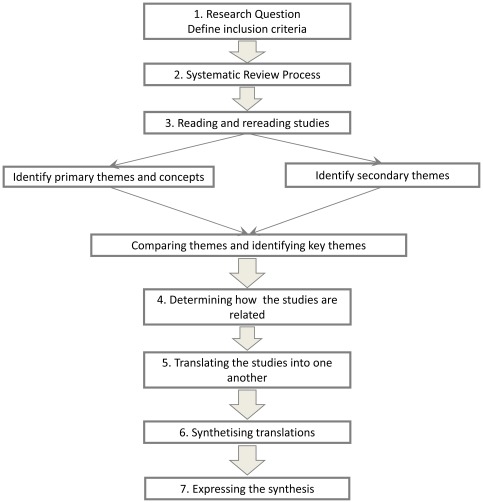
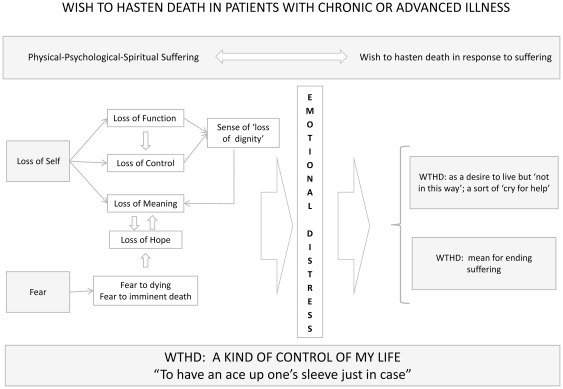
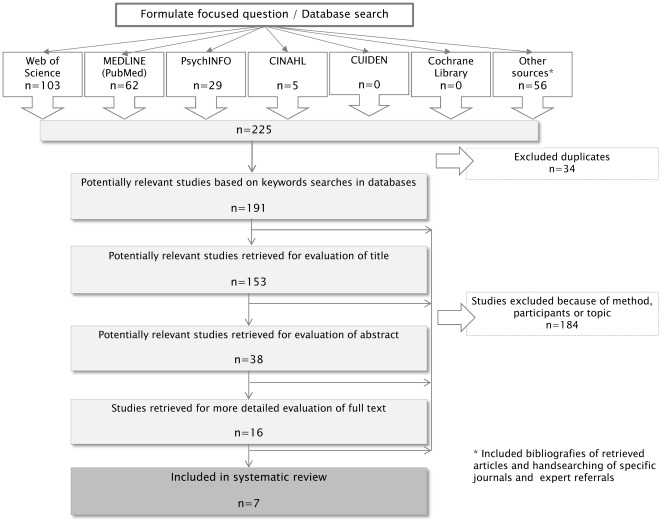
Systematic review and meta-ethnography of qualitative studies from the patient's perspective. Studies were identified through six databases (ISI, PubMed, PsycINFO, CINAHL, CUIDEN and the Cochrane Register of Controlled Trials), together with citation searches and consultation with experts. Finally, seven studies reporting the experiences of 155 patients were included. The seven-stage Noblit and Hare approach was applied, using reciprocal translation and line-of-argument synthesis. Six main themes emerged giving meaning to the WTHD: WTHD in response to physical/psychological/spiritual suffering, loss of self, fear of dying, the desire to live but not in this way, WTHD as a way of ending suffering, and WTHD as a kind of control over one's life ('having an ace up one's sleeve just in case'). An explanatory model was developed which showed the WTHD to be a reactive phenomenon: a response to multidimensional suffering, rather than only one aspect of the despair that may accompany this suffering. According to this model the factors that lead to the emergence of WTHD are total suffering, loss of self and fear, which together produce an overwhelming emotional distress that generates the WTHD as a way out, i.e. to cease living in this way and to put an end to suffering while maintaining some control over the situation.
The expression of the WTHD in these patients is a response to overwhelming emotional distress and has different meanings, which do not necessarily imply a genuine wish to hasten one's death. These meanings, which have a causal relationship to the phenomenon, should be taken into account when drawing up care plans.
需要深入探讨表达加速死亡意愿(WTHD)的含义。本研究旨在了解表达这种意愿的严重或不治之症患者的体验。
系统综述和荟萃元分析来自患者视角的定性研究。通过六个数据库(ISI、PubMed、PsycINFO、CINAHL、CUIDEN 和 Cochrane 对照试验登记册)以及引文搜索和专家咨询来识别研究。最终,纳入了 7 项报告了 155 名患者经历的研究。应用 Noblit 和 Hare 的七阶段方法,使用互译和论点综合。出现了六个主要主题,赋予了 WTHD 的意义:WTHD 是对身体/心理/精神痛苦、自我丧失、对死亡的恐惧、渴望生存但不是以这种方式、WTHD 是结束痛苦的一种方式、WTHD 是一种对生活的控制(“万一有王牌在手”)。提出了一个解释模型,表明 WTHD 是一种反应性现象:对多维痛苦的反应,而不仅仅是伴随这种痛苦的绝望的一个方面。根据该模型,导致 WTHD 出现的因素是总痛苦、自我丧失和恐惧,它们共同产生压倒性的情绪困扰,导致 WTHD 作为一种出路,即停止以这种方式生活,并结束痛苦,同时对情况保持一定的控制。
这些患者表达的 WTHD 是对压倒性情绪困扰的反应,具有不同的含义,并不一定意味着真正希望加速死亡。在制定护理计划时,应考虑这些与现象有因果关系的含义。