Guruprasad Yadavalli, Chauhan Dinesh Singh
Department of Oral and Maxillofacial Surgery, AME's Dental College Hospital and Research Centre, Raichur, Karnataka, India.
Natl J Maxillofac Surg. 2011 Jul;2(2):152-5. doi: 10.4103/0975-5950.94470.
Injuries from occupational accidents are associ-ated with agents of biological risk, as they are the gateway to serious and potentially lethal infectious diseases that can be spread by contact between people. Several studies have demonstrated that dental students are among the most vulnerable to blood-borne exposure.
To assess the knowledge, attitude and practice regarding risk of HIV transmission through accidental needlestick injury amongst dental students and providing supportive and proper guidelines regarding needlestick injuries and HIV infection.
This was a cross-sectional study done at a dental college attached to a tertiary care hospital, which included third, fourth year students and interns. The results obtained were subjected to statistical analysis using Chi-square test.
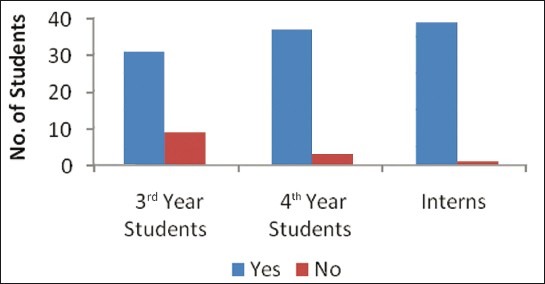
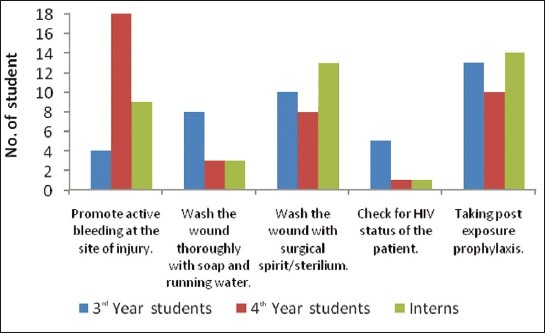
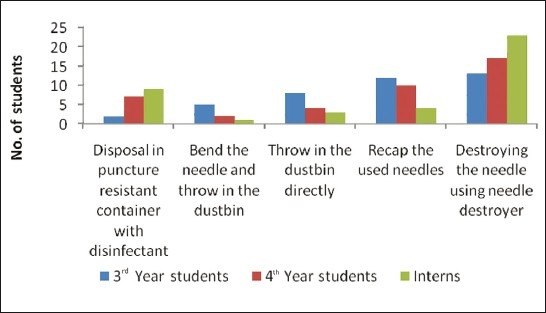
Of the 120 students, 13 (11%) were not even aware that virus could be transmitted through infected needle. A significant proportion of the third year students i.e. 27 (67.5%) were not aware of correct method of disposal of disposable needles and syringes as against interns 17 (42.5%). Around 31 (26%) said that they would promote active bleeding at the site of injury and 37 (30%) said they would take post-exposure prophylaxis.
Dental professionals are at a risk of occupational acquisition of HIV primarily due to accidental exposure to infected blood and body fluids. There is a need of correcting the existing misconceptions through education programs early in the course and providing supportive and proper guidelines regarding needlestick injuries and HIV infection.
职业事故造成的伤害与生物风险因素相关,因为这些因素是严重且可能致命的传染病的传播途径,这些传染病可通过人与人之间的接触传播。多项研究表明,牙科专业学生是最易遭受血源性暴露的人群之一。
评估牙科专业学生对因意外针刺伤导致艾滋病毒传播风险的知识、态度和行为,并提供关于针刺伤和艾滋病毒感染的支持性及适当指导方针。
这是一项在一所附属于三级护理医院的牙科学院进行的横断面研究,研究对象包括三年级、四年级学生和实习生。使用卡方检验对所得结果进行统计分析。
在120名学生中,有13名(11%)甚至不知道病毒可通过受感染的针头传播。相当一部分三年级学生,即27名(67.5%)不知道一次性针头和注射器的正确处理方法,而实习生中这一比例为17名(42.5%)。约31名(26%)学生表示他们会促使受伤部位主动出血,37名(30%)学生表示他们会采取暴露后预防措施。
牙科专业人员主要因意外接触受感染的血液和体液而面临职业感染艾滋病毒的风险。需要在课程早期通过教育项目纠正现有的误解,并提供关于针刺伤和艾滋病毒感染的支持性及适当指导方针。