Department of Plant Pathology and Microbiology, Texas A&M University College Station, TX, USA.
Front Plant Sci. 2012 Jan 18;2:112. doi: 10.3389/fpls.2011.00112. eCollection 2011.
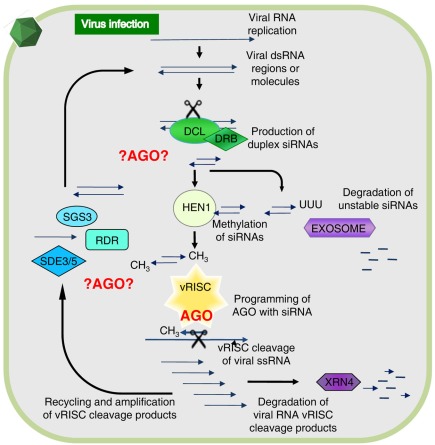
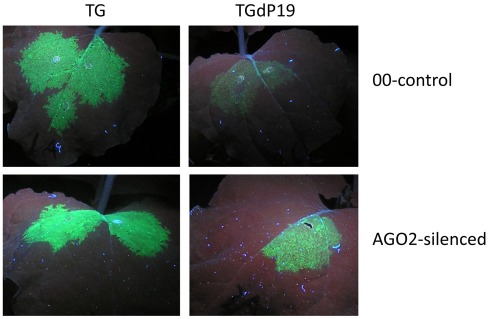
Plant viruses use several strategies to transport their nucleic acid genomes throughout the plants. Regardless of the movement mechanism, a universal major block to uninterrupted viral trafficking is the induction of antiviral silencing that degrades viral RNA. To counteract this defense, viruses encode suppressors that block certain steps in the RNA silencing pathway, and consequently these proteins allow viral spread to proceed. There is a constant battle between plants and viruses and sometimes viruses will succeed and invade the plants and in other cases the RNA silencing mechanism will override the virus. A key role in the silencing versus suppression conflict between plants and viruses is played by one or more members of the Argonaute protein (AGO) family encoded by plants. Here we review the mechanisms and effects of antiviral silencing with an emphasis on the contribution of AGOs, especially the recently discovered role of AGO2.
植物病毒利用多种策略将其核酸基因组在植物体内运输。无论移动机制如何,阻止病毒运输的一个普遍主要障碍是诱导抗病毒沉默,从而降解病毒 RNA。为了对抗这种防御,病毒编码抑制因子来阻断 RNA 沉默途径中的某些步骤,因此这些蛋白允许病毒传播继续进行。植物和病毒之间存在着一场持续的战斗,有时病毒会成功入侵植物,而在其他情况下,RNA 沉默机制会压倒病毒。在植物和病毒之间的沉默与抑制冲突中,Argonaute 蛋白(AGO)家族的一个或多个成员起着关键作用,这些蛋白由植物编码。本文综述了抗病毒沉默的机制和影响,并特别强调了 AGOs 的作用,尤其是最近发现的 AGO2 的作用。