Systems Ecology, Department of Ecological Science, Faculty of Earth and Life Sciences, VU University Amsterdam, Netherlands.
Front Plant Sci. 2012 Apr 9;3:63. doi: 10.3389/fpls.2012.00063. eCollection 2012.
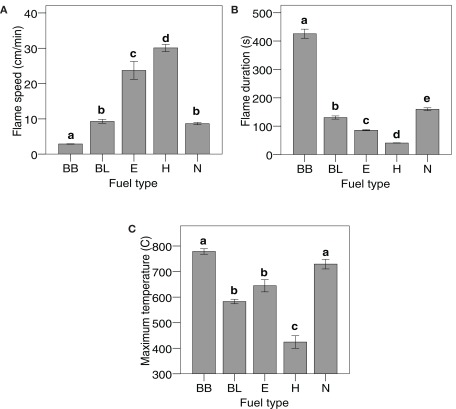
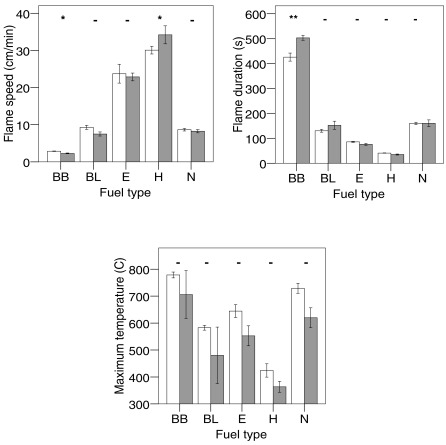
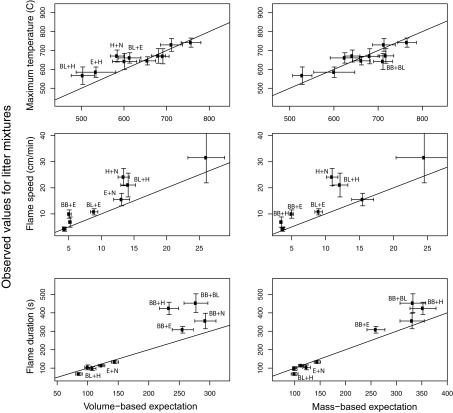
Diversity effects on many aspects of ecosystem function have been well documented. However, fire is an exception: fire experiments have mainly included single species, bulk litter, or vegetation, and, as such, the role of diversity as a determinant of flammability, a crucial aspect of ecosystem function, is poorly understood. This study is the first to experimentally test whether flammability characteristics of two-species mixtures are non-additive, i.e., differ from expected flammability based on the component species in monospecific fuel. In standardized fire experiments on ground fuels, including monospecific fuels and mixtures of five contrasting subarctic plant fuel types in a controlled laboratory environment, we measured flame speed, flame duration, and maximum temperature. Broadly half of the mixture combinations showed non-additive effects for these flammability indicators; these were mainly enhanced dominance effects for temporal dynamics - fire speed and duration. Fuel types with the more flammable value for a characteristic determined the rate of fire speed and duration of the whole mixture; in contrast, maximum temperature of the fire was determined by the biomass-weighted mean of the mixture. These results suggest that ecological invasions by highly flammable species may have effects on ground-fire dynamics well out of proportion to their biomass.
多样性对生态系统功能的许多方面都有影响,这已经得到了很好的证明。然而,火是一个例外:火灾实验主要包括单一物种、大块凋落物或植被,因此,多样性作为可燃性决定因素的作用——这是生态系统功能的一个关键方面——还了解甚少。本研究首次通过实验测试了两种物质混合物的可燃性特征是否具有非加性,即与单种燃料中组成物种的预期可燃性不同。在标准化的地面燃料火灾实验中,包括在受控实验室环境下的五种对比的亚北极植物燃料类型的单种燃料和混合物,我们测量了火焰速度、火焰持续时间和最高温度。大约一半的混合物组合在这些可燃性指标上表现出非加性效应;这些主要是时间动态的优势增强效应——火灾速度和持续时间。对于一个特征,具有更易燃值的燃料类型决定了整个混合物的火灾速度和持续时间;相比之下,火灾的最高温度是由混合物的生物量加权平均值决定的。这些结果表明,高度易燃物种的生态入侵可能对地面火灾动态产生的影响远远超过其生物量。