Division of Biology, Kansas State University Manhattan, KS, USA.
Front Plant Sci. 2012 May 3;3:84. doi: 10.3389/fpls.2012.00084. eCollection 2012.
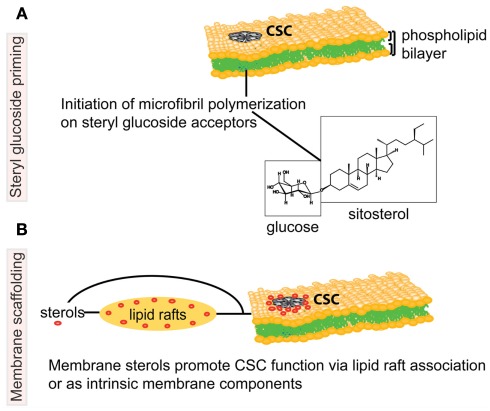
Sterols play vital roles in plant growth and development, as components of membranes and as precursors to steroid hormones. Analysis of Arabidopsis mutants indicates that sterol composition is crucial for cellulose biosynthesis. Sterols are widespread in the plasma membrane (PM), suggesting a possible link between sterols and the multimeric cellulose synthase complex. In one possible scenario, molecular interactions in sterol-rich PM microdomains or another form of sterol-dependent membrane scaffolding may be critical for maintaining the correct subcellular localization, structural integrity and/or activity of the cellulose synthase machinery. Another possible link may be through steryl glucosides, which could act as primers for the attachment of glucose monomers during the synthesis of β-(1 → 4) glucan chains that form the cellulose microfibrils. This mini-review examines genetic and biochemical data supporting the link between sterols and cellulose biosynthesis in cell wall formation and explores potential approaches to elucidate the mechanism of this association.
甾醇在植物生长和发育中起着至关重要的作用,它们是膜的组成部分,也是类固醇激素的前体。拟南芥突变体的分析表明,甾醇组成对纤维素生物合成至关重要。甾醇广泛存在于质膜(PM)中,这表明甾醇与多聚体纤维素合酶复合物之间可能存在联系。在一种可能的情况下,富含甾醇的 PM 微区中的分子相互作用或另一种形式的固醇依赖性膜支架可能对维持纤维素合酶机制的正确亚细胞定位、结构完整性和/或活性至关重要。另一种可能的联系可能是通过甾醇葡萄糖苷,它可以作为在β-(1→4)葡聚糖链合成过程中附着葡萄糖单体的引物,β-(1→4)葡聚糖链形成纤维素微纤维。这篇小综述检查了支持甾醇与细胞壁形成中纤维素生物合成之间联系的遗传和生化数据,并探讨了阐明这种关联机制的潜在方法。