Voronin Victor, Ivlev Alexander A, Oskolkov Vladimir, Boettger Tatjana
Department of Bioindication, Siberian Institute of Plant Physiology and Biochemistry, Siberian Branch, Russian Academy of Sciences, 132 Lermontov Street, 664033, Irkutsk, Russia.
BMC Plant Biol. 2012 May 30;12:76. doi: 10.1186/1471-2229-12-76.
Carbon isotope data from conifer trees play an important role in research on the boreal forest carbon reservoir in the global carbon cycle. Carbon isotopes are routinely used to study interactions between the environment and tree growth. Moreover, carbon isotopes became an essential tool for the evaluation of carbon assimilation and transport from needles into reserve pools, as well as the allocation of stored assimilates within a tree. The successful application and interpretation of carbon isotopes rely on the coherence of isotopic fractionation modeling. This study employs a new Carbon Metabolism Oscillatory Model (CMOM) to interpret the experimental data sets on metabolic seasonal dynamics of 13C/12 C and 18O/16O ratios measured in twig components of Scots pine growing in southern Siberia (Russia).
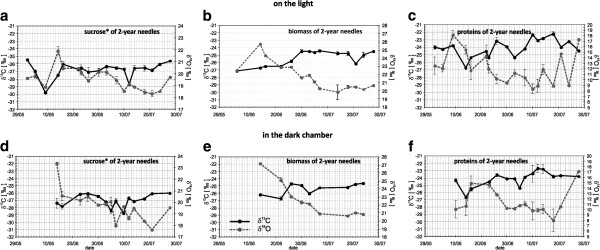
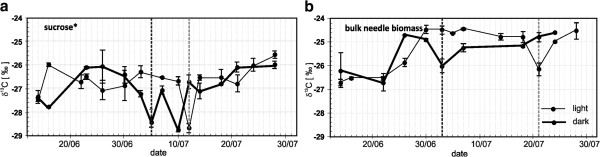
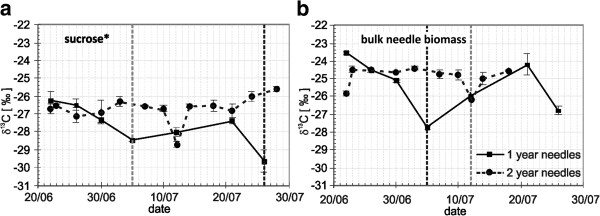
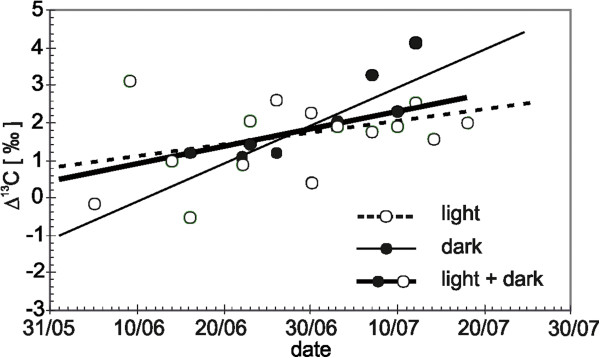
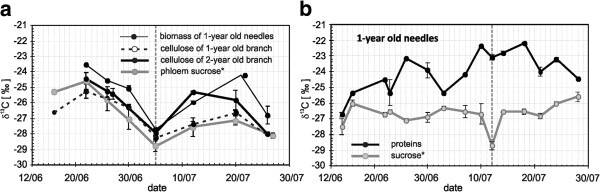
The dynamics of carbon isotopic variables were studied in components of Pinus sylvestris L. in light and in dark chambers during the vegetation period from 14 June to 28 July 2006. At the beginning of this period water-soluble organic matter, mostly labile sugars (including sucrose as the main component) and newly formed bulk needle material, displayed relatively "light" δ13C values (depletion in 13 C). Then, 13 C content increased again with noticeable "depletion" events in the middle of the growth period. A gradual 13 C accumulation took place in the second half of the vegetation period. Similar effects were observed both in the light and in the dark with some temporal shifts. Environmental factors did not influence the δ13C values. A gradual 12C-depletion effect was noticed in needles of the previous year. The δ13C values of sucrose and proteins from needle biomass altered independently from each other in the light chamber. A distinct negative correlation between δ13C and δ18O values was revealed for all studied variables.
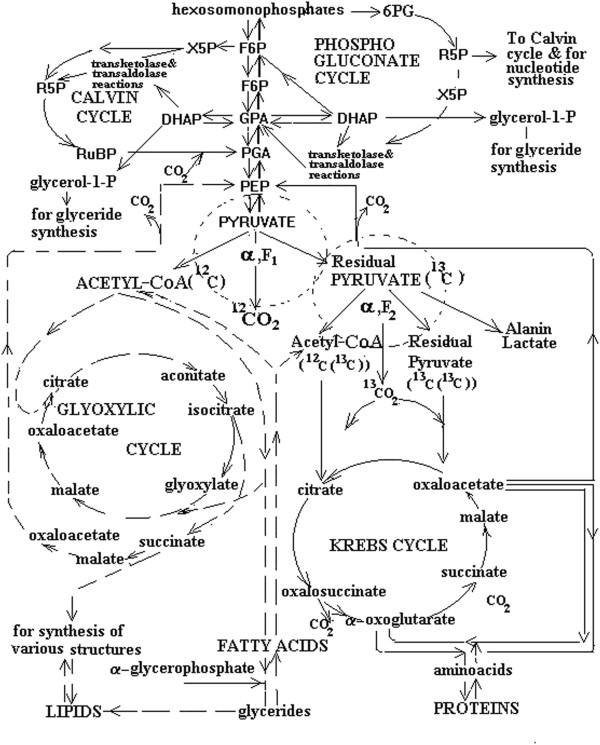
The abrupt 13C depletion recorded by all tested trees for the period from June to July provides clear evidence of the transition from the dominant role of reserve carbohydrate pool (RCP) during the first half of the growth season to the preferable current year carbohydrate pool (CCP) consumption by new needles during its second half. The investigation of the isotopic signatures of Pinus sylvestris L. emphasizes the pivotal role of the intra-seasonal dynamics in carbon metabolism through the transport of assimilates from autotrophic (needles) to heterotrophic (twigs) organs of the studied trees. This provides an explanation for changes of carbon isotopic values observed within the growth season. The CMOM-based results support the hypothesis of the integration of three carbohydrate pools by photosynthesizing cells. The fluctuations of the carbon isotope ratios in different carbohydrate pools underlie various physiological processes in the tree metabolism. The possible mechanisms and pathways of formation of these carbohydrate pools are further discussed. Hence, CMOM provides a reasonable explanation for the absence of the impact of environmental conditions on the needle isotopic variables, the 12C-depletion effects and the use of RCP in needles. The model explains the negative connections between δ13C and δ18O values in all studied variables.
针叶树的碳同位素数据在全球碳循环中北方森林碳库的研究中发挥着重要作用。碳同位素经常被用于研究环境与树木生长之间的相互作用。此外,碳同位素已成为评估碳同化、从针叶向储备库的运输以及树木体内储存同化物分配的重要工具。碳同位素的成功应用和解释依赖于同位素分馏模型的一致性。本研究采用一种新的碳代谢振荡模型(CMOM)来解释在俄罗斯西伯利亚南部生长的苏格兰松树小枝成分中测量的13C/12C和18O/16O比率代谢季节动态的实验数据集。
在2006年6月14日至7月28日的植被期内,在光照和黑暗环境中研究了樟子松各成分中碳同位素变量的动态变化。在该时期开始时,水溶性有机物,主要是不稳定糖(包括以蔗糖为主要成分)和新形成的大量针叶物质,显示出相对“轻”的δ13C值(13C贫化)。然后,在生长中期,13C含量再次增加,并伴有明显的“贫化”事件。在植被期后半段发生了13C的逐渐积累。在光照和黑暗环境中都观察到了类似的效应,但有一些时间上的偏移。环境因素不影响δ13C值。在前一年的针叶中注意到了逐渐的12C贫化效应。在光照箱中,针叶生物量中蔗糖和蛋白质的δ13C值彼此独立变化。对于所有研究变量,δ13C和δ18O值之间呈现出明显的负相关。
所有受试树木在6月至7月期间记录到的13C突然贫化,清楚地证明了在生长季节上半年储备碳水化合物库(RCP)起主导作用,到下半年新针叶优先消耗当年碳水化合物库(CCP)的转变。对樟子松同位素特征的研究强调了季节内动态在碳代谢中的关键作用,即通过同化物从自养(针叶)器官向异养(小枝)器官的运输。这为生长季节内观察到的碳同位素值变化提供了解释。基于CMOM的结果支持了光合细胞整合三个碳水化合物库的假设。不同碳水化合物库中碳同位素比率的波动是树木代谢中各种生理过程的基础。进一步讨论了这些碳水化合物库形成的可能机制和途径。因此,CMOM为环境条件对针叶同位素变量无影响、12C贫化效应以及针叶中RCP的利用提供了合理的解释。该模型解释了所有研究变量中δ13C和δ18O值之间的负相关关系。