Sopka Saša, Biermann Henning, Rossaint Rolf, Knott Sebastian, Skorning Max, Brokmann Jörg C, Heussen Nicole, Beckers Stefan K
Scand J Trauma Resusc Emerg Med. 2012 May 30;20:37. doi: 10.1186/1757-7241-20-37.
The quality of external chest compressions (ECC) is of primary importance within basic life support (BLS). Recent guidelines delineate the so-called 4"-step approach" for teaching practical skills within resuscitation training guided by a certified instructor. The objective of this study was to evaluate whether a "media-supported 4-step approach" for BLS training leads to equal practical performance compared to the standard 4-step approach.
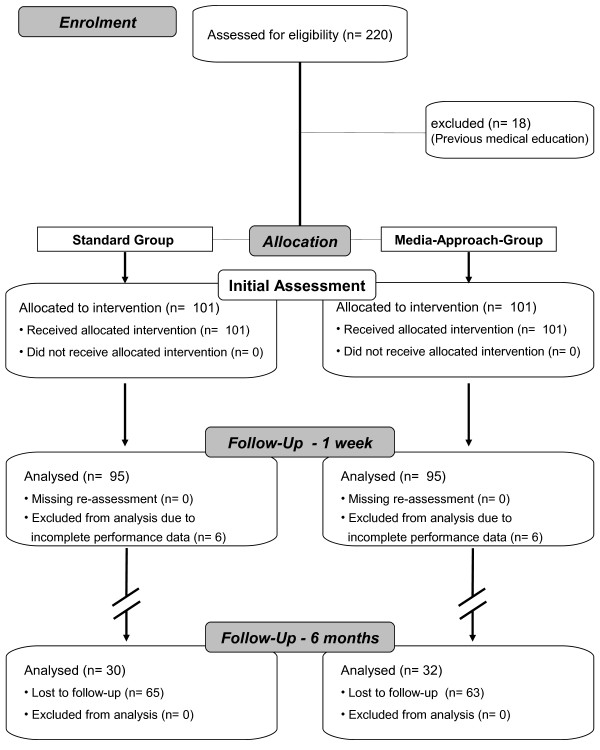
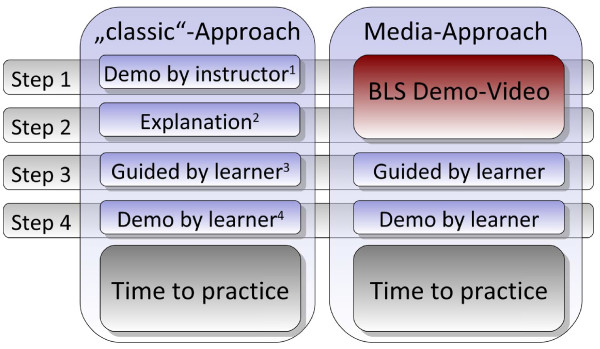
After baseline testing, 220 laypersons were either trained using the widely accepted method for resuscitation training (4-step approach) or using a newly created "media-supported 4-step approach", both of equal duration. In this approach, steps 1 and 2 were ensured via a standardised self-produced podcast, which included all of the information regarding the BLS algorithm and resuscitation skills. Participants were tested on manikins in the same mock cardiac arrest single-rescuer scenario prior to intervention, after one week and after six months with respect to ECC-performance, and participants were surveyed about the approach.
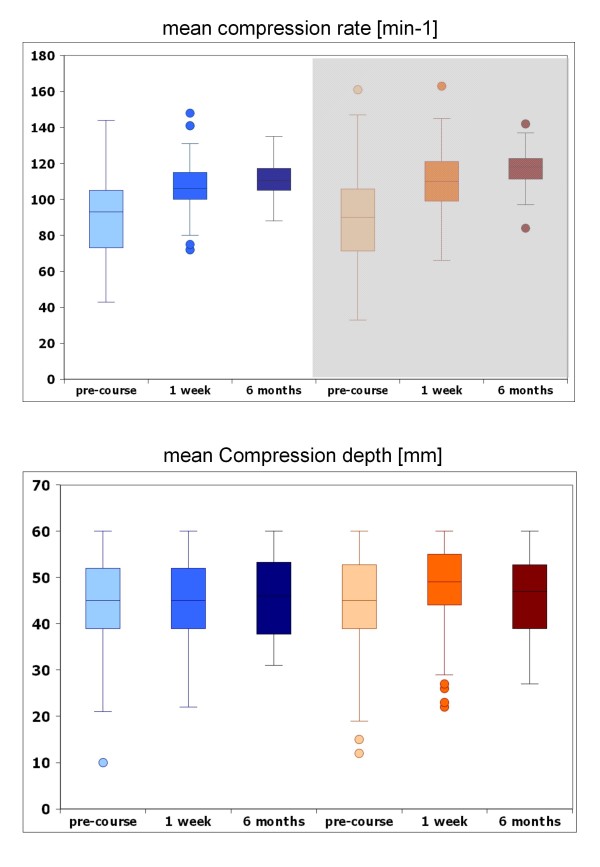
Participants (age 23 ± 11, 69% female) reached comparable practical ECC performances in both groups, with no statistical difference. Even after six months, there was no difference detected in the quality of the initial assessment algorithm or delay concerning initiation of CPR. Overall, at least 99% of the intervention group (n = 99; mean 1.5 ± 0.8; 6-point Likert scale: 1 = completely agree, 6 = completely disagree) agreed that the video provided an adequate introduction to BLS skills.
The "media-supported 4-step approach" leads to comparable practical ECC-performance compared to standard teaching, even with respect to retention of skills. Therefore, this approach could be useful in special educational settings where, for example, instructors' resources are sparse or large-group sessions have to be prepared.
在基础生命支持(BLS)中,胸外按压(ECC)的质量至关重要。最近的指南规定了在认证教员指导下的复苏培训中教授实践技能的所谓“4步方法”。本研究的目的是评估BLS培训的“媒体支持4步方法”与标准4步方法相比是否能带来同等的实践表现。
在基线测试后,220名外行人要么接受广泛接受的复苏培训方法(4步方法),要么接受新创建的“媒体支持4步方法”培训,两种方法持续时间相同。在这种方法中,步骤1和2通过标准化的自制播客来确保,该播客包含了所有关于BLS算法和复苏技能的信息。在干预前、干预后一周和六个月,让参与者在相同的模拟心脏骤停单人救援场景中使用人体模型进行ECC性能测试,并对参与者进行关于该方法的调查。
两组参与者(年龄23±11岁,69%为女性)在实践ECC表现上相当,无统计学差异。即使在六个月后,初始评估算法的质量或开始心肺复苏的延迟方面也未检测到差异。总体而言,至少99%的干预组(n = 99;平均1.5±0.8;6点李克特量表:1 = 完全同意,6 = 完全不同意)同意该视频对BLS技能进行了充分介绍。
与标准教学相比,“媒体支持4步方法”能带来相当的实践ECC表现,即使在技能保持方面也是如此。因此,这种方法在特殊教育环境中可能有用,例如在教员资源稀缺或必须准备大型团体课程的情况下。