Cho Youngsuk, Je Sangmo, Yoon Yoo Sang, Roh Hye Rin, Chang Chulho, Kang Hyunggoo, Lim Taeho
Department of Emergency Medicine, Hallym University Kangdong Sacred Heart Hospital, Seoul, Republic of Korea.
Department of Emergency Medicine, Cha University Bundang Medical Center, 59 Yatap-ro, Bundang-gu, Seongnam-si, 463-712, Gyeonggi-do, South Korea.
BMC Med Educ. 2016 Jul 4;16:167. doi: 10.1186/s12909-016-0682-5.
Students are largely providing feedback to one another when instructor facilitates peer feedback rather than teaching in group training. The number of students in a group affect the learning of students in the group training. We aimed to investigate whether a larger group size increases students' test scores on a post-training test with peer feedback facilitated by instructor after video-guided basic life support (BLS) refresher training. Students' one-rescuer adult BLS skills were assessed by a 2-min checklist-based test 1 year after the initial training.
A cluster randomized controlled trial was conducted to evaluate the effect of student number in a group on BLS refresher training. Participants included 115 final-year medical students undergoing their emergency medicine clerkship. The median number of students was 8 in the large groups and 4 in the standard group. The primary outcome was to examine group differences in post-training test scores after video-guided BLS training. Secondary outcomes included the feedback time, number of feedback topics, and results of end-of-training evaluation questionnaires.
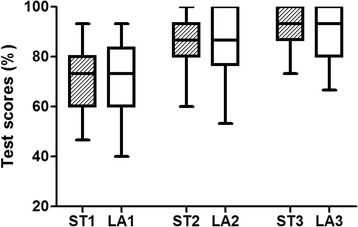
Scores on the post-training test increased over three consecutive tests with instructor-led peer feedback, but not differ between large and standard groups. The feedback time was longer and number of feedback topics generated by students were higher in standard groups compared to large groups on the first and second tests. The end-of-training questionnaire revealed that the students in large groups preferred the smaller group size compared to their actual group size.
In this BLS refresher training, the instructor-led group feedback increased the test score after tutorial video-guided BLS learning, irrespective of the group size. A smaller group size allowed more participations in peer feedback.
在小组培训中,当教师促进同伴反馈而非授课时,学生很大程度上是在相互提供反馈。小组中学生的数量会影响小组培训中学生的学习情况。我们旨在调查在视频引导的基础生命支持(BLS)复习培训后,由教师促进同伴反馈的情况下,较大的小组规模是否会提高学生在培训后测试中的成绩。在初始培训1年后,通过一项基于2分钟清单的测试评估学生的单人成人BLS技能。
进行一项整群随机对照试验,以评估小组中学生数量对BLS复习培训的影响。参与者包括115名正在接受急诊医学实习的医学专业最后一年学生。大组中学生的中位数为8人,标准组为4人。主要结果是检查视频引导的BLS培训后培训后测试成绩的组间差异。次要结果包括反馈时间、反馈主题数量以及培训结束评估问卷的结果。
在教师主导的同伴反馈下,连续三次测试的培训后测试成绩均有所提高,但大组和标准组之间没有差异。在第一次和第二次测试中,标准组的反馈时间更长,学生产生的反馈主题数量比大组更多。培训结束问卷显示,与实际小组规模相比,大组中的学生更喜欢较小的小组规模。
在这项BLS复习培训中,无论小组规模如何,教师主导的小组反馈在教程视频引导的BLS学习后提高了测试成绩。较小的小组规模允许更多人参与同伴反馈。