Spire Sciences, LLC, 72 Rock Road, San Francisco, CA 94904, USA.
Arthritis Res Ther. 2012 May 30;14(3):R131. doi: 10.1186/ar3861.
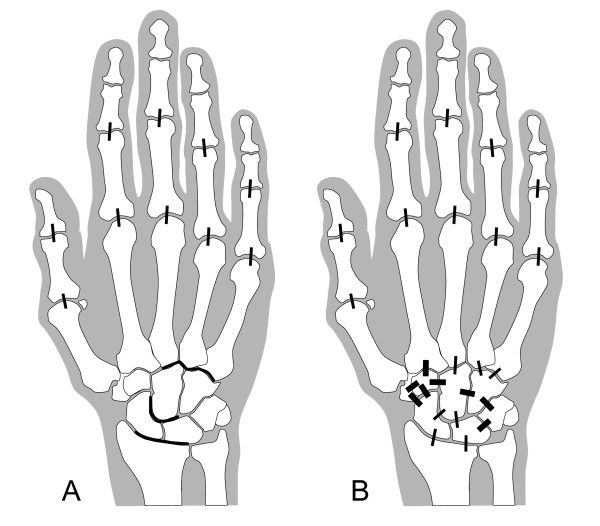
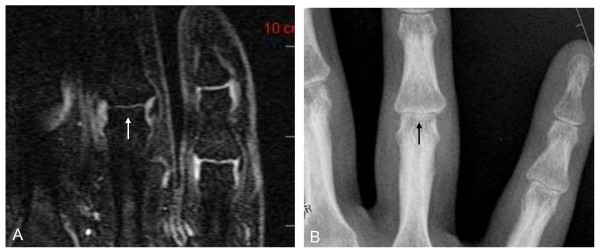
Magnetic resonance imaging (MRI) has been shown to be superior to radiography (XR) for assessing synovitis, osteitis, and bone erosion in rheumatoid arthritis (RA), particularly in clinical trials. However, relatively little has been reported on the ability of MRI to evaluate articular cartilage loss, or joint-space narrowing (JSN), in the hands and wrists. In a previous study, we adapted the nine-point Genant-modified Sharp XR-JSN score for use with MRI (MRI-JSN). In this study, we compare MRI-JSN with XR-JSN by using images from two multicenter clinical trials.
Baseline XR and 1.5-Tesla MR images of one hand and wrist from each of 47 subjects with RA enrolled in one of two multicenter clinical trials were evaluated by using the XR-JSN and MRI-JSN methods by a single radiologist experienced in the two methods. Radiographs and MR images were read independently on different occasions.
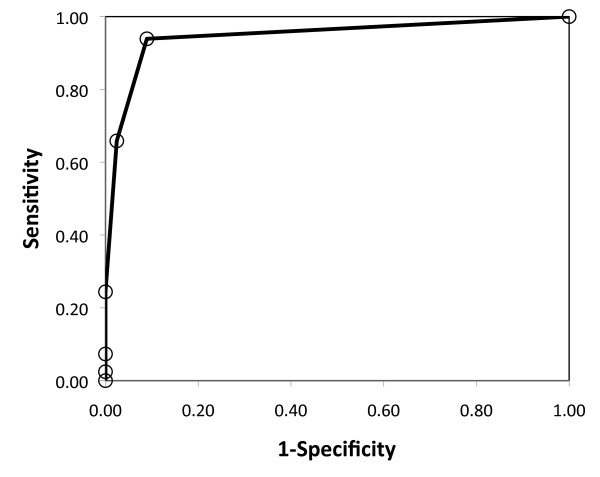
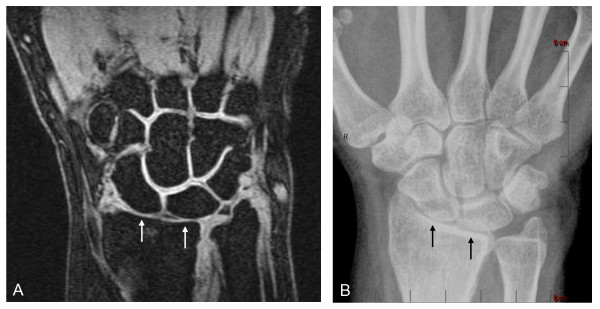
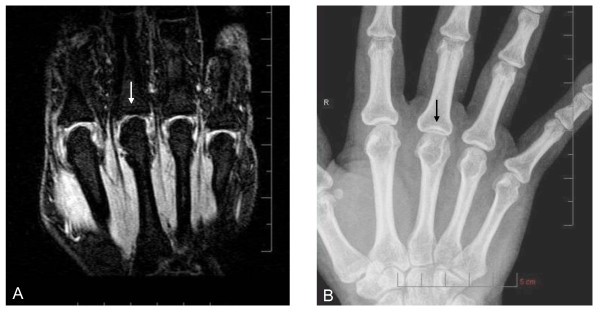
In total, 575 of 611 joints were compared (one metacarpophalangeal joint of the thumb and 35 proximal interphalangeal joints were outside the MRI field of view and could not be assessed). The 22 (47%) subjects showed JSN with both XR and MRI, and 25 (53%) subjects showed no JSN with either method. No subject showed JSN with only one or the other method. MRI showed high agreement with XR (intraclass correlation coefficient = 0.83). Sensitivity of MRI for JSN, by using XR as the gold standard, was 0.94; specificity was 0.91; accuracy was 0.91; positive predictive value was 0.64; and negative predictive value was 0.99.
This validation exercise suggests that MRI JSN scoring may offer a viable alternative to XR JSN scoring in multicenter clinical trials of RA. However, the relative longitudinal sensitivity of MRI to change and the ability to discriminate therapeutic effect on JSN were not evaluated in this study.
磁共振成像(MRI)已被证明在评估类风湿关节炎(RA)的滑膜炎、骨炎和骨侵蚀方面优于 X 射线摄影(XR),尤其是在临床试验中。然而,关于 MRI 评估手部和腕部关节软骨损失或关节间隙变窄(JSN)的能力,报道相对较少。在之前的一项研究中,我们改编了九点 Genant 改良Sharp XR-JSN 评分用于 MRI(MRI-JSN)。在这项研究中,我们通过两项多中心临床试验的图像比较了 MRI-JSN 和 XR-JSN。
对两项多中心临床试验中招募的 47 名 RA 患者的一只手和手腕的基线 XR 和 1.5T 磁共振图像,由一位具有两种方法阅片经验的放射科医生使用 XR-JSN 和 MRI-JSN 方法进行评估。X 线片和磁共振图像在不同的时间点进行独立阅读。
共比较了 611 个关节中的 575 个(一个拇指掌指关节和 35 个近端指间关节超出 MRI 视野,无法评估)。22 名(47%)患者的 XR 和 MRI 均显示 JSN,25 名(53%)患者的两种方法均未显示 JSN。没有患者仅用一种方法显示 JSN。MRI 与 XR 具有高度一致性(组内相关系数=0.83)。以 XR 为金标准,MRI 对 JSN 的敏感性为 0.94;特异性为 0.91;准确性为 0.91;阳性预测值为 0.64;阴性预测值为 0.99。
这项验证性研究表明,MRI-JSN 评分可能是 RA 多中心临床试验中替代 XR-JSN 评分的一种可行方法。然而,在这项研究中,我们没有评估 MRI 对 JSN 的相对纵向敏感性和区分治疗效果的能力。