Laboratory of Virus Control, Institute for Virus Research, Kyoto University, Kyoto, 606-8507, Japan.
Retrovirology. 2012 May 30;9:46. doi: 10.1186/1742-4690-9-46.
HTLV-1 utilizes CD4 T cells as the main host cell and maintains the proviral load via clonal proliferation of infected CD4+ T cells. Infection of CD4+ T cells by HTLV-1 is therefore thought to play a pivotal role in HTLV-1-related pathogenicity, including leukemia/lymphoma of CD4+ T cells and chronic inflammatory diseases. Recently, it has been reported that a proportion of HTLV-1 infected CD4+ T cells express FoxP3, a master molecule of regulatory T cells. However, crucial questions remain unanswered on the relationship between HTLV-1 infection and FoxP3 expression.
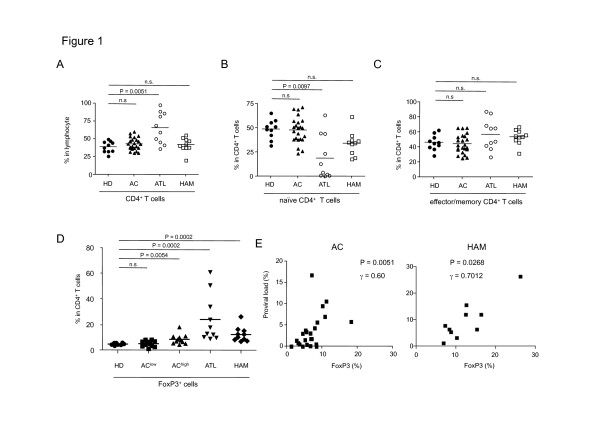
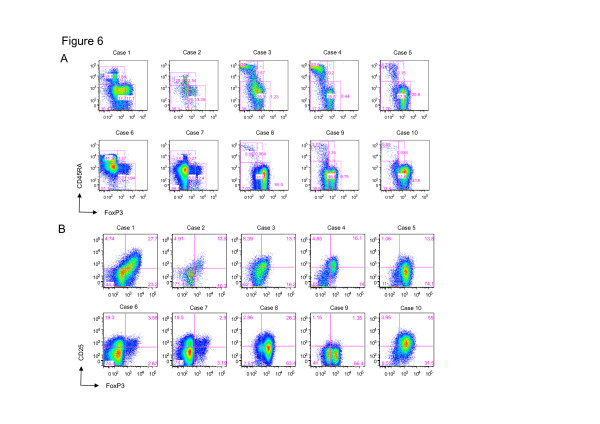
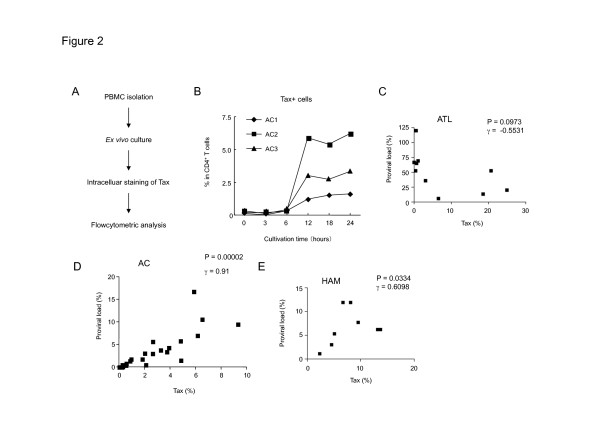
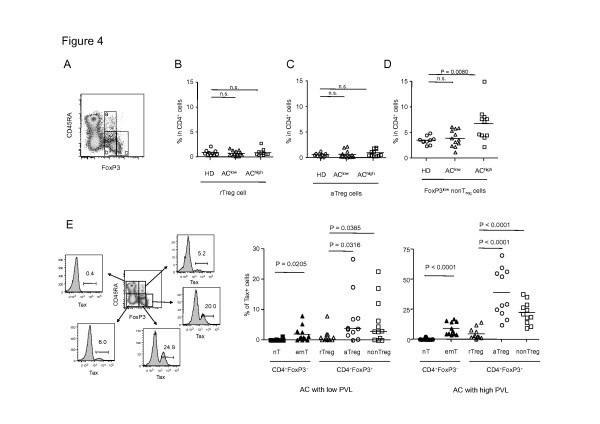
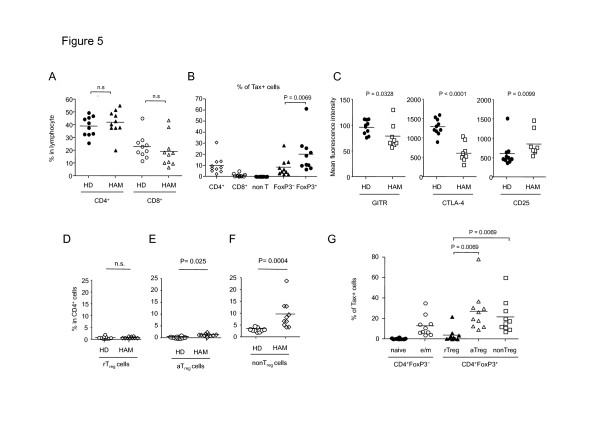
To investigate the effect of HTLV-1 infection on CD4+ T-cell subsets, we used flow cytometry to analyze the T-cell phenotype and HTLV-1 infection in peripheral mononuclear cells (PBMCs) of four groups of subjects, including 23 HTLV-1-infected asymptomatic carriers (AC), 10 patients with HTLV-1 associated myelopathy/tropical spastic paraparesis (HAM/TSP), 10 patients with adult T-cell leukemia (ATL), and 10 healthy donors. The frequency of FoxP3+ cells in CD4+ T cells in AC with high proviral load and patients with HAM/TSP or ATL was higher than that in uninfected individuals. The proviral load was positively correlated with the percentage of CD4+ T cells that were FoxP3+. The CD4+FoxP3+ T cells, themselves, were frequently infected with HTLV-1. We conclude that FoxP3+ T- cells are disproportionately infected with HTLV-1 during chronic infection. We next focused on PBMCs of HAM/TSP patients. The expression levels of the Treg associated molecules CTLA-4 and GITR were decreased in CD4+FoxP3+ T cells. Further we characterized FoxP3+CD4+ T-cell subsets by staining CD45RA and FoxP3, which revealed an increase in CD45RA-FoxP3low non-suppressive T-cells. These findings can reconcile the inflammatory phenotype of HAM/TSP with the observed increase in frequency of FoxP3+ cells. Finally, we analyzed ATL cells and observed not only a high frequency of FoxP3 expression but also wide variation in FoxP3 expression level among individual cases.
HTLV-1 infection induces an abnormal frequency and phenotype of FoxP3+CD4+ T cells.
HTLV-1 利用 CD4 T 细胞作为主要宿主细胞,并通过感染的 CD4+T 细胞的克隆增殖来维持前病毒载量。因此,HTLV-1 感染 CD4+T 细胞被认为在 HTLV-1 相关发病机制中起着关键作用,包括 CD4+T 细胞白血病/淋巴瘤和慢性炎症性疾病。最近,有报道称一部分 HTLV-1 感染的 CD4+T 细胞表达 FoxP3,FoxP3 是调节性 T 细胞的主要分子。然而,关于 HTLV-1 感染与 FoxP3 表达之间的关系,仍有一些关键问题尚未得到解答。
为了研究 HTLV-1 感染对 CD4+T 细胞亚群的影响,我们使用流式细胞术分析了四组研究对象的外周血单个核细胞(PBMCs)的 T 细胞表型和 HTLV-1 感染情况,这四组研究对象包括 23 例 HTLV-1 感染无症状携带者(AC)、10 例 HTLV-1 相关脊髓病/热带痉挛性截瘫(HAM/TSP)患者、10 例成人 T 细胞白血病(ATL)患者和 10 例健康供体。高前病毒载量的 AC 和 HAM/TSP 或 ATL 患者中 CD4+T 细胞中 FoxP3+细胞的频率高于未感染者。前病毒载量与 CD4+T 细胞中 FoxP3+的百分比呈正相关。CD4+FoxP3+T 细胞本身就经常受到 HTLV-1 的感染。我们的结论是,在慢性感染过程中,FoxP3+T 细胞不成比例地受到 HTLV-1 的感染。接下来,我们将重点放在 HAM/TSP 患者的 PBMCs 上。在 CD4+FoxP3+T 细胞中,Treg 相关分子 CTLA-4 和 GITR 的表达水平降低。我们进一步通过染色 CD45RA 和 FoxP3 来对 FoxP3+CD4+T 细胞亚群进行了特征描述,结果显示 CD45RA-FoxP3low 非抑制性 T 细胞增多。这些发现可以将 HAM/TSP 的炎症表型与观察到的 FoxP3+细胞频率增加联系起来。最后,我们分析了 ATL 细胞,观察到不仅 FoxP3 表达频率高,而且个体病例中 FoxP3 表达水平的差异也很大。
HTLV-1 感染诱导 FoxP3+CD4+T 细胞异常频率和表型。