Department of General Surgery, Shanghai Ruijin Hospital, Shanghai Minimally Invasive Surgery Center, Shanghai, China.
Med Sci Monit. 2012 Jun;18(6):BR237-46. doi: 10.12659/msm.882900.
Polo-like kinase 1 (PLK1) is an important molecule in proliferation of many human cancers. The aim of study is to clarify the expression patterns and potential function of PLK1 in colorectal cancers.
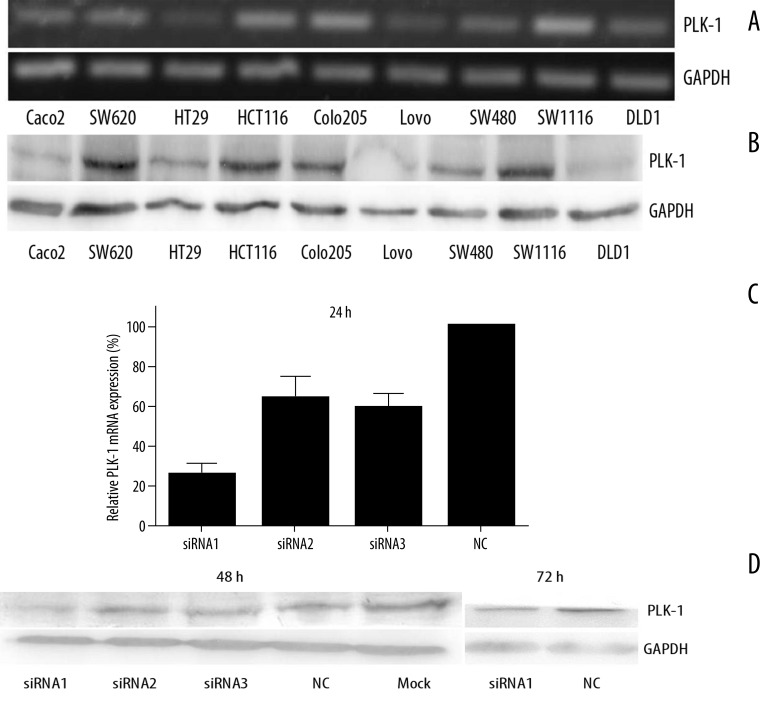
MATERIAL/METHODS: Fifty-six colorectal cancers samples were collected and arranged onto a tissue array and the expression of PLK1 were detected by immunohistochemistry and correlated with clinico-pathological characteristics and expression of PCNA. Expression of PLK1 in 9 colorectal cancer cells lines was investigated by RT-PCR and Western blot, then SW1116 cells lines were treated with PLK1 siRNA and the efficiency was examined by Western blot. Transwell test was applied to detect the migration and invasion capability of cancer cells by counting the number of cells passing through the membranes. Cell proliferation and apoptosis were examined by Cell Counting Kit-8 (CCK-8) and Annexin-V Kit.
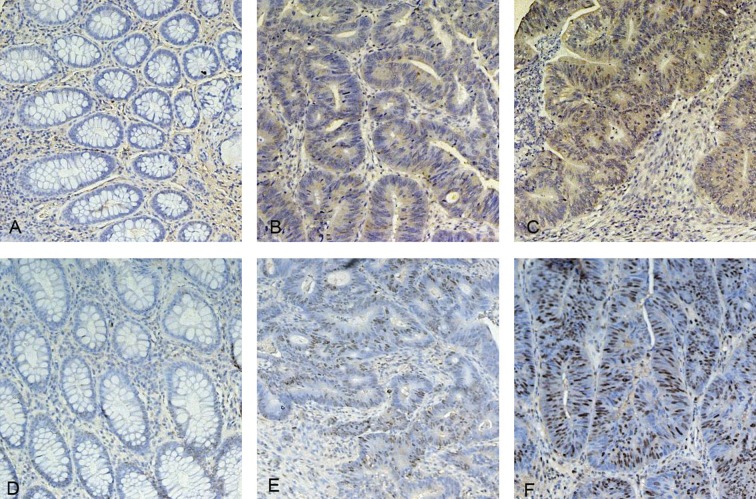
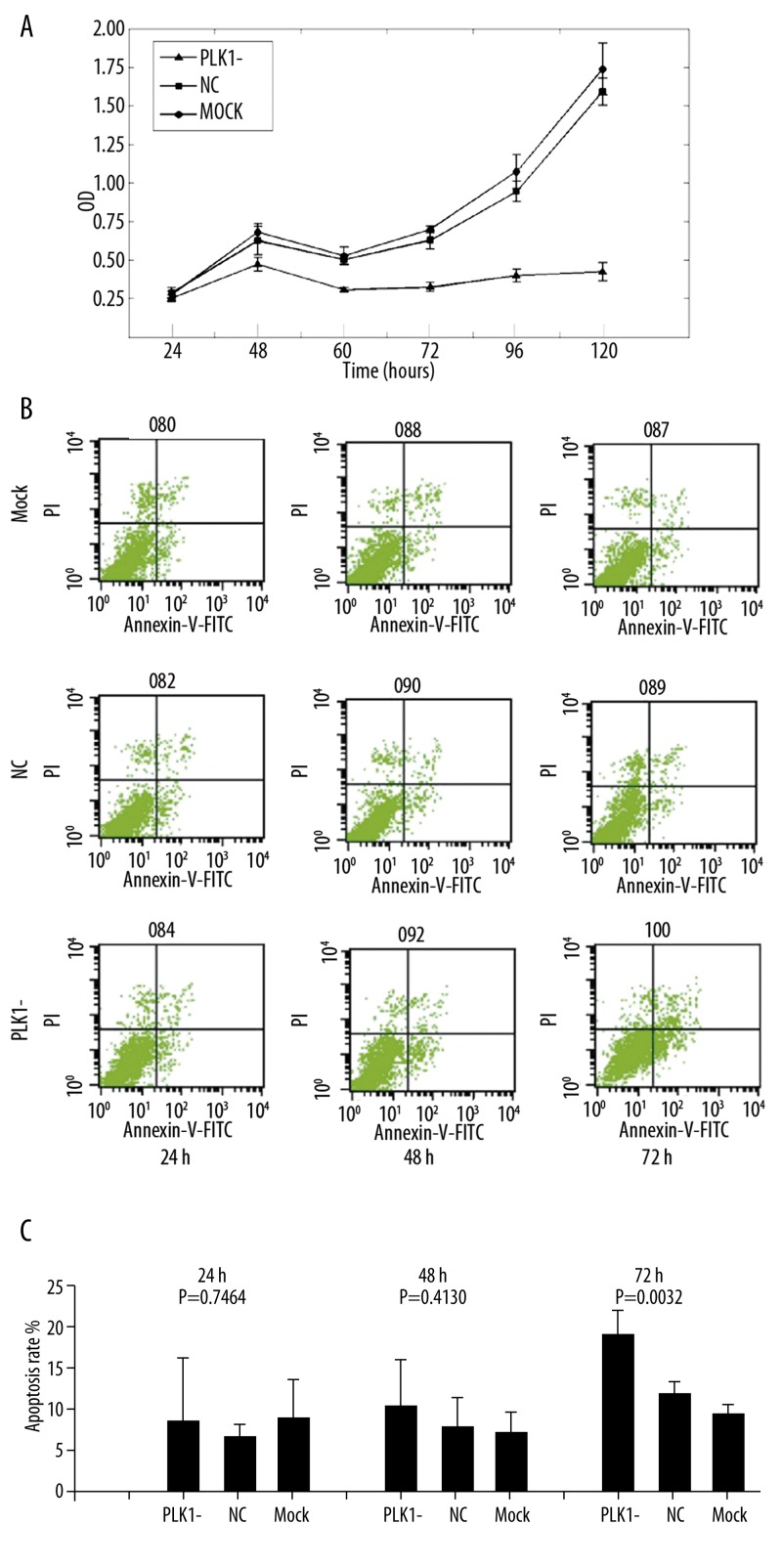
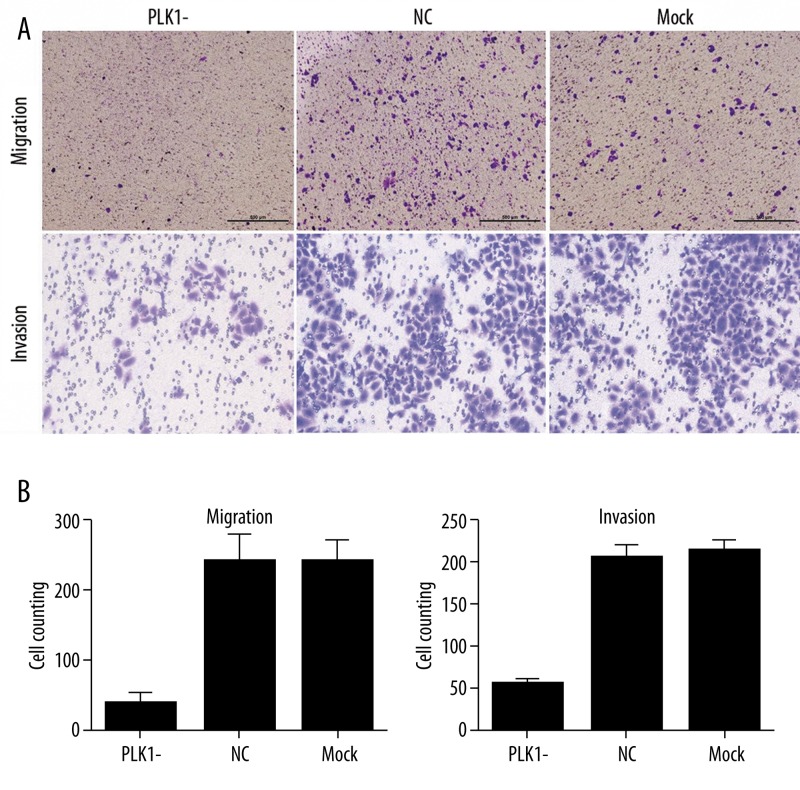
PLK1 was positively expressed in 73.2% (41/56) of colorectal cancers tissues, but in only 3.6% (2/56) of normal tissues, and was associated with Duke's stage (P<0.01), tumor size (P<0.01), invasion extent (P<0.05) and lymphatic metastasis (P<0.01). The expression of PLK1 was correlated with expression of PCNA (R=0.553, P<0.01). PLK1 was inhibited in SW1116 cells by treating with PLK1 siRNA oligos, which resulted in a decreased number of cells passing through the membrane as compared with control groups (P<0.01) at 24 hours after transfection. Cell proliferation was inhibited from 48 hours after transfection, while cells apoptosis was induced from 72 hours after transfection.
PLK1 could be a progression marker for colorectal cancer patients and PLK1 depletion can inhibit migration and invasion capability of colorectal cancer cells SW1116, suggesting that PLK1 might be involved in metastasis and invasion of colorectal cancer. Therapeutic strategies targeting PLK1 may be a new approach to colorectal cancer.
Polo 样激酶 1(PLK1)是许多人类癌症增殖过程中的重要分子。本研究旨在阐明 PLK1 在结直肠癌中的表达模式和潜在功能。
材料/方法: 收集了 56 例结直肠癌样本,并将其排列在组织阵列上,通过免疫组织化学检测 PLK1 的表达,并将其与临床病理特征和 PCNA 的表达相关联。通过 RT-PCR 和 Western blot 检测 9 种结直肠癌细胞系中 PLK1 的表达,然后用 PLK1 siRNA 处理 SW1116 细胞系,并通过 Western blot 检测效率。通过计数穿过膜的细胞数,应用 Transwell 试验检测癌细胞的迁移和侵袭能力。通过 Cell Counting Kit-8(CCK-8)和 Annexin-V 试剂盒检测细胞增殖和凋亡。
在 73.2%(41/56)的结直肠癌组织中,PLK1 呈阳性表达,但在仅 3.6%(2/56)的正常组织中呈阳性表达,与 Duke 分期(P<0.01)、肿瘤大小(P<0.01)、侵袭程度(P<0.05)和淋巴转移(P<0.01)相关。PLK1 的表达与 PCNA 的表达相关(R=0.553,P<0.01)。用 PLK1 siRNA 寡核苷酸处理 SW1116 细胞可抑制 PLK1 的表达,与对照组相比,转染后 24 小时穿过膜的细胞数量减少(P<0.01)。转染后 48 小时细胞增殖受到抑制,而 72 小时后细胞凋亡被诱导。
PLK1 可能是结直肠癌患者的进展标志物,PLK1 耗竭可抑制结直肠癌细胞 SW1116 的迁移和侵袭能力,提示 PLK1 可能参与结直肠癌的转移和侵袭。针对 PLK1 的治疗策略可能是结直肠癌的一种新方法。