Department of Cell Biology, Physiology and Immunology, University of Cordoba Cordoba, Spain.
Front Endocrinol (Lausanne). 2011 Jan 17;2:1. doi: 10.3389/fendo.2011.00001. eCollection 2011.
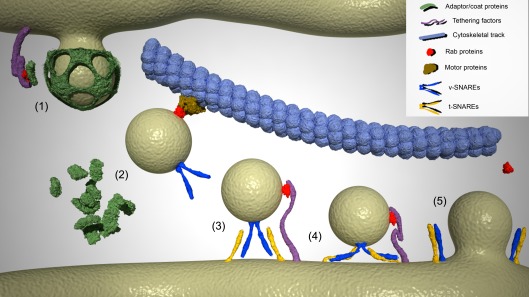
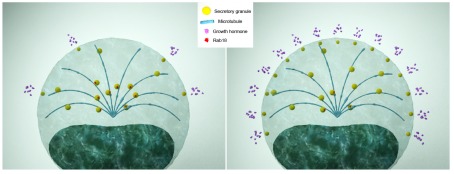
The secretory pathway is a process characteristic of cells specialized in secretion such as endocrine cells and neurons. It consists of different stages that are dependent on specific transport of proteins in vesicular-tubular carriers. Biochemical analyses have unveiled a number of protein families that confer identity to carrier vesicles and specificity to their transport. Among them is the family of Rab proteins, Ras-like small GTPases that anchor to the surface of transport vesicles and participate in vesicle formation from the donor compartment, transport along cytoskeletal tracks, and docking and fusion with the acceptor compartment. All of these functions are accomplished through the recruitment of effector proteins, such as sorting adaptors, tethering factors, kinases, phosphatases, and motors. The numerous Rab proteins have distinct subcellular distributions throughout the endomembrane system, which ensures efficient cargo transfer. Rab proteins act as molecular switches that alternate between a cytosolic GDP-bound, inactive form and a membrane-associated GTP-bound, active conformation. Cycling between inactive and active states is a highly regulated process that enables Rabs to confer spatio-temporal precision to the different stages through which a vesicle passes during its lifespan. This review focuses on our current knowledge on Rab functioning, from their structural features to the multiple regulatory proteins and effectors that control Rab activity and translate Rab function. Furthermore, we also summarize the information available on a particular Rab protein, Rab18, which has been linked to the control of secretory granule traffic in neuroendocrine cells.
分泌途径是一种特化细胞(如内分泌细胞和神经元)所具有的过程。它由不同的阶段组成,这些阶段依赖于蛋白质在囊泡-管状载体中的特异性运输。生化分析揭示了许多赋予载体囊泡身份和运输特异性的蛋白质家族。其中包括 Rab 蛋白家族,即 Ras 样小分子 GTP 酶,它们附着在运输囊泡的表面,参与从供体区室形成囊泡、沿着细胞骨架轨道运输以及与受体区室对接和融合。所有这些功能都是通过募集效应蛋白来完成的,如分拣衔接蛋白、 tethering 因子、激酶、磷酸酶和马达。众多 Rab 蛋白在整个内膜系统中有不同的亚细胞分布,这确保了有效的货物转移。Rab 蛋白作为分子开关,在胞质 GDP 结合的无活性形式和膜结合的 GTP 结合的有活性构象之间交替。无活性和活性状态之间的循环是一个高度调节的过程,使 Rab 蛋白能够为囊泡在其生命周期中通过的不同阶段赋予时空精度。这篇综述重点介绍了我们目前对 Rab 功能的认识,从它们的结构特征到控制 Rab 活性并将 Rab 功能转化的多种调节蛋白和效应蛋白。此外,我们还总结了与神经内分泌细胞中分泌颗粒运输控制相关的特定 Rab 蛋白 Rab18 的信息。