Tromsø Endocrine Research Group, Department of Clinical Medicine, University of Tromsø, and Division of Internal Medicine, University Hospital of North Norway, Tromsø, Norway.
PLoS One. 2012;7(5):e37295. doi: 10.1371/journal.pone.0037295. Epub 2012 May 23.
Low serum 25(OH)D levels are associated with cardiovascular risk factors, and also predict future myocardial infarction (MI), type 2 diabetes (T2DM), cancer and all-cause mortality. Recently several single nucleotide polymorphisms (SNPs) associated with serum 25-hydroxyvitamin D (25(OH)D) level have been identified. If these relations are causal one would expect a similar association between these SNPs and health.
DNA was prepared from subjects who participated in the fourth survey of the Tromsø Study in 1994-1995 and who were registered with the endpoints MI, T2DM, cancer or death as well as a randomly selected control group. The endpoint registers were complete up to 2007-2010. Genotyping was performed for 17 SNPs related to the serum 25(OH)D level.
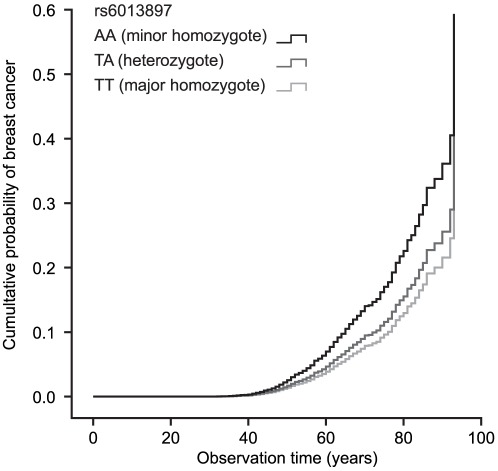
A total of 9528 subjects were selected for genetic analyses which were successfully performed for at least one SNP in 9471 subjects. Among these, 2025 were registered with MI, 1092 with T2DM, 2924 with cancer and 3828 had died. The mean differences in serum 25(OH)D levels between SNP genotypes with the lowest and highest serum 25(OH)D levels varied from 0.1 to 7.8 nmol/L. A genotype score based on weighted risk alleles regarding low serum 25(OH)D levels was established. There was no consistent association between the genotype score or individuals SNPs and MI, T2DM, cancer, mortality or risk factors for disease. However, for rs6013897 genotypes (located at the 24-hydroxylase gene (CYP24A1)) there was a significant association with breast cancer (P<0.05).
Our results do not support nor exclude a causal relationship between serum 25(OH)D levels and MI, T2DM, cancer or mortality, and our observation on breast cancer needs confirmation. Further genetic studies are warranted, particularly in populations with vitamin D deficiency.
ClinicalTrials.gov NCT01395303.
血清 25(OH)D 水平较低与心血管危险因素相关,并且可以预测未来的心肌梗死 (MI)、2 型糖尿病 (T2DM)、癌症和全因死亡率。最近,已经发现了一些与血清 25-羟维生素 D(25(OH)D)水平相关的单核苷酸多态性 (SNP)。如果这些关系是因果关系,那么人们预计这些 SNP 与健康之间也存在类似的关联。
从参加 1994-1995 年特罗姆瑟研究第四次调查的受试者中提取 DNA,这些受试者已经登记了 MI、T2DM、癌症或死亡等终点事件,以及一个随机选择的对照组。终点登记截至 2007-2010 年完整。对与血清 25(OH)D 水平相关的 17 个 SNP 进行了基因分型。
共选择了 9528 名受试者进行遗传分析,其中 9471 名受试者至少成功进行了一个 SNP 的基因分型。其中,2025 名受试者登记患有 MI,1092 名患有 T2DM,2924 名患有癌症,3828 名受试者死亡。血清 25(OH)D 水平最低和最高 SNP 基因型之间的平均差异在 0.1 至 7.8 nmol/L 之间。建立了基于低血清 25(OH)D 水平的风险等位基因加权的基因型评分。基因型评分或个体 SNP 与 MI、T2DM、癌症、死亡率或疾病风险因素之间没有一致的关联。然而,对于位于 24-羟化酶基因 (CYP24A1)的 rs6013897 基因型,与乳腺癌之间存在显著关联 (P<0.05)。
我们的结果既不支持也不排除血清 25(OH)D 水平与 MI、T2DM、癌症或死亡率之间的因果关系,我们对乳腺癌的观察结果需要进一步证实。有必要进行进一步的遗传研究,特别是在维生素 D 缺乏的人群中。
ClinicalTrials.gov NCT01395303。