Shenzhen Key Laboratory for Orchid Conservation and Utilization, The National Orchid Conservation Center of China, Shenzhen, China.
PLoS One. 2012;7(5):e37478. doi: 10.1371/journal.pone.0037478. Epub 2012 May 23.
Due to the spatial separation between male and female pollen grains from the anther of most flowering plants, including orchids, pollens are transported by wind or animals and deposited onto the receptive surface of the stigma of a different plant. However, self-pollination is common in pollinating animal-scarce habitats. In such habitats, self-pollinations require the assistance of a pollinating agent (e.g., wind, gravity, or floral assembly) to transport the pollen grains from the anther onto its own stigma.
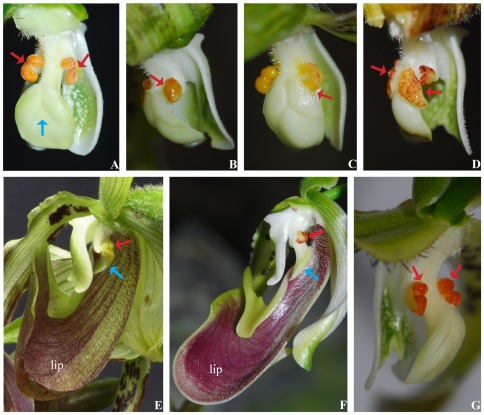
METHODOLOGY/PRINCIPAL FINDINGS: Based on observations on floral morphology and flowering phenology, tests of the breeding system, and a comparison of pollination mechanisms, a new self-pollination process was discovered in the hermaphroditic (i.e., possessing spatially separated male and female organs) flower of a slipper orchid, Paphiopedilum parishii. The anther changes from a solid to a liquid state and directly steps onto the stigma surface without the aid of any pollinating agent or floral assembly.
The mode of self-pollination discussed here is a new addition to the broad range of genetic and morphological mechanisms that have evolved in flowering plants to ensure their reproductive success. The present self-contained pollination mechanism is a possible adaptation to the insect-scarce habitat of the orchid.
由于大多数开花植物(包括兰花)的花粉粒在花药中存在雌雄分离现象,因此花粉通常由风或动物携带,并沉积在另一株植物柱头的可接受表面上。然而,在授粉动物稀少的生境中,自交是很常见的。在这些生境中,自交需要授粉媒介(例如风、重力或花部结构)的帮助,将花粉粒从花药转移到自身的柱头上。
方法/主要发现:基于对花部形态和开花物候学的观察、对繁殖系统的测试以及对授粉机制的比较,我们在两性花(即具有空间分离的雄性和雌性器官)的拖鞋兰属Paphiopedilum parishii中发现了一种新的自交过程。花药从固态变为液态,并直接踏上柱头表面,无需任何授粉媒介或花部结构的帮助。
这里讨论的自交方式是为确保开花植物生殖成功而进化出的广泛遗传和形态机制的新补充。目前这种自我包含的授粉机制可能是兰花对昆虫稀少生境的一种适应。