Department of Organismic Biology, University of Salzburg, Salzburg, Austria.
PLoS One. 2013 Aug 13;8(8):e72688. doi: 10.1371/journal.pone.0072688. eCollection 2013.
The rostellum, a projecting part of the gynostemium in orchid flowers, separates the anther(s) from the stigma and thus commonly prevents auto-pollination. Nonetheless, as a modified (usually distal) portion of the median stigma lobe, the rostellum has been frequently invoked of having re-gained a stigmatic function in rare cases of orchid auto-pollination. Here it is shown that a newly discovered selfing variant of Madagascan Bulbophyllumbicoloratum has evolved a modified rostellum allowing the penetration of pollen tubes from in situ pollinia.
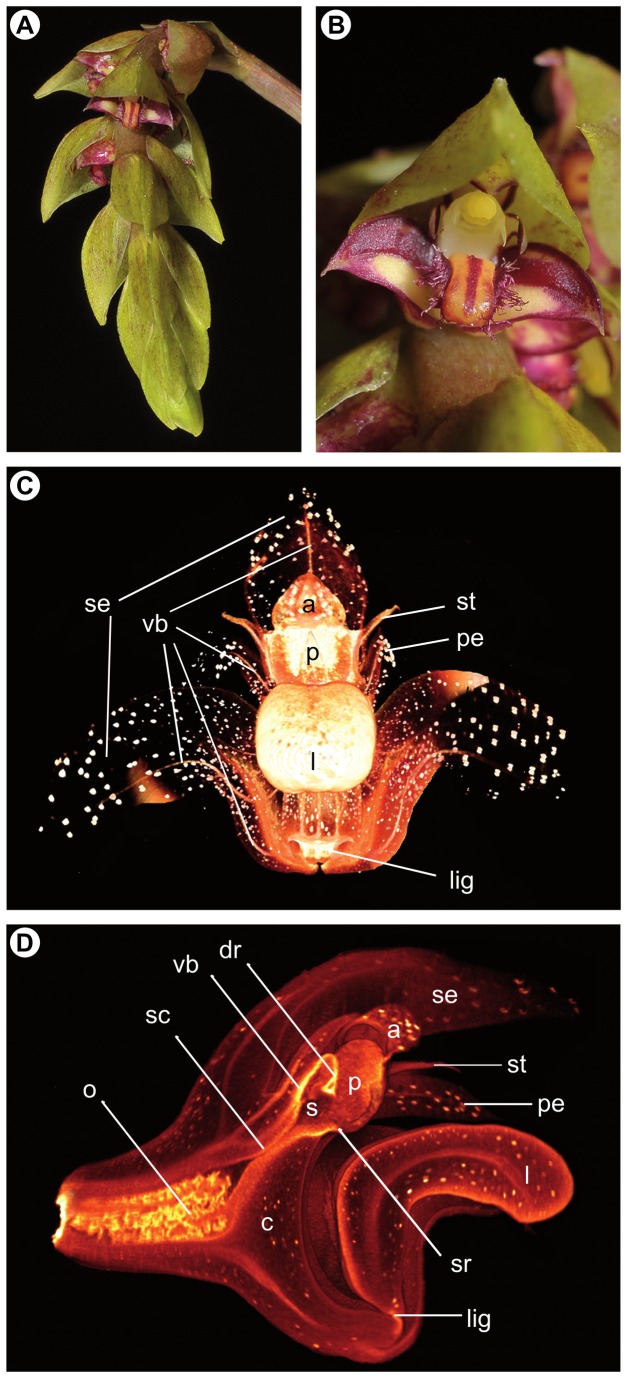
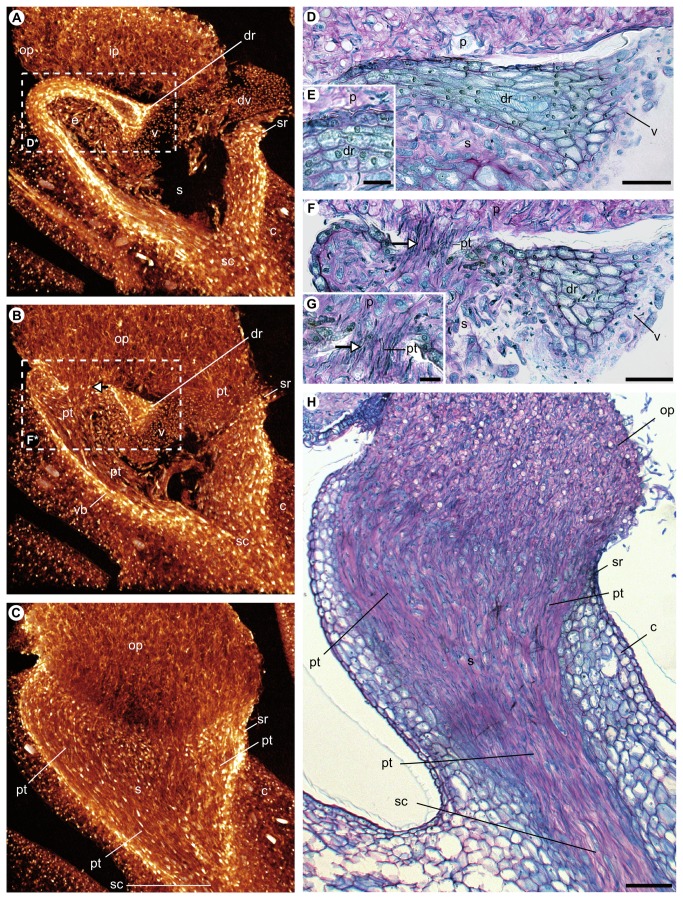
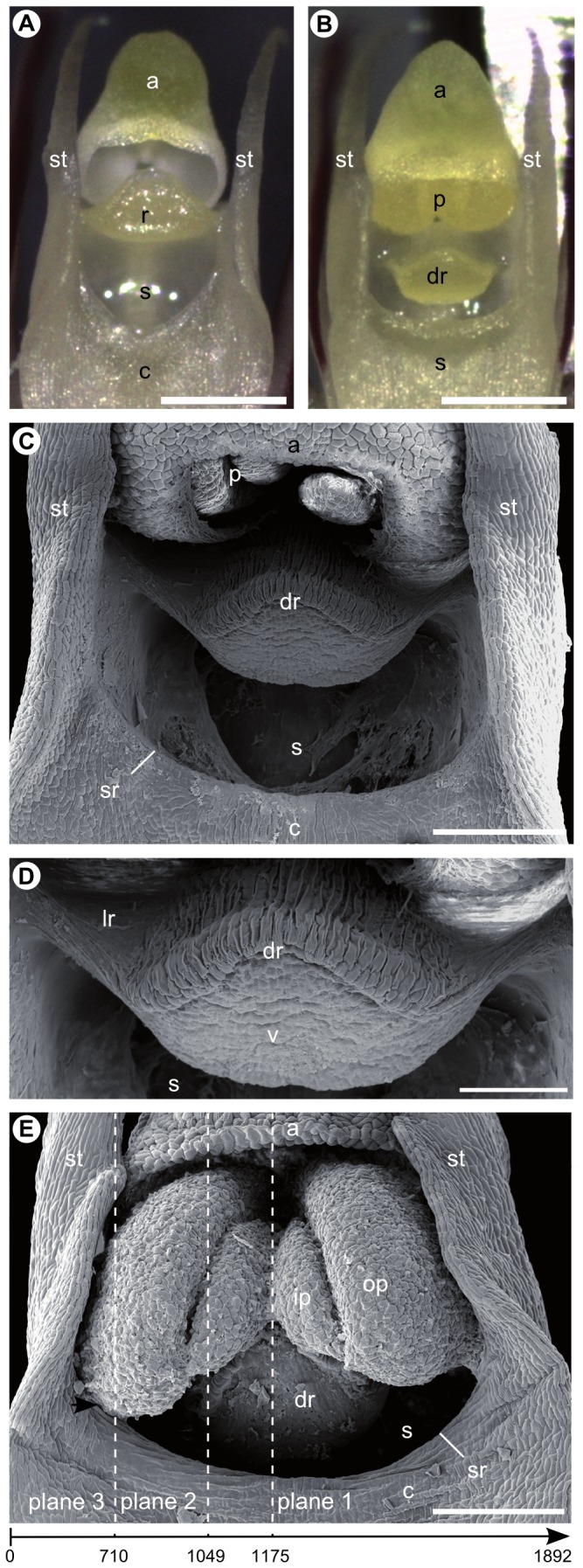
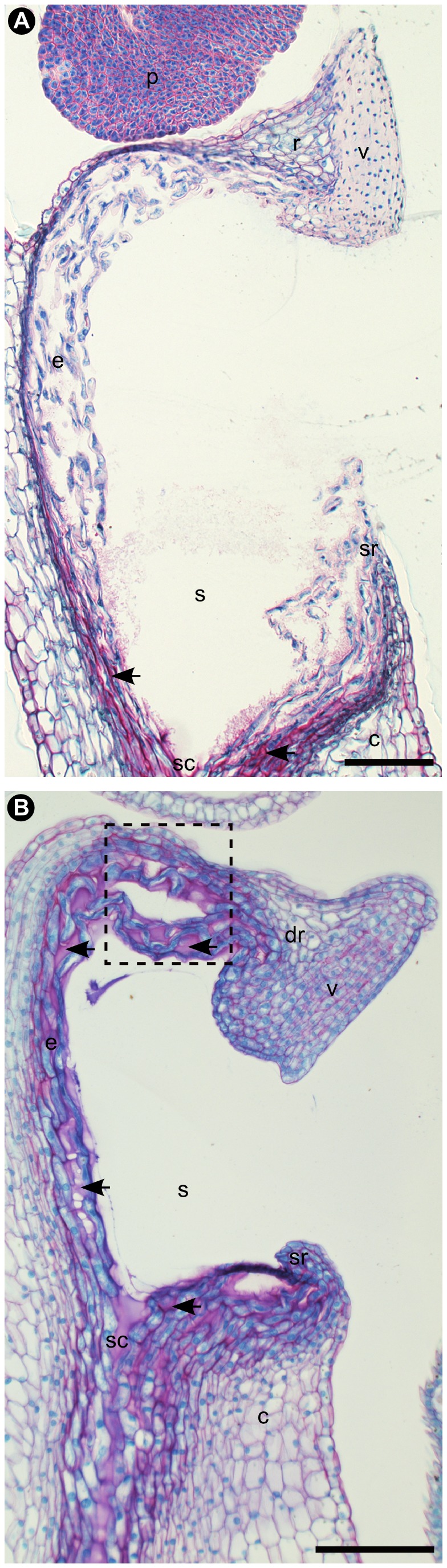
Gynostemium micro-morphology and anatomy of selfing and outcrossing variants of B. bicoloratum was studied by using light and scanning electron microscopy and histological sections. Pollen tube growth in the selfing variant was further observed via X-ray computed microtomography (micro-CT), providing 3D reconstructions of floral tissues at a micron scale.
Selfing variants possess a suberect ('displaced') rostellum rather than the conventional, erect type. Very early in anthesis, the pollinia of selfers are released from the anther and slide down onto the suberect rostellum, where pollen tube growth preferentially occurs through the non-vascularized, i.e. rear (adaxial) and (semi-) lateral parts. This penetrated tissue is comprised of a thin layer of elongate and loosely arranged cells, embedded in stigmatic exudates, as also observed in the stigmatic cavity of both selfing and outcrossing variants.
Our results provide the first solid evidence of a stigmatic function for the rostellum in orchid flowers, thereby demonstrating for the first time the feasibility of the micro-CT technique for accurately visualizing pollen tube growth in flowering plants. Rostellum receptivity in B. bicoloratum probably uniquely evolved as an adaptation for reproductive assurance from an outcrossing ancestor possessing an erect (non-receptive) rostellum. These findings open up new avenues in the investigation of an organ that apparently re-gained its 'primordial function' of being penetrated by pollen tubes.
蕊喙是兰花花朵中位于雌蕊柱上的突出部分,它将花药与柱头隔开,从而通常防止自花授粉。然而,作为中柱头裂片的一个被修饰的(通常是远端)部分,蕊喙在兰花自花授粉的极少数情况下,经常被认为重新获得了柱头的功能。本文表明,马达加斯加球兰的一个新发现的自交变体进化出了一个修饰的蕊喙,允许花粉管从原位花粉块中穿透。
通过使用光镜和扫描电子显微镜以及组织切片,研究了自交和异交变体的 B. bicoloratum 的雌蕊柱微观形态和解剖结构。通过 X 射线计算机微断层扫描(微 CT)进一步观察自交变体中的花粉管生长,提供了微米尺度的花部组织的 3D 重建。
自交变体具有一个近直立的(“移位的”)蕊喙,而不是传统的直立类型。在早期开花时,自交的花粉块从花药中释放出来并滑落到近直立的蕊喙上,花粉管生长优先发生在无血管的,即后部(腹面)和(半)侧面部分。穿透的组织由一层薄的、拉长的和松散排列的细胞组成,嵌入在柱头分泌物中,这也在自交和异交变体的柱头腔中观察到。
我们的结果提供了蕊喙在兰花花朵中具有柱头功能的第一个确凿证据,从而首次证明了微 CT 技术用于准确可视化开花植物花粉管生长的可行性。B. bicoloratum 中的蕊喙接受性可能是从具有直立(不可接受)蕊喙的异交祖先中独特进化而来的,作为生殖保证的适应。这些发现为研究一个显然重新获得其被花粉管穿透的“原始功能”的器官开辟了新的途径。