Department of Biology, East Carolina University, Greenville, North Carolina, United States of America.
PLoS One. 2012;7(5):e37544. doi: 10.1371/journal.pone.0037544. Epub 2012 May 23.
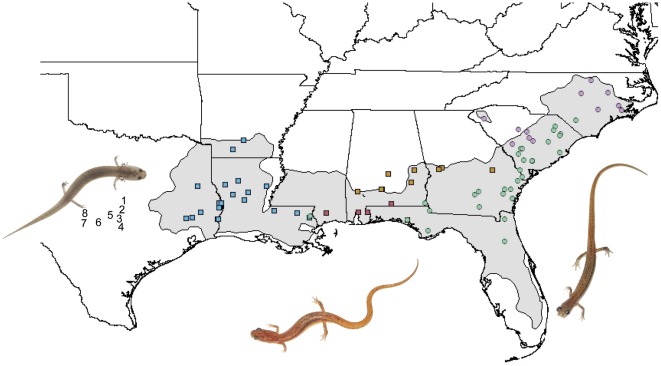
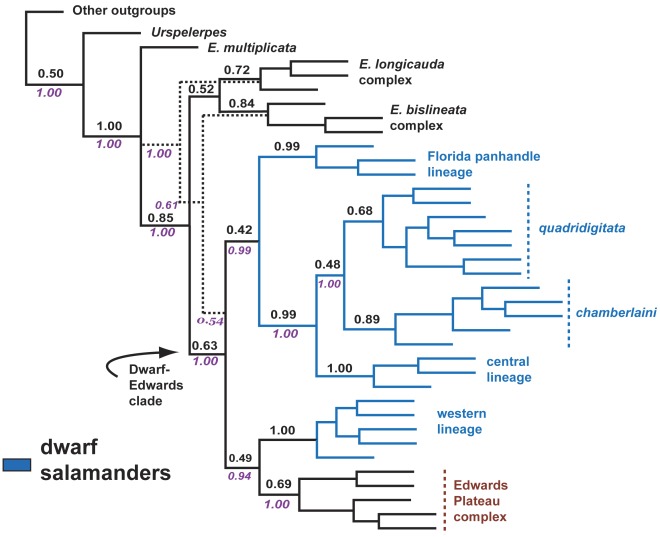
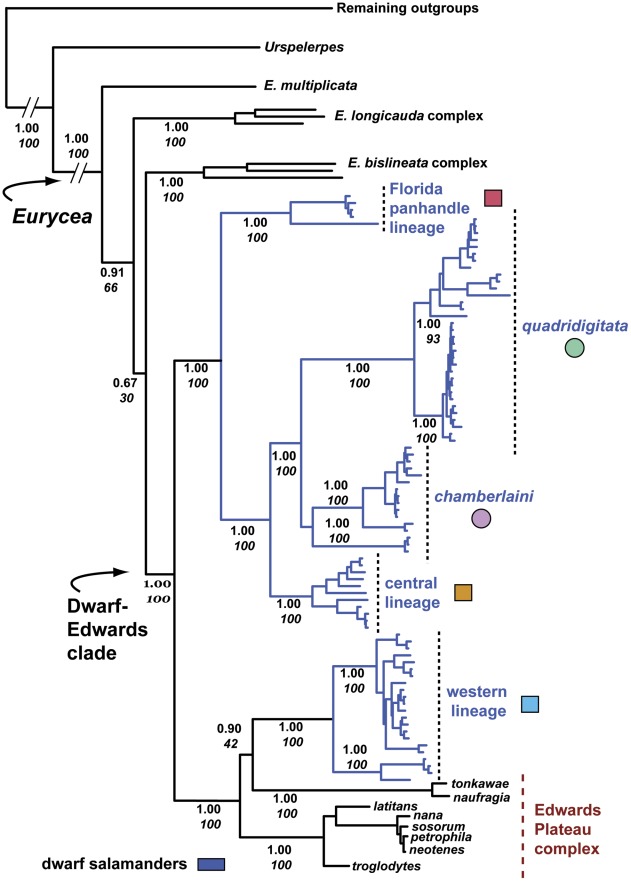
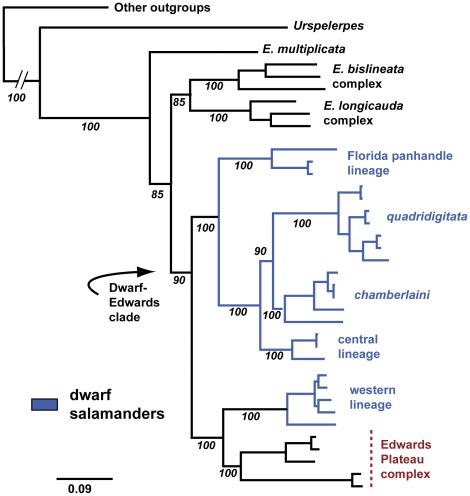
Change in digit number, particularly digit loss, has occurred repeatedly over the evolutionary history of tetrapods. Although digit loss has been documented among distantly related species of salamanders, it is relatively uncommon in this amphibian order. For example, reduction from five to four toes appears to have evolved just three times in the morphologically and ecologically diverse family Plethodontidae. Here we report a molecular phylogenetic analysis for one of these four-toed lineages--the Eurycea quadridigitata complex (dwarf salamanders)--emphasizing relationships to other species in the genus. A multilocus phylogeny reveals that dwarf salamanders are paraphyletic with respect to a complex of five-toed, paedomorphic Eurycea from the Edwards Plateau in Texas. We use this phylogeny to examine evolution of digit number within the dwarf-Edwards Plateau clade, testing contrasting hypotheses of digit loss (parallelism among dwarf salamanders) versus digit gain (re-evolution in the Edwards Plateau complex). Bayes factors analysis provides statistical support for a five-toed common ancestor at the dwarf-Edwards node, favoring, slightly, the parallelism hypothesis for digit loss. More importantly, our phylogenetic results pinpoint a rare event in the pedal evolution of plethodontid salamanders.
在四足动物的进化历史中,数字(即趾数)的变化,特别是趾数的减少,反复出现。虽然在亲缘关系较远的蝾螈物种中已经有趾数减少的记录,但在这种两栖动物目中,这种情况相对较少见。例如,从五趾减少到四趾似乎只在形态和生态多样化的有尾目蟾蜍科中进化了三次。在这里,我们报告了其中一个四趾谱系——Eurycea quadridigitata 复合体(侏儒蝾螈)的分子系统发育分析,重点是与该属中其他物种的关系。一个多基因座系统发育揭示,侏儒蝾螈相对于来自德克萨斯州爱德华兹高原的一组五趾、幼态延续的具有五趾的 Eurycea 是并系的。我们利用这个系统发育来研究侏儒-爱德华兹高原分支内的趾数进化,检验趾数减少(侏儒蝾螈之间的平行进化)与趾数增加(爱德华兹高原复合体中的重新进化)的对比假说。贝叶斯因子分析为在侏儒-爱德华兹高原节点处存在五趾共同祖先提供了统计支持,略微有利于趾数减少的平行进化假说。更重要的是,我们的系统发育结果指出了有尾目蟾蜍科中一个罕见的足进化事件。