Department of Biology, Drexel University, Philadelphia, Pennsylvania, United States of America.
PLoS One. 2012;7(5):e37602. doi: 10.1371/journal.pone.0037602. Epub 2012 May 23.
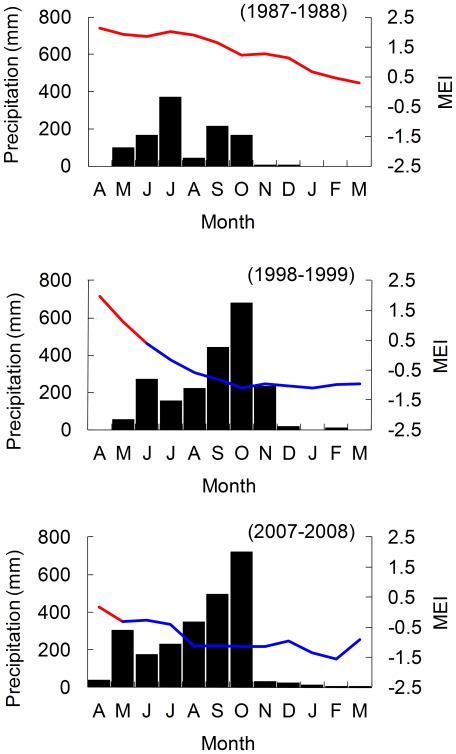
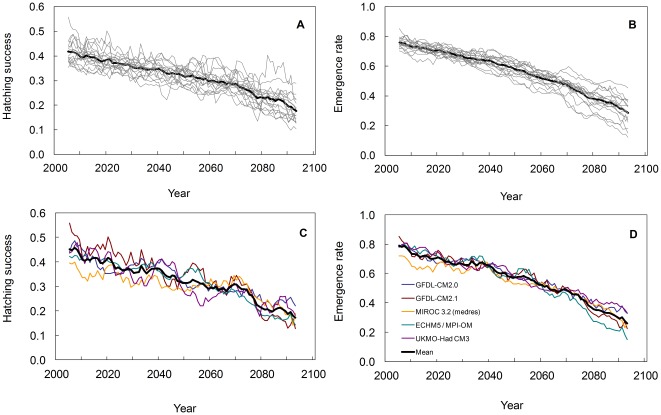
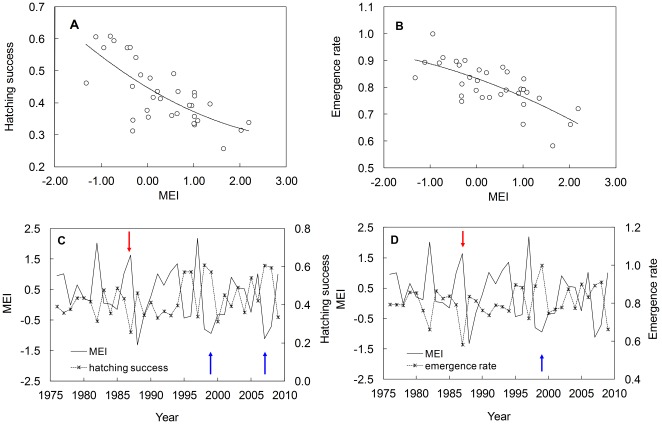
Egg-burying reptiles need relatively stable temperature and humidity in the substrate surrounding their eggs for successful development and hatchling emergence. Here we show that egg and hatchling mortality of leatherback turtles (Dermochelys coriacea) in northwest Costa Rica were affected by climatic variability (precipitation and air temperature) driven by the El Niño Southern Oscillation (ENSO). Drier and warmer conditions associated with El Niño increased egg and hatchling mortality. The fourth assessment report of the Intergovernmental Panel on Climate Change (IPCC) projects a warming and drying in Central America and other regions of the World, under the SRES A2 development scenario. Using projections from an ensemble of global climate models contributed to the IPCC report, we project that egg and hatchling survival will rapidly decline in the region over the next 100 years by ∼50-60%, due to warming and drying in northwestern Costa Rica, threatening the survival of leatherback turtles. Warming and drying trends may also threaten the survival of sea turtles in other areas affected by similar climate changes.
埋卵爬行动物需要其卵周围的基质中具有相对稳定的温度和湿度,以实现成功发育和幼体孵化。在这里,我们表明,中美洲西北海岸的棱皮龟(Dermochelys coriacea)的卵和幼体死亡率受到厄尔尼诺南方涛动(ENSO)驱动的气候变异性(降水和气温)的影响。与厄尔尼诺相关的干燥和温暖的条件增加了卵和幼体的死亡率。政府间气候变化专门委员会(IPCC)第四次评估报告预测,在 SRES A2 发展情景下,中美洲和世界其他地区将变暖变干。我们利用 IPCC 报告中全球气候模型集合的预测结果,预测在未来 100 年内,由于中美洲西北海岸的变暖变干,该地区的卵和幼体存活率将迅速下降约 50-60%,这对棱皮龟的生存构成威胁。变暖变干的趋势也可能威胁到受类似气候变化影响的其他地区海龟的生存。