Munoz Miguel, Pronovost Peter, Dintzis Joanne, Kemmerer Theresa, Wang Nae-Yuh, Chang Yi-Ting, Efird Leigh, Berenholtz Sean M, Golden Sherita Hill
Johns Hopkins University School of Medicine, Baltimore, USA.
Jt Comm J Qual Patient Saf. 2012 May;38(5):195-206. doi: 10.1016/s1553-7250(12)38025-2.
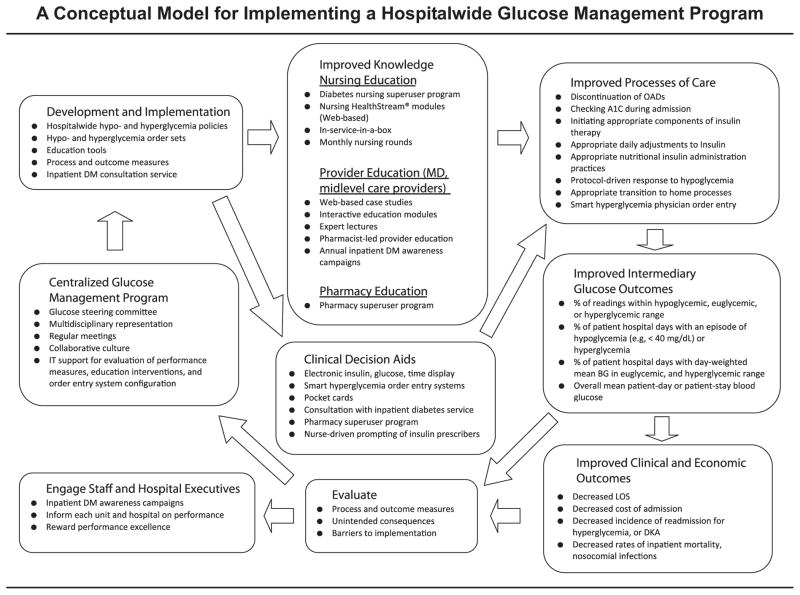
Strategies for successful implementation of hospitalwide glucose control efforts were addressed in a conceptual model for the development and implementation of an institutional inpatient glucose management program. CONCEPTUAL MODEL COMPONENTS: The Glucose Steering Committee incrementally developed and implemented hospitalwide glucose policies, coupled with targeted education and clinical decision support to facilitate policy acceptance and uptake by staffwhile incorporating process and outcome measures to objectively assess the effectiveness of quality improvement efforts. The model includes four components: (1) engaging staff and hospital executives in the importance of inpatient glycemic management, (2) educating staff involved in the care of patients with diabetes through structured knowledge dissemination, (3) executing evidence-based inpatient glucose management through development of policies and clinical decision aids, and (4) evaluating intervention effectiveness through assessing process measures, intermediary glucometric outcomes, and clinical and economic outcomes. An educational curriculum for nursing, provider, and pharmacist diabetes education programs and current glucometrics were also developed.
Overall the average patient-day-weighted mean blood glucose (PDWMBG) was below the currently recommended maximum of 180 mg/dL in patients with diabetes and hyperglycemia, with a significant decrease in PDWMBG of 7.8 mg/dL in patients with hyperglycemia. The program resulted in an 18.8% reduction in hypoglycemia event rates, which was sustained.
Inpatient glucose management remains an important area for patient safety, quality improvement, and clinical research, and the implementation model should guide other hospitals in their glucose management initiatives.
在一个用于制定和实施机构性住院患者血糖管理项目的概念模型中,探讨了成功实施全院血糖控制措施的策略。
血糖管理指导委员会逐步制定并实施全院血糖政策,同时进行有针对性的教育和临床决策支持,以促进员工接受并采用该政策,同时纳入过程和结果指标,以客观评估质量改进工作的有效性。该模型包括四个组成部分:(1)让员工和医院管理人员认识到住院患者血糖管理的重要性;(2)通过结构化的知识传播,对参与糖尿病患者护理的员工进行教育;(3)通过制定政策和临床决策辅助工具,实施基于证据的住院患者血糖管理;(4)通过评估过程指标、中间血糖测量结果以及临床和经济结果,评估干预效果。还制定了针对护士、医护人员和药剂师糖尿病教育项目的教育课程以及当前的血糖测量方法。
总体而言,糖尿病和高血糖患者的平均患者日加权平均血糖(PDWMBG)低于目前建议的最高值180mg/dL,高血糖患者的PDWMBG显著下降了7.8mg/dL。该项目使低血糖事件发生率降低了18.8%,且持续保持。
住院患者血糖管理仍然是患者安全、质量改进和临床研究的重要领域,该实施模型应指导其他医院开展血糖管理工作。