Department of Medical Oncology, Melanoma Disease Center, Dana-Farber Cancer Institute and Harvard Medical School, Boston, Massachusetts 02215, USA.
Mol Cancer Ther. 2012 Sep;11(9):1905-14. doi: 10.1158/1535-7163.MCT-12-0121. Epub 2012 May 31.
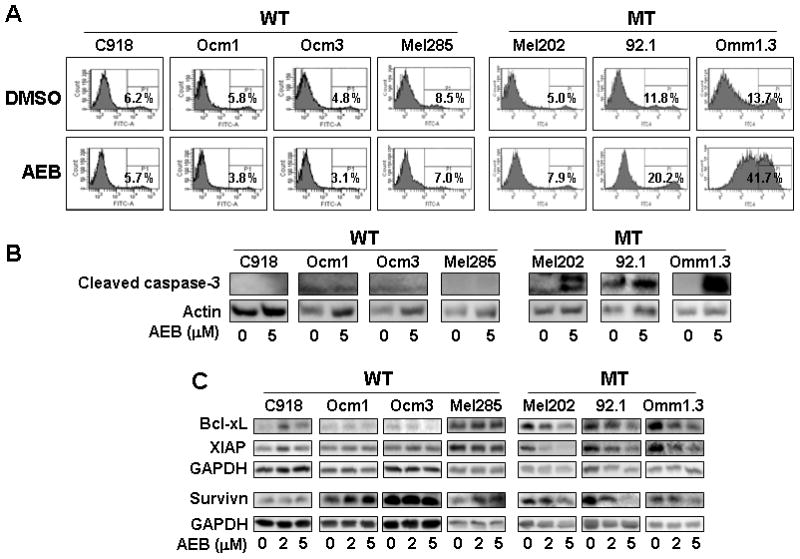
Somatic GNAQ mutations at codon 209 have been identified in approximately 50% of uveal melanomas and have been reported to be oncogenic through activating PLCβ/PKC/Erk1/2 pathways. We hypothesized that protein kinase C (PKC) may provide new opportunities for therapeutic targeting of uveal melanoma carrying GNAQ mutations. To test this hypothesis, uveal melanoma cells harboring wild-type or mutant GNAQ were treated with the PKC inhibitor AEB071 (sotrastaurin) or infected with lentivirus-expressing short hairpin RNAs (shRNA) targeting PKC isoforms. Notably, AEB071 at low micromolar concentrations significantly inhibited the growth of uveal melanoma cells harboring GNAQ mutations through induction of G(1) arrest and apoptosis. However, AEB071 had little effect on uveal melanoma cells carrying wild-type GNAQ. AEB071-mediated cell inhibition in the GNAQ-mutated uveal melanoma was accompanied by inhibition of extracellular signal-regulated kinase (Erk)1/2 phosphorylation, NF-κB, decreased expression of cyclin D1, survivin, Bcl-xL, and XIAP, and increased expression of cyclin-dependent kinase inhibitor p27(Kip1). AEB071 suppressed the expression of PKC α, β, δ, ε, and θ in GNAQ-mutated uveal melanoma cells. Our findings from shRNA-mediated knockdown studies revealed that these PKC isoforms are functionally important for uveal melanoma cells harboring GNAQ mutations. Furthermore, inhibitors of Erk1/2 and NF-κB pathways reduced viability of uveal melanoma cells. Together, our findings show that AEB071 exerts antitumor action on uveal melanoma cells carrying GNAQ mutations via targeting PKC/Erk1/2 and PKC/NF-κB pathways. Targeted PKC inhibition with drugs such as AEB071 offers novel therapeutic potential for uveal melanoma harboring GNAQ mutations.
GNAQ 基因 209 密码子的体细胞突变约占葡萄膜黑色素瘤的 50%,并通过激活 PLCβ/PKC/Erk1/2 通路被报道具有致癌性。我们假设蛋白激酶 C(PKC)可能为携带 GNAQ 突变的葡萄膜黑色素瘤的治疗靶向提供新的机会。为了验证这一假设,用 PKC 抑制剂 AEB071(索拉非尼)或表达针对 PKC 同工型的短发夹 RNA(shRNA)的慢病毒感染携带野生型或突变 GNAQ 的葡萄膜黑色素瘤细胞。值得注意的是,AEB071 在低微摩尔浓度下通过诱导 G1 期阻滞和细胞凋亡显著抑制携带 GNAQ 突变的葡萄膜黑色素瘤细胞的生长。然而,AEB071 对携带野生型 GNAQ 的葡萄膜黑色素瘤细胞几乎没有影响。AEB071 介导的 GNAQ 突变葡萄膜黑色素瘤细胞抑制伴随着细胞外信号调节激酶(Erk)1/2 磷酸化、NF-κB 的抑制、细胞周期蛋白 D1、存活素、Bcl-xL 和 XIAP 的表达降低以及细胞周期蛋白依赖性激酶抑制剂 p27(Kip1)的表达增加。AEB071 抑制 GNAQ 突变的葡萄膜黑色素瘤细胞中 PKCα、β、δ、ε 和θ 的表达。通过 shRNA 介导的敲低研究,我们发现这些 PKC 同工型对于携带 GNAQ 突变的葡萄膜黑色素瘤细胞具有功能重要性。此外,Erk1/2 和 NF-κB 通路的抑制剂降低了葡萄膜黑色素瘤细胞的活力。总之,我们的研究结果表明,AEB071 通过靶向 PKC/Erk1/2 和 PKC/NF-κB 通路对携带 GNAQ 突变的葡萄膜黑色素瘤细胞发挥抗肿瘤作用。用 AEB071 等药物靶向抑制 PKC 为携带 GNAQ 突变的葡萄膜黑色素瘤提供了新的治疗潜力。