Department of Microbiology and Environmental Toxicology, University of California, Santa Cruz, Santa Cruz, California, USA.
PLoS Pathog. 2012;8(5):e1002719. doi: 10.1371/journal.ppat.1002719. Epub 2012 May 24.
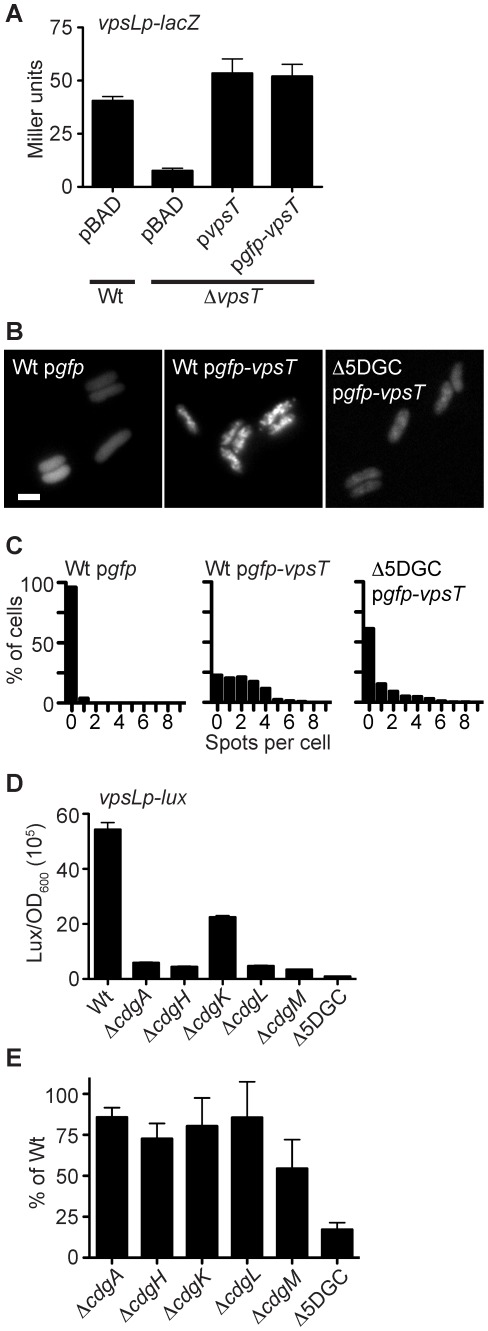
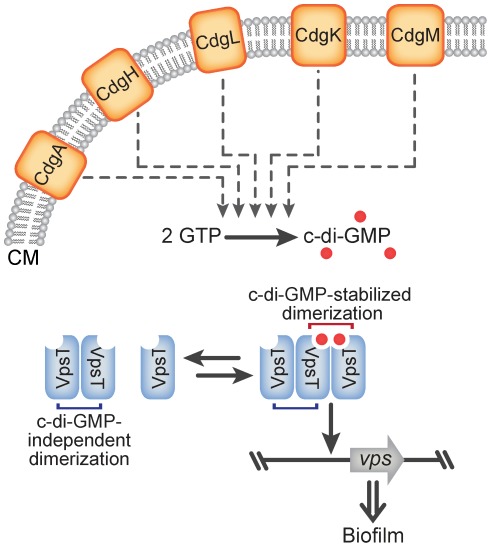
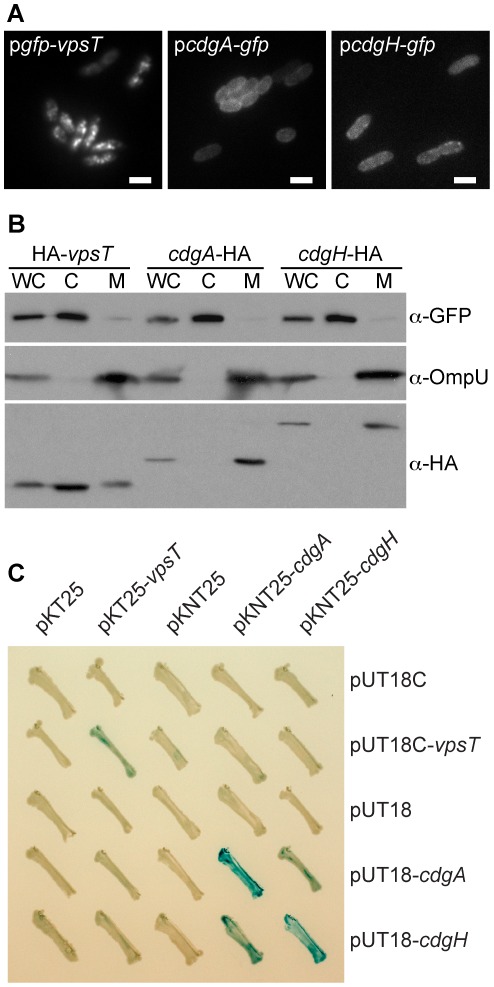
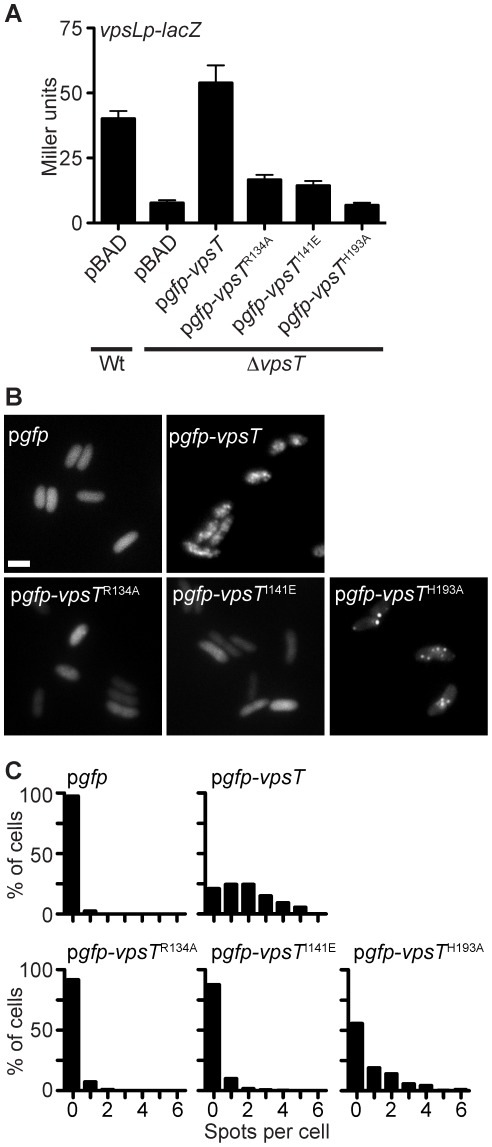
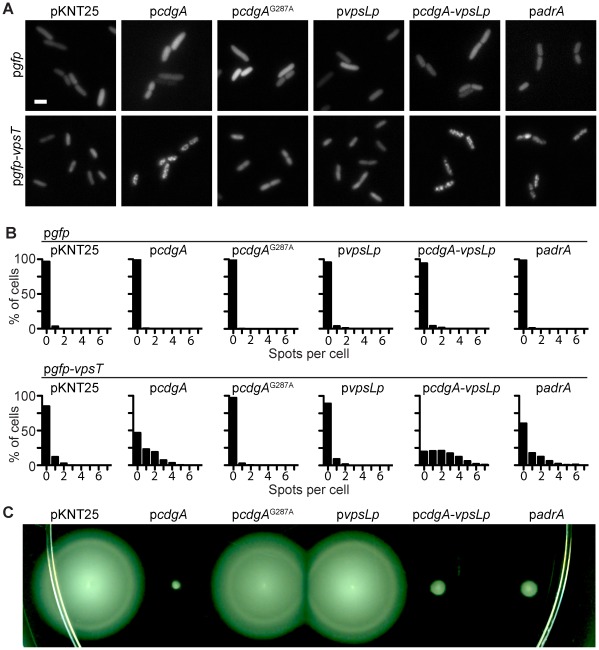
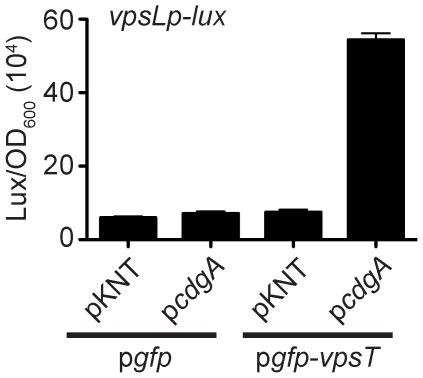
The second messenger, cyclic diguanylate (c-di-GMP), regulates diverse cellular processes in bacteria. C-di-GMP is produced by diguanylate cyclases (DGCs), degraded by phosphodiesterases (PDEs), and receptors couple c-di-GMP production to cellular responses. In many bacteria, including Vibrio cholerae, multiple DGCs and PDEs contribute to c-di-GMP signaling, and it is currently unclear whether the compartmentalization of c-di-GMP signaling components is required to mediate c-di-GMP signal transduction. In this study we show that the transcriptional regulator, VpsT, requires c-di-GMP binding for subcellular localization and activity. Only the additive deletion of five DGCs markedly decreases the localization of VpsT, while single deletions of each DGC do not impact VpsT localization. Moreover, mutations in residues required for c-di-GMP binding, c-di-GMP-stabilized dimerization and DNA binding of VpsT abrogate wild type localization and activity. VpsT does not co-localize or interact with DGCs suggesting that c-di-GMP from these DGCs diffuses to VpsT, supporting a model in which c-di-GMP acts at a distance. Furthermore, VpsT localization in a heterologous host, Escherichia coli, requires a catalytically active DGC and is enhanced by the presence of VpsT-target sequences. Our data show that c-di-GMP signaling can be executed through an additive cellular c-di-GMP level from multiple DGCs affecting the localization and activity of a c-di-GMP receptor and furthers our understanding of the mechanisms of second messenger signaling.
第二信使环二鸟苷酸(c-di-GMP)调节细菌中的多种细胞过程。c-di-GMP 由二鸟苷酸环化酶(DGCs)产生,被磷酸二酯酶(PDEs)降解,受体将 c-di-GMP 的产生与细胞反应偶联。在许多细菌中,包括霍乱弧菌,多个 DGCs 和 PDEs 有助于 c-di-GMP 信号传递,目前尚不清楚 c-di-GMP 信号传递成分的区室化是否需要介导 c-di-GMP 信号转导。在这项研究中,我们表明转录调节因子 VpsT 需要 c-di-GMP 结合才能进行亚细胞定位和活性。只有五个 DGC 的累加缺失显着降低了 VpsT 的定位,而每个 DGC 的单一缺失并不影响 VpsT 的定位。此外,VpsT 中 c-di-GMP 结合、c-di-GMP 稳定二聚化和 DNA 结合所必需的残基的突变会使野生型定位和活性丧失。VpsT 不会与 DGC 共定位或相互作用,这表明这些 DGC 中的 c-di-GMP 扩散到 VpsT,支持 c-di-GMP 在远处起作用的模型。此外,VpsT 在异源宿主大肠杆菌中的定位需要一个具有催化活性的 DGC,并且 VpsT 靶序列的存在增强了这种定位。我们的数据表明,c-di-GMP 信号可以通过多个 DGC 的累加细胞 c-di-GMP 水平来执行,从而影响 c-di-GMP 受体的定位和活性,并进一步加深我们对第二信使信号转导机制的理解。