Laboratoire de Neurophysique et Physiologie, CNRS UMS 8119, Université Paris Descartes Paris, France.
Front Comput Neurosci. 2012 May 28;6:29. doi: 10.3389/fncom.2012.00029. eCollection 2012.
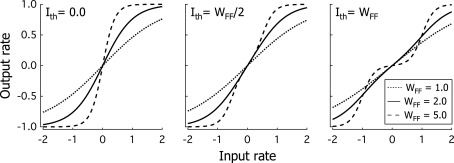
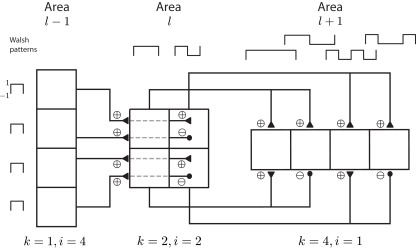
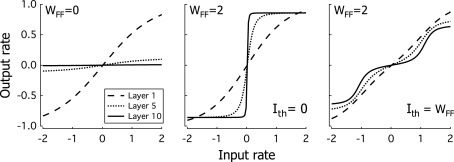
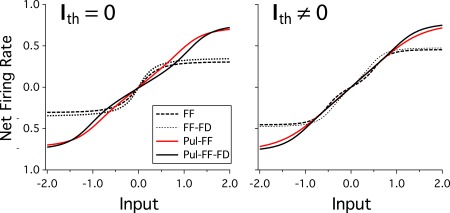
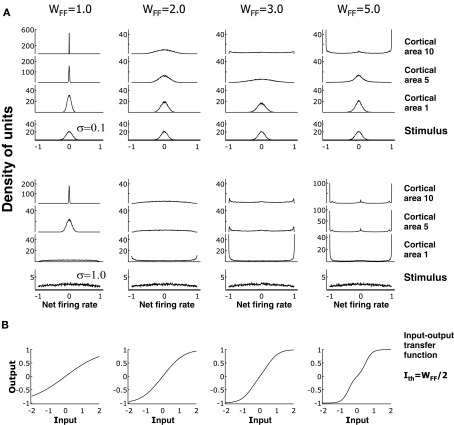
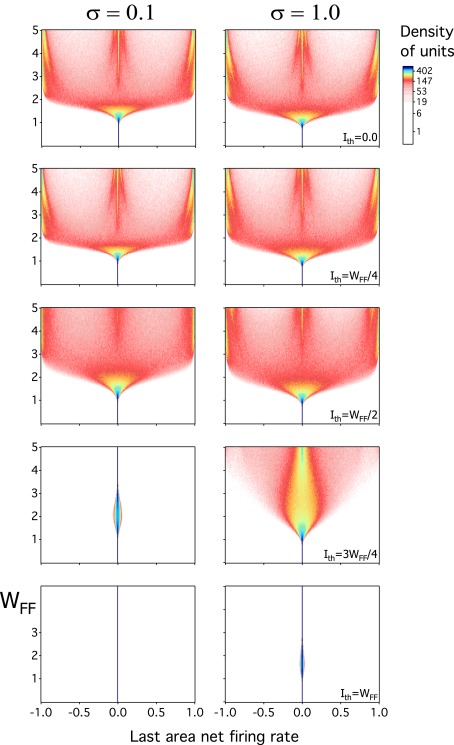
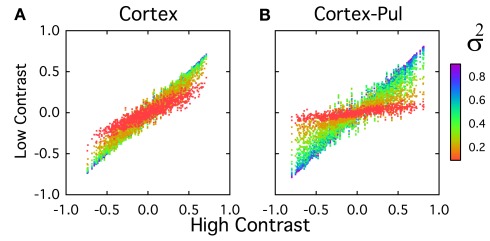
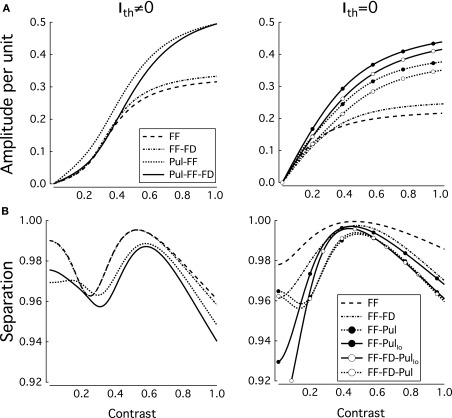
VISUAL RECEPTIVE FIELD (RF) ATTRIBUTES IN VISUAL CORTEX OF PRIMATES HAVE BEEN EXPLAINED MAINLY FROM CORTICAL CONNECTIONS: visual RFs progress from simple to complex through cortico-cortical pathways from lower to higher levels in the visual hierarchy. This feedforward flow of information is paired with top-down processes through the feedback pathway. Although the hierarchical organization explains the spatial properties of RFs, is unclear how a non-linear transmission of activity through the visual hierarchy can yield smooth contrast response functions in all level of the hierarchy. Depending on the gain, non-linear transfer functions create either a bimodal response to contrast, or no contrast dependence of the response in the highest level of the hierarchy. One possible mechanism to regulate this transmission of visual contrast information from low to high level involves an external component that shortcuts the flow of information through the hierarchy. A candidate for this shortcut is the Pulvinar nucleus of the thalamus. To investigate representation of stimulus contrast a hierarchical model network of ten cortical areas is examined. In each level of the network, the activity from the previous layer is integrated and then non-linearly transmitted to the next level. The arrangement of interactions creates a gradient from simple to complex RFs of increasing size as one moves from lower to higher cortical levels. The visual input is modeled as a Gaussian random input, whose width codes for the contrast. This input is applied to the first area. The output activity ratio among different contrast values is analyzed for the last level to observe sensitivity to a contrast and contrast invariant tuning. For a purely cortical system, the output of the last area can be approximately contrast invariant, but the sensitivity to contrast is poor. To account for an alternative visual processing pathway, non-reciprocal connections from and to a parallel pulvinar like structure of nine areas is coupled to the system. Compared to the pure feedforward model, cortico-pulvino-cortical output presents much more sensitivity to contrast and has a similar level of contrast invariance of the tuning.
灵长类动物视觉皮层的视感受野(RF)属性主要通过皮质连接来解释:视觉 RF 从简单到复杂通过皮质-皮质通路从低层次到高层次在视觉层次结构中。这种信息的前馈流与通过反馈通路的自上而下的过程相配对。虽然层次结构组织解释了 RF 的空间属性,但尚不清楚活动如何通过视觉层次结构的非线性传递在层次结构的所有级别产生平滑的对比度响应函数。根据增益,非线性传递函数会导致对比度产生双峰响应,或者在层次结构的最高级别中响应没有对比度依赖性。一种可能的机制来调节这种从低到高的视觉对比度信息的传递涉及到一个外部组件,该组件可以缩短信息通过层次结构的流动。丘脑的Pulvinar 核是这个捷径的一个候选者。为了研究刺激对比度的表示,检查了一个由十个皮质区域组成的分层模型网络。在网络的每一层,来自前一层的活动被整合,然后非线性地传递到下一层。交互的排列从低到高皮质层从简单到复杂的 RF 形成大小递增的梯度。视觉输入被建模为高斯随机输入,其宽度编码对比度。此输入应用于第一个区域。分析最后一个级别中不同对比度值之间的输出活动比,以观察对对比度和对比度不变调谐的敏感性。对于纯粹的皮质系统,最后一个区域的输出可以近似于对比度不变,但对比度的敏感性较差。为了说明替代的视觉处理途径,来自和到类似 Pulvinar 的九个区域的非互易连接与系统耦合。与纯前馈模型相比,皮质- Pulvino-皮质输出对对比度的敏感性更高,并且调谐的对比度不变性相似。