Anticevic Alan, Halassa Michael M
School of Medicine, Yale University, New Haven, CT, United States.
Department of Neuroscience, Tufts University School of Medicine, Boston, MA, United States.
Front Neurosci. 2023 Apr 13;17:1163600. doi: 10.3389/fnins.2023.1163600. eCollection 2023.
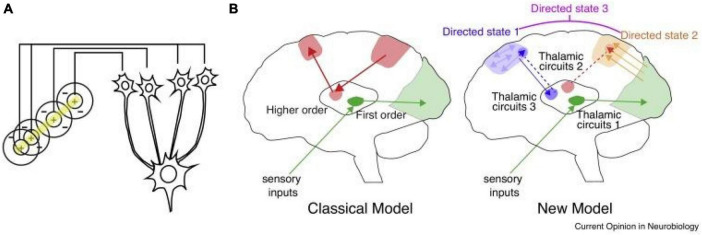
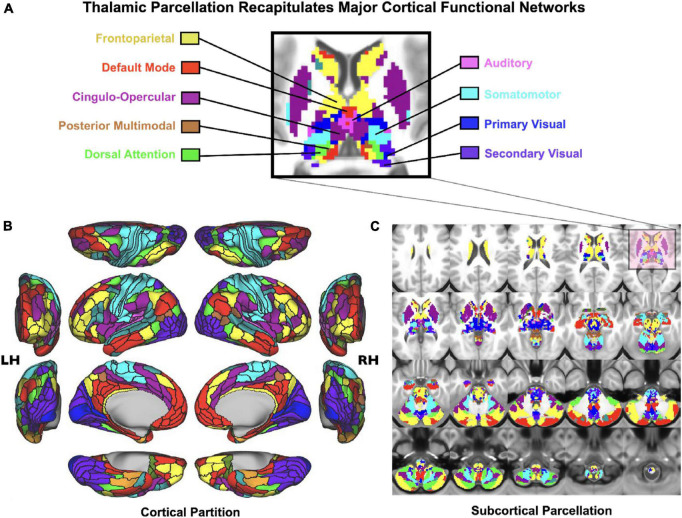
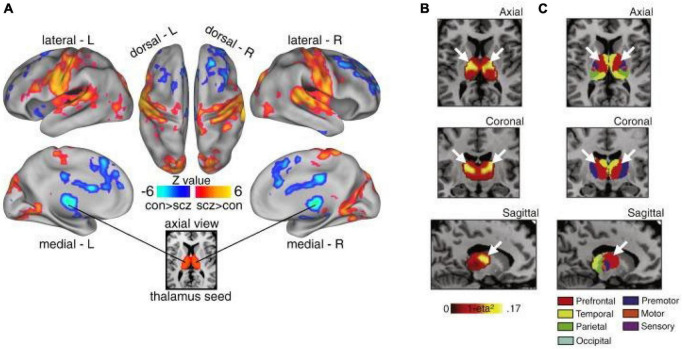
Psychosis spectrum disorder (PSD) affects 1% of the world population and results in a lifetime of chronic disability, causing devastating personal and economic consequences. Developing new treatments for PSD remains a challenge, particularly those that target its core cognitive deficits. A key barrier to progress is the tenuous link between the basic neurobiological understanding of PSD and its clinical phenomenology. In this perspective, we focus on a key opportunity that combines innovations in non-invasive human neuroimaging with basic insights into thalamic regulation of functional cortical connectivity. The thalamus is an evolutionary conserved region that forms forebrain-wide functional loops critical for the transmission of external inputs as well as the construction and update of internal models. We discuss our perspective across four lines of evidence: First, we articulate how PSD symptomatology may arise from a faulty network organization at the macroscopic circuit level with the thalamus playing a central coordinating role. Second, we discuss how recent animal work has mechanistically clarified the properties of thalamic circuits relevant to regulating cortical dynamics and cognitive function more generally. Third, we present human neuroimaging evidence in support of thalamic alterations in PSD, and propose that a similar "thalamocortical dysconnectivity" seen in pharmacological imaging (under ketamine, LSD and THC) in healthy individuals may link this circuit phenotype to the common set of symptoms in idiopathic and drug-induced psychosis. Lastly, we synthesize animal and human work, and lay out a translational path for biomarker and therapeutic development.
精神分裂症谱系障碍(PSD)影响着全球1%的人口,并导致终生慢性残疾,造成毁灭性的个人和经济后果。开发针对PSD的新疗法仍然是一项挑战,尤其是针对其核心认知缺陷的疗法。进展的一个关键障碍是对PSD的基本神经生物学理解与其临床现象学之间的薄弱联系。从这个角度来看,我们关注一个关键机会,即将无创人类神经成像的创新与对丘脑对功能性皮质连接调节的基本见解相结合。丘脑是一个进化上保守的区域,形成了全脑范围的功能回路,对外部输入的传递以及内部模型的构建和更新至关重要。我们从四条证据线来阐述我们的观点:第一,我们阐明PSD症状学可能如何源于宏观电路水平上错误的网络组织,丘脑在其中发挥着核心协调作用。第二,我们讨论最近的动物研究如何从机制上阐明了与更普遍地调节皮质动力学和认知功能相关的丘脑回路的特性。第三,我们展示支持PSD中丘脑改变的人类神经成像证据,并提出在健康个体中药物成像(在氯胺酮、LSD和THC作用下)中看到的类似“丘脑皮质连接障碍”可能将这种回路表型与特发性和药物性精神病的常见症状联系起来。最后,我们综合动物和人类研究成果,为生物标志物和治疗开发制定一条转化路径。