School of Public Health and Social Work, Institute of Health and Biomedical Innovation, Queensland University of Technology, Brisbane, Queensland, Australia.
PLoS One. 2012;7(5):e37500. doi: 10.1371/journal.pone.0037500. Epub 2012 May 24.
Heat-related impacts may have greater public health implications as climate change continues. It is important to appropriately characterize the relationship between heatwave and health outcomes. However, it is unclear whether a case-crossover design can be effectively used to assess the event- or episode-related health effects. This study examined the association between exposure to heatwaves and mortality and emergency hospital admissions (EHAs) from non-external causes in Brisbane, Australia, using both case-crossover and time series analyses approaches.
Poisson generalised additive model (GAM) and time-stratified case-crossover analyses were used to assess the short-term impact of heatwaves on mortality and EHAs. Heatwaves exhibited a significant impact on mortality and EHAs after adjusting for air pollution, day of the week, and season.
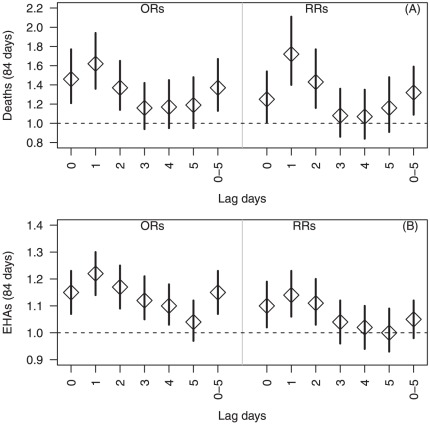
For time-stratified case-crossover analysis, odds ratios of mortality and EHAs during heatwaves were 1.62 (95% confidence interval (CI): 1.36-1.94) and 1.22 (95% CI: 1.14-1.30) at lag 1, respectively. Time series GAM models gave similar results. Relative risks of mortality and EHAs ranged from 1.72 (95% CI: 1.40-2.11) to 1.81 (95% CI: 1.56-2.10) and from 1.14 (95% CI: 1.06-1.23) to 1.28 (95% CI: 1.21-1.36) at lag 1, respectively. The risk estimates gradually attenuated after the lag of one day for both case-crossover and time series analyses.
The risk estimates from both case-crossover and time series models were consistent and comparable. This finding may have implications for future research on the assessment of event- or episode-related (e.g., heatwave) health effects.
随着气候变化的持续,与热相关的影响可能对公共卫生产生更大的影响。准确描述热浪与健康结果之间的关系非常重要。然而,目前尚不清楚病例交叉设计是否可以有效地用于评估与事件或时段相关的健康影响。本研究使用病例交叉和时间序列分析方法,在澳大利亚布里斯班考察了热浪暴露与死亡率和非外部原因的急诊入院(EHAs)之间的关系。
泊松广义加性模型(GAM)和时间分层病例交叉分析用于评估热浪对死亡率和 EHAs 的短期影响。在调整了空气污染、星期几和季节等因素后,热浪对死亡率和 EHAs 有显著影响。
对于时间分层病例交叉分析,热浪期间死亡率和 EHAs 的比值比分别为 1.62(95%置信区间(CI):1.36-1.94)和 1.22(95% CI:1.14-1.30),在滞后 1 时。时间序列 GAM 模型给出了类似的结果。死亡率和 EHAs 的相对风险范围分别为 1.72(95% CI:1.40-2.11)至 1.81(95% CI:1.56-2.10)和 1.14(95% CI:1.06-1.23)至 1.28(95% CI:1.21-1.36),在滞后 1 时。对于病例交叉和时间序列分析,滞后一天后风险估计逐渐减弱。
病例交叉和时间序列模型的风险估计结果一致且可比。这一发现可能对未来与评估与事件或时段相关(例如,热浪)健康影响有关的研究具有重要意义。