Environmental Engineering Program, Yale University, New Haven, Connecticut, USA.
Environ Health Perspect. 2011 Feb;119(2):210-8. doi: 10.1289/ehp.1002313. Epub 2010 Oct 7.
Devastating health effects from recent heat waves, and projected increases in frequency, duration, and severity of heat waves from climate change, highlight the importance of understanding health consequences of heat waves.
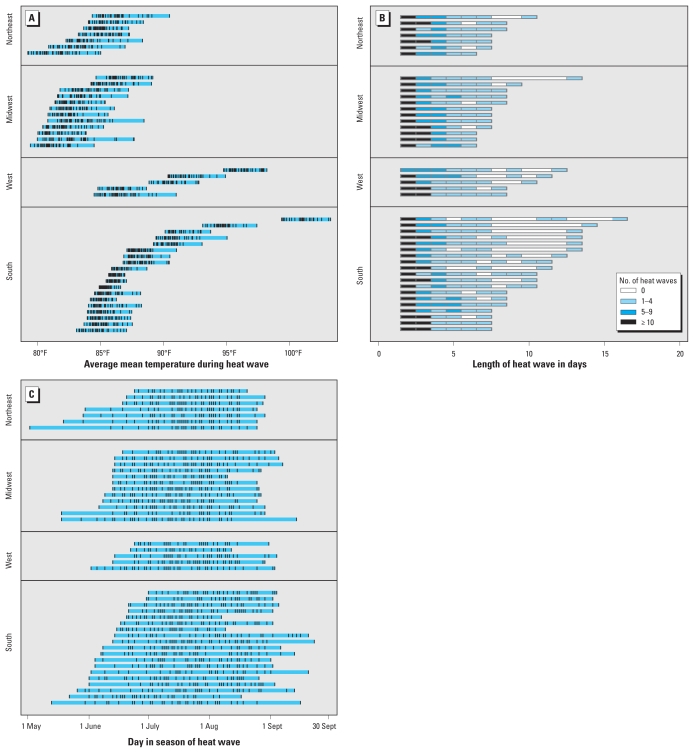
We analyzed mortality risk for heat waves in 43 U.S. cities (1987-2005) and investigated how effects relate to heat waves' intensity, duration, or timing in season.
Heat waves were defined as ≥ 2 days with temperature ≥ 95th percentile for the community for 1 May through 30 September. Heat waves were characterized by their intensity, duration, and timing in season. Within each community, we estimated mortality risk during each heat wave compared with non-heat wave days, controlling for potential confounders. We combined individual heat wave effect estimates using Bayesian hierarchical modeling to generate overall effects at the community, regional, and national levels. We estimated how heat wave mortality effects were modified by heat wave characteristics (intensity, duration, timing in season).
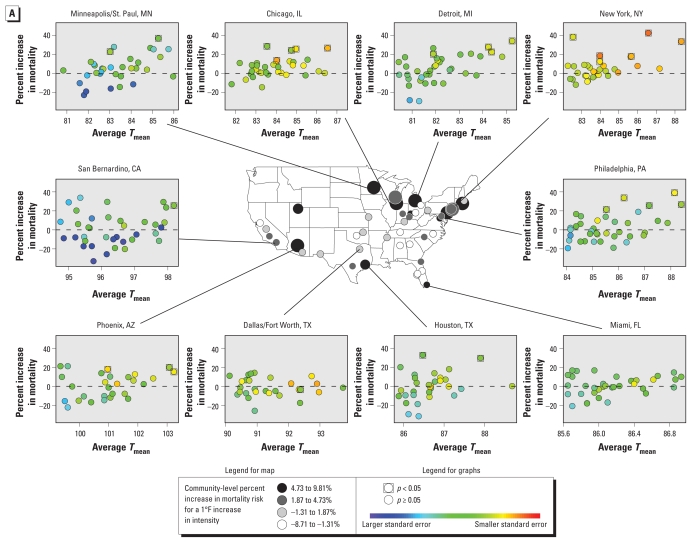
Nationally, mortality increased 3.74% [95% posterior interval (PI), 2.29-5.22%] during heat waves compared with non-heat wave days. Heat wave mortality risk increased 2.49% for every 1°F increase in heat wave intensity and 0.38% for every 1-day increase in heat wave duration. Mortality increased 5.04% (95% PI, 3.06-7.06%) during the first heat wave of the summer versus 2.65% (95% PI, 1.14-4.18%) during later heat waves, compared with non-heat wave days. Heat wave mortality impacts and effect modification by heat wave characteristics were more pronounced in the Northeast and Midwest compared with the South.
We found higher mortality risk from heat waves that were more intense or longer, or those occurring earlier in summer. These findings have implications for decision makers and researchers estimating health effects from climate change.
最近的热浪对健康造成了严重影响,预计气候变化导致的热浪频率、持续时间和强度都将增加,这凸显了了解热浪对健康影响的重要性。
我们分析了 1987 年至 2005 年间美国 43 个城市热浪的死亡率风险,并研究了热浪强度、持续时间或季节时间对其影响的关系。
热浪定义为 5 月 1 日至 9 月 30 日期间,社区内温度≥第 95 百分位数的≥2 天。热浪的特征是其强度、持续时间和季节时间。在每个社区内,我们与非热浪日相比,估计每个热浪期间的死亡率风险,同时控制潜在的混杂因素。我们使用贝叶斯层次模型结合个体热浪效应估计值,生成社区、地区和国家层面的总体效应。我们估计了热浪死亡率效应如何受热浪特征(强度、持续时间、季节时间)的影响。
全国范围内,与非热浪日相比,热浪期间的死亡率增加了 3.74%[95%后验区间(PI),2.29%-5.22%]。热浪强度每增加 1°F,热浪死亡率风险增加 2.49%,热浪持续时间每增加 1 天,死亡率增加 0.38%。与非热浪日相比,夏季第一个热浪期间的死亡率增加了 5.04%(95%PI,3.06%-7.06%),而后期热浪期间的死亡率增加了 2.65%(95%PI,1.14%-4.18%)。与南部地区相比,东北部和中西部地区热浪的死亡率影响和热浪特征的影响修饰作用更为明显。
我们发现,强度更高、持续时间更长或夏季早期发生的热浪会导致更高的死亡率风险。这些发现对决策者和研究人员估计气候变化对健康的影响具有重要意义。