Australian Institute of Marine Science, Townsville, Australia.
PLoS One. 2012;7(5):e37774. doi: 10.1371/journal.pone.0037774. Epub 2012 May 24.
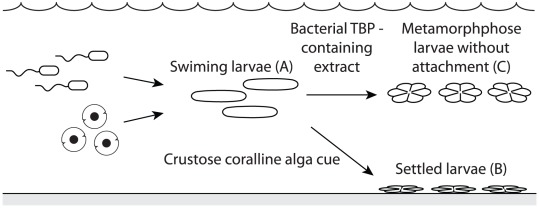
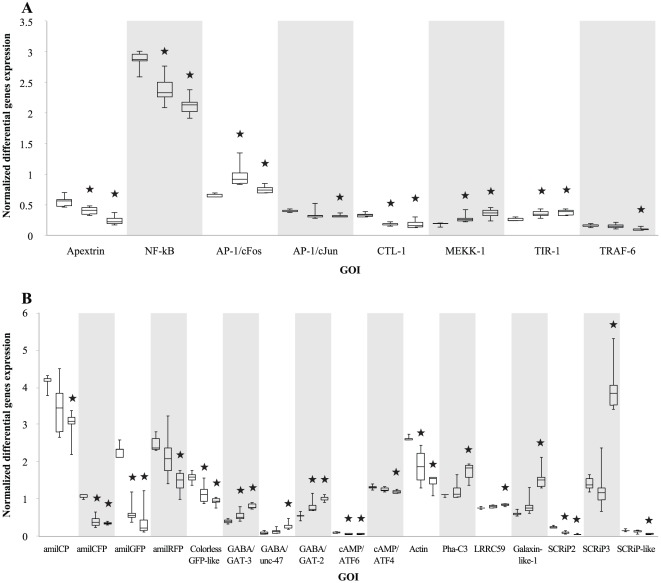
Biofilms of the bacterium Pseudoalteromonas induce metamorphosis of acroporid coral larvae. The bacterial metabolite tetrabromopyrrole (TBP), isolated from an extract of Pseudoalteromonas sp. associated with the crustose coralline alga (CCA) Neogoniolithon fosliei, induced coral larval metamorphosis (100%) with little or no attachment (0-2%). To better understand the molecular events and mechanisms underpinning the induction of Acropora millepora larval metamorphosis, including cell proliferation, apoptosis, differentiation, migration, adhesion and biomineralisation, two novel coral gene expression assays were implemented. These involved the use of reverse-transcriptase quantitative PCR (RT-qPCR) and employed 47 genes of interest (GOI), selected based on putative roles in the processes of settlement and metamorphosis. Substantial differences in transcriptomic responses of GOI were detected following incubation of A. millepora larvae with a threshold concentration and 10-fold elevated concentration of TBP-containing extracts of Pseudoalteromonas sp. The notable and relatively abrupt changes of the larval body structure during metamorphosis correlated, at the molecular level, with significant differences (p<0.05) in gene expression profiles of 24 GOI, 12 hours post exposure. Fourteen of those GOI also presented differences in expression (p<0.05) following exposure to the threshold concentration of bacterial TBP-containing extract. The specificity of the bacterial TBP-containing extract to induce the metamorphic stage in A. millepora larvae without attachment, using a robust, low cost, accurate, ecologically relevant and highly reproducible RT-qPCR assay, allowed partially decoupling of the transcriptomic processes of attachment and metamorphosis. The bacterial TBP-containing extract provided a unique opportunity to monitor the regulation of genes exclusively involved in the process of metamorphosis, contrasting previous gene expression studies that utilized cues, such as crustose coralline algae, biofilms or with GLW-amide neuropeptides that stimulate the entire onset of larval metamorphosis and attachment.
假交替单胞菌的生物膜诱导鹿角珊瑚幼虫变态。从与壳状珊瑚藻 Neogoniolithon fosliei 相关的假交替单胞菌 sp. 的提取物中分离出的细菌代谢产物四溴吡咯(TBP),诱导珊瑚幼虫变态(100%),几乎没有或没有附着(0-2%)。为了更好地理解诱导鹿角珊瑚幼虫变态的分子事件和机制,包括细胞增殖、凋亡、分化、迁移、粘附和生物矿化,我们实施了两种新的珊瑚基因表达检测方法。这些方法涉及逆转录定量 PCR(RT-qPCR)的使用,并采用了 47 个感兴趣的基因(GOI),这些基因是基于在定居和变态过程中的假定作用选择的。在 A. millepora 幼虫与 TBP 含量阈值浓度和 10 倍升高浓度的 Pseudoalteromonas sp. 提取物孵育后,GOI 的转录组反应存在显著差异。在变态过程中幼虫身体结构的显著和相对突然变化,在分子水平上,与暴露后 12 小时 24 个 GOI 的基因表达谱有显著差异(p<0.05)。在暴露于细菌 TBP 含量阈值提取物后,其中 14 个 GOI 的表达也存在差异(p<0.05)。使用稳健、低成本、准确、生态相关且高度可重复的 RT-qPCR 检测,细菌 TBP 含量提取物特异性地诱导 A. millepora 幼虫变态阶段而不附着,这使得附着和变态的转录组过程部分解耦。细菌 TBP 含量提取物提供了一个独特的机会,可以监测仅参与变态过程的基因的调控,与以前使用壳状珊瑚藻、生物膜或 GLW-酰胺神经肽等刺激幼虫变态和附着整个过程的基因表达研究形成对比。