Division of Health and Social Care, University of Surrey, Guildford, Surrey, UK.
BMC Health Serv Res. 2012 Jun 1;12:138. doi: 10.1186/1472-6963-12-138.
Over 50,000 non-medical healthcare professionals across the United Kingdom now have prescribing capabilities. However, there is no evidence available with regards to the extent to which non-medical prescribing (NMP) has been implemented within organisations across a strategic health authority (SHA). The aim of the study was to provide an overview of NMP across one SHA.
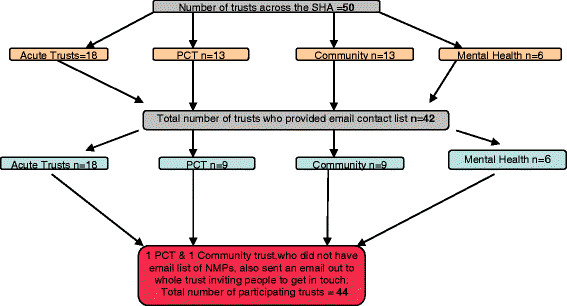
NMP leads across one SHA were asked to supply the email addresses of NMPs within their organisation. One thousand five hundred and eighty five NMPs were contacted and invited to complete an on-line descriptive questionnaire survey, 883 (55.7%) participants responded. Data was collected between November 2010 and February 2011.
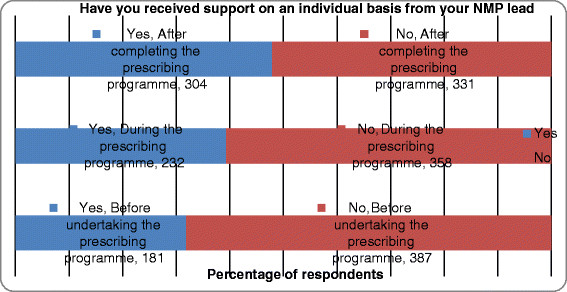
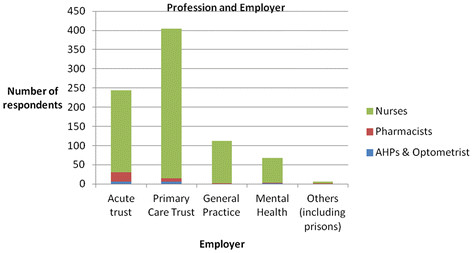
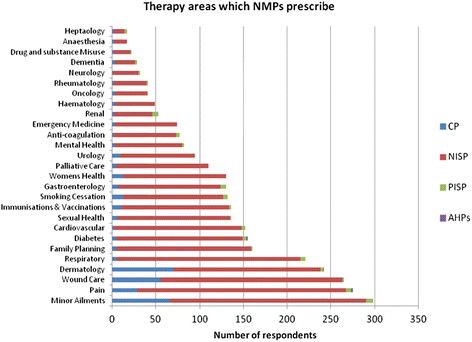
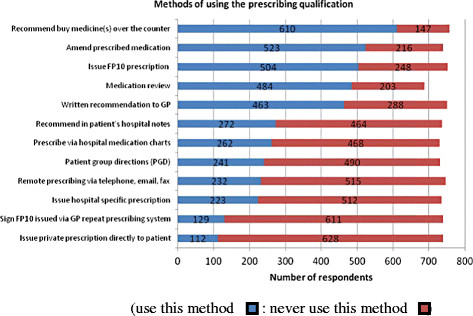
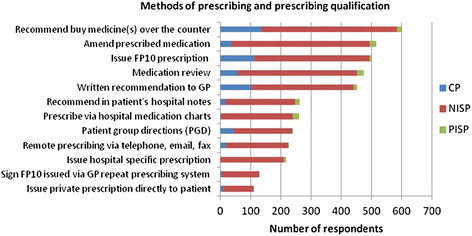
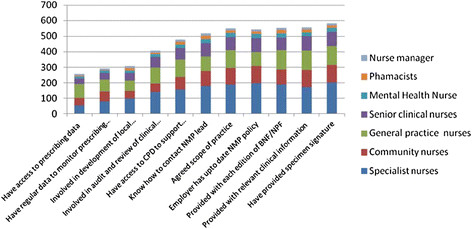
The majority of NMPs were based in primary care and worked in a team of 2 or more. Nurse independent supplementary prescribers were the largest group (590 or 68.6%) compared to community practitioner prescribers (198 or 22.4%), pharmacist independent supplementary prescribers (35 or 4%), and allied health professionals and optometrist independent and/or supplementary prescribers (8 or 0.9%). Nearly all (over 90%) of nurse independent supplementary prescribers prescribed medicines. Approximately a third of pharmacist independent supplementary prescribers, allied health professionals, and community practitioner prescribers did not prescribe. Clinical governance procedures were largely in place, although fewer procedures were reported by community practitioner prescribers. General practice nurses prescribed the most items. Factors affecting prescribing practice were: employer, the level of experience prior to becoming a non-medical prescriber, existence of governance procedures and support for the prescribing role (p < 0.001).
NMP in this strategic health authority reflects national development of this relatively new role in that the majority of non-medical prescribers were nurses based in primary care, with fewer pharmacist and allied health professional prescribers. This workforce is contributing to medicines management activities in a range of care settings. If non-medical prescibers are to maximise their contribution, robust governance and support from healthcare organisations is essential. The continued use of supplementary prescribing is questionable if maximum efficiency is sought. These are important points that need to be considered by those responsible for developing non-medical prescribing in the United Kingdom and other countries around the world.
在英国,已有超过 50,000 名非医疗保健专业人员具备处方能力。然而,目前尚不清楚在战略卫生局(SHA)中,非医疗处方(NMP)在组织中的实施程度。本研究的目的是提供 SHA 中 NMP 的概述。
要求 SHA 中的 NMP 负责人提供其组织内 NMP 的电子邮件地址。联系了 1585 名 NMP,并邀请他们完成在线描述性问卷调查,883 名(55.7%)参与者做出了回应。数据收集于 2010 年 11 月至 2011 年 2 月之间。
大多数 NMP 都在初级保健领域工作,并且是 2 人或更多人的团队成员。与社区执业医师处方者(198 或 22.4%)相比,护士独立补充处方者是最大的群体(590 或 68.6%),药剂师独立补充处方者(35 或 4%),以及联合卫生专业人员和验光师独立和/或补充处方者(8 或 0.9%)。几乎所有(超过 90%)的护士独立补充处方者都开了药。大约三分之一的药剂师独立补充处方者、联合卫生专业人员和社区执业医师处方者没有开处方。临床治理程序基本到位,尽管社区执业医师处方者报告的程序较少。普通科护士开的药品种类最多。影响处方实践的因素包括:雇主、成为非医疗从业者之前的经验水平、治理程序的存在以及对处方角色的支持(p < 0.001)。
在这个战略卫生局中,NMP 反映了这一新角色在全国范围内的发展,大多数非医疗从业者是初级保健领域的护士,药剂师和联合卫生专业人员的处方者较少。这支劳动力正在为各种医疗保健环境中的药物管理活动做出贡献。如果要使非医疗从业者最大程度地发挥其作用,则医疗保健组织必须提供强有力的治理和支持。如果要追求最高效率,则继续使用补充处方是值得怀疑的。这些都是负责在英国和世界其他国家发展非医疗处方的人需要考虑的重要问题。