Department of Pharmacy & Pharmacology, University of Bath, Bath, England.
University of Exeter Medical School, University of Exeter, Exeter, England.
BMC Health Serv Res. 2021 Jan 13;21(1):64. doi: 10.1186/s12913-021-06056-5.
Up to 50% of medicines are not used as intended, resulting in poor health and economic outcomes. Medicines optimisation is 'a person-centred approach to safe and effective medicines use, to ensure people obtain the best possible outcomes from their medicines'. The purpose of this exercise was to co-produce a prioritised research agenda for medicines optimisation using a multi-stakeholder (patient, researcher, public and health professionals) approach.
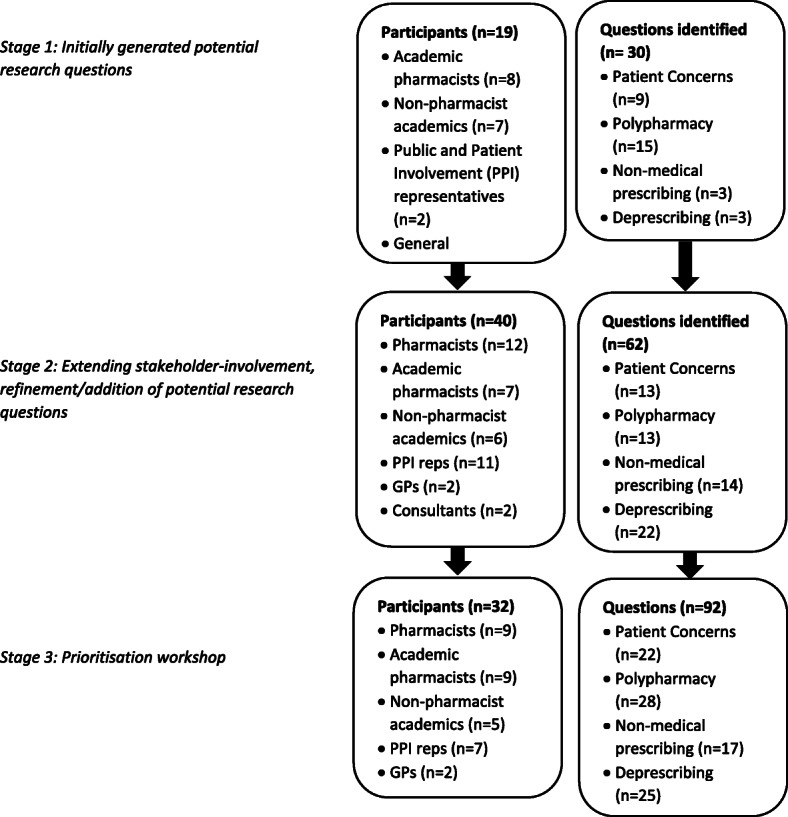
A three-stage, multiple method process was used including: generation of preliminary research questions (Stage 1) using a modified Nominal Group Technique; electronic consultation and ranking with a wider multi-stakeholder group (Stage 2); a face-to-face, one-day consensus meeting involving representatives from all stakeholder groups (Stage 3).
In total, 92 research questions were identified during Stages 1 and 2 and ranked in order of priority during stage 3. Questions were categorised into four areas: 'Patient Concerns' [e.g. is there a shared decision (with patients) about using each medicine?], 'Polypharmacy' [e.g. how to design health services to cope with the challenge of multiple medicines use?], 'Non-Medical Prescribing' [e.g. how can the contribution of non-medical prescribers be optimised in primary care?], and 'Deprescribing' [e.g. what support is needed by prescribers to deprescribe?]. A significant number of the 92 questions were generated by Patient and Public Involvement representatives, which demonstrates the importance of including this stakeholder group when identifying research priorities.
A wide range of research questions was generated reflecting concerns which affect patients, practitioners, the health service, as well the ethical and philosophical aspects of the prescribing and deprescribing of medicines. These questions should be used to set future research agendas and funding commissions.
多达 50%的药物未被按预期使用,导致健康状况不佳和经济后果不佳。药物优化是“一种以患者为中心的安全有效使用药物的方法,旨在确保患者从药物中获得最佳效果”。本研究旨在采用多利益相关者(患者、研究人员、公众和卫生专业人员)方法共同制定药物优化的优先研究议程。
使用包括三个阶段和多种方法的过程,包括:使用改良的名义小组技术生成初步研究问题(第 1 阶段);与更广泛的多利益相关者群体进行电子咨询和排名(第 2 阶段);涉及所有利益相关者群体代表的面对面为期一天的共识会议(第 3 阶段)。
在第 1 阶段和第 2 阶段共确定了 92 个研究问题,并在第 3 阶段按优先级进行了排名。这些问题分为四个领域:“患者关注”[例如,是否与患者共同决定使用每种药物?]、“多种药物使用”[例如,如何设计卫生服务以应对多种药物使用的挑战?]、“非医疗处方”[例如,如何优化初级保健中非医疗处方者的贡献?]和“去处方”[例如,处方者需要什么支持来减少药物的使用?]。患者和公众参与代表提出了大量的问题,这表明在确定研究重点时,纳入这一利益相关者群体非常重要。
提出了广泛的研究问题,反映了影响患者、从业者、卫生服务以及处方和去处方药物的伦理和哲学方面的问题。这些问题应被用于制定未来的研究议程和资助委员会。