Associated Faculty of Applied Bioscience Engineering, University College Ghent, Valentin Vaerwyckweg 1, B-9000 Ghent, Belgium.
BMC Evol Biol. 2012 Jun 1;12:76. doi: 10.1186/1471-2148-12-76.
Powdery mildew, caused by the obligate biotrophic fungus Blumeria graminis, is a major problem in cereal production as it can reduce quality and yield. B. graminis has evolved eight distinct formae speciales (f.sp.) which display strict host specialization. In the last decade, powdery mildew has emerged on triticale, the artificial intergeneric hybrid between wheat and rye. This emergence is probably triggered by a host range expansion of the wheat powdery mildew B. graminis f.sp. tritici. To gain more precise information about the evolutionary processes that led to this host range expansion, we pursued a combined pathological and genetic approach.
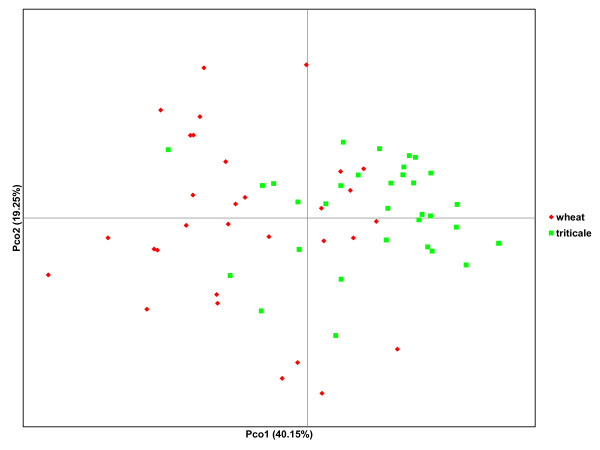
B. graminis isolates were sampled from triticale, wheat and rye from different breeding regions in Europe. Pathogenicity tests showed that isolates collected from triticale are highly pathogenic on most of the tested triticale cultivars. Moreover, these isolates were also able to infect several wheat cultivars (their previous hosts), although a lower aggressiveness was observed compared to isolates collected from wheat. Phylogenetic analysis of nuclear gene regions identified two statistically significant clades, which to a certain extent correlated with pathogenicity. No differences in virulence profiles were found among the sampled regions, but the distribution of genetic variation demonstrated to be geography dependent. A multilocus haplotype network showed that haplotypes pathogenic on triticale are distributed at different sites in the network, but always clustered at or near the tips of the network.
This study reveals a genetic structure in B. graminis with population differentiation according to geography and host specificity. In addition, evidence is brought forward demonstrating that the host range expansion of wheat isolates to the new host triticale occurred recently and multiple times at different locations in Europe.
由专性活体营养真菌玉蜀黍球腔菌引起的白粉病是谷物生产中的一个主要问题,因为它会降低质量和产量。玉蜀黍球腔菌已经进化出 8 个不同的专化型(f.sp.),表现出严格的宿主专化性。在过去的十年中,白粉病出现在黑小麦上,这是小麦和黑麦的人工属间杂种。这种出现可能是由小麦白粉病玉蜀黍球腔菌 f.sp. tritici的宿主范围扩大引起的。为了更准确地了解导致这种宿主范围扩大的进化过程,我们采用了病理和遗传相结合的方法。
从欧洲不同的育种地区采集的黑小麦、小麦和黑麦上的玉蜀黍球腔菌分离物进行了致病性测试。结果表明,从黑小麦上采集的分离物对大多数测试的黑小麦品种具有高度致病性。此外,这些分离物还能够感染几种小麦品种(它们的前宿主),尽管与从小麦上采集的分离物相比,它们的侵染能力较低。核基因区域的系统发育分析确定了两个具有统计学意义的分支,在一定程度上与致病性相关。在所采样的地区之间,没有发现毒力谱的差异,但遗传变异的分布表现出与地理有关。多基因单倍型网络表明,能够侵染黑小麦的单倍型分布在网络的不同位置,但总是聚集在网络的末端或附近。
本研究揭示了玉蜀黍球腔菌的遗传结构,其种群分化与地理和宿主特异性有关。此外,还提供了证据表明,小麦分离物对新宿主黑小麦的宿主范围扩大是最近在欧洲不同地点多次发生的。