Department of Psychology, Royal Holloway, University of London, Egham, TW20 0EX Surrey, UK.
Conscious Cogn. 2012 Sep;21(3):1242-56. doi: 10.1016/j.concog.2012.04.011. Epub 2012 Jun 1.
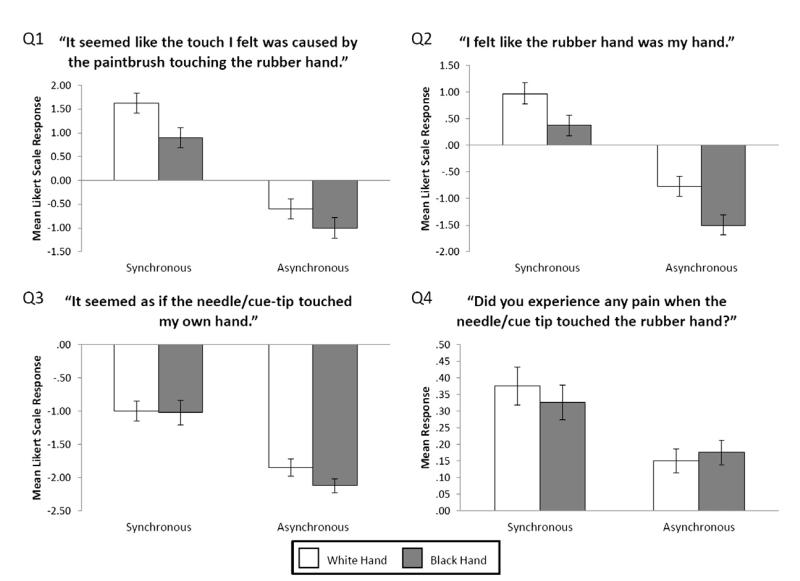
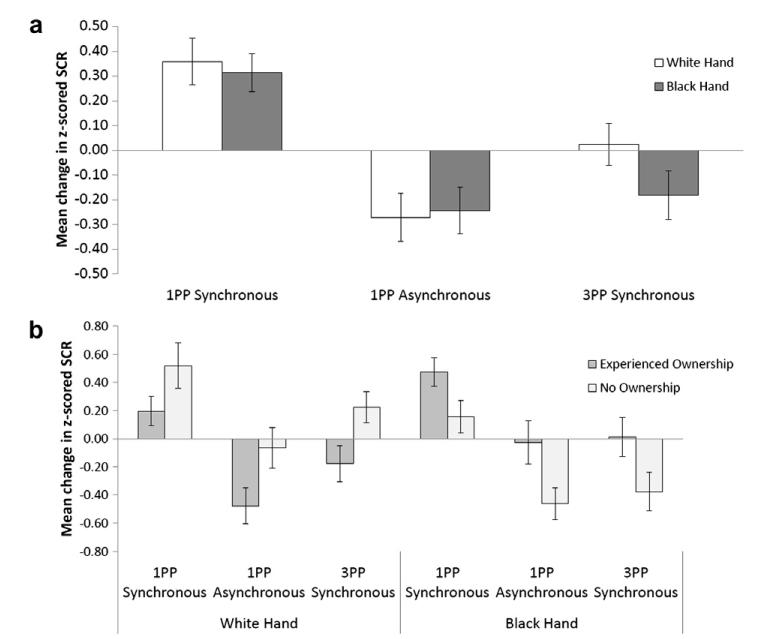
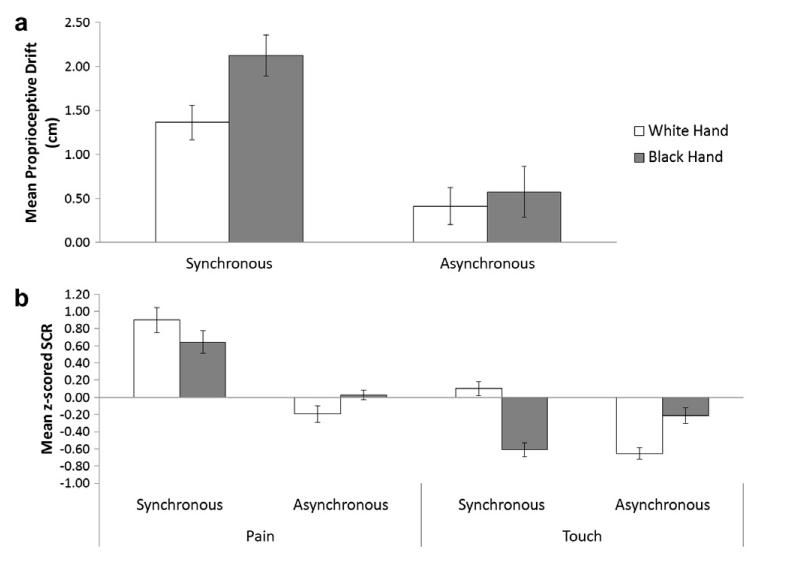
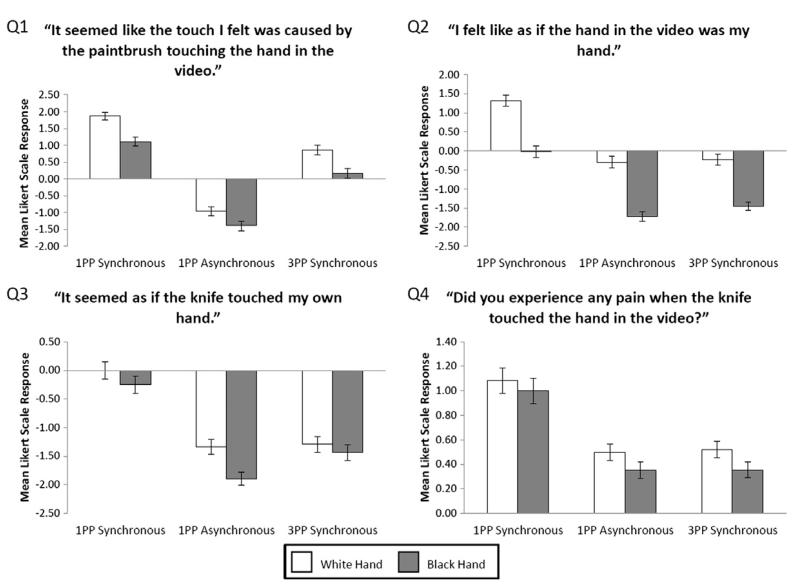
Multisensory stimulation has been shown to alter the sense of body-ownership. Given that perceived similarity between one's own body and those of others is crucial for social cognition, we investigated whether multisensory stimulation can lead participants to experience ownership over a hand of different skin colour. Results from two studies using introspective, behavioural and physiological methods show that, following synchronous visuotactile (VT) stimulation, participants can experience body-ownership over hands that seem to belong to a different racial group. Interestingly, a baseline measure of implicit racial bias did not predict whether participants would experience the RHI, but the overall strength of experienced body-ownership seemed to predict the participants' post-illusion implicit racial bias with those who experienced a stronger RHI showing a lower bias. These findings suggest that multisensory experiences can override strict ingroup/outgroup distinctions based on skin colour and point to a key role for sensory processing in social cognition.
多感觉刺激已被证明可以改变身体所有权的感觉。鉴于自己的身体和他人的身体之间的相似性对于社会认知至关重要,我们研究了多感觉刺激是否可以使参与者体验到不同肤色的手的所有权。使用内省、行为和生理方法的两项研究的结果表明,在进行同步视触(VT)刺激后,参与者可以体验到手似乎属于不同种族群体的身体所有权。有趣的是,隐性种族偏见的基线测量并不能预测参与者是否会体验到手部错觉,但所经历的身体所有权的总体强度似乎可以预测参与者在错觉后的隐性种族偏见,那些经历更强的手部错觉的人表现出的偏见较低。这些发现表明,多感觉体验可以覆盖基于肤色的严格的内群体/外群体区别,并指出感觉处理在社会认知中的关键作用。