Section for Women's Mental Health, Institute of Psychiatry, King's College London, London, United Kingdom.
PLoS Med. 2012;9(5):e1001224. doi: 10.1371/journal.pmed.1001224. Epub 2012 May 29.
There is very limited evidence on the health consequences of human trafficking. This systematic review reports on studies investigating the prevalence and risk of violence while trafficked and the prevalence and risk of physical, mental, and sexual health problems, including HIV, among trafficked people.
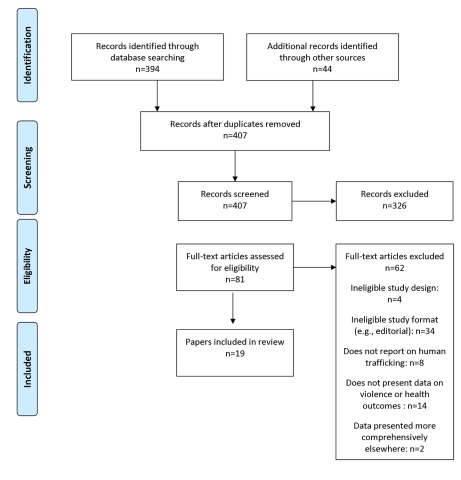
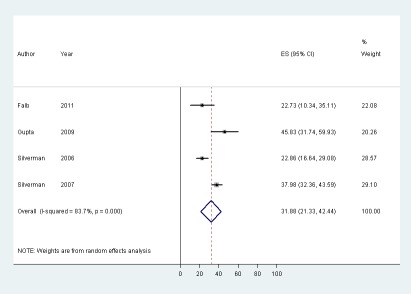
We conducted a systematic review comprising a search of Medline, PubMed, PsycINFO, EMBASE, and Web of Science, hand searches of reference lists of included articles, citation tracking, and expert recommendations. We included peer-reviewed papers reporting on the prevalence or risk of violence while trafficked and/or on the prevalence or risk of any measure of physical, mental, or sexual health among trafficked people. Two reviewers independently screened papers for eligibility and appraised the quality of included studies. The search identified 19 eligible studies, all of which reported on trafficked women and girls only and focused primarily on trafficking for sexual exploitation. The review suggests a high prevalence of violence and of mental distress among women and girls trafficked for sexual exploitation. The random effects pooled prevalence of diagnosed HIV was 31.9% (95% CI 21.3%-42.4%) in studies of women accessing post-trafficking support in India and Nepal, but the estimate was associated with high heterogeneity (I² = 83.7%). Infection prevalence may be related as much to prevalence rates in women's areas of origin or exploitation as to the characteristics of their experience. Findings are limited by the methodological weaknesses of primary studies and their poor comparability and generalisability.
Although limited, existing evidence suggests that trafficking for sexual exploitation is associated with violence and a range of serious health problems. Further research is needed on the health of trafficked men, individuals trafficked for other forms of exploitation, and effective health intervention approaches.
关于人口贩运对健康造成的影响,目前仅有少量证据。本系统综述报告了研究人员调查人口贩运过程中暴力发生率和风险以及人身伤害、精神和性健康问题(包括艾滋病毒)发生率和风险的研究。
我们进行了系统综述,检索了 Medline、PubMed、PsycINFO、EMBASE 和 Web of Science,查阅了纳入文章的参考文献列表、引文追踪和专家建议,纳入了报告人口贩运过程中暴力发生率和风险以及人口贩运者任何身体、精神或性健康指标发生率和风险的同行评审论文。两名评审员独立筛选论文的合格性,并评估纳入研究的质量。检索共确定了 19 项符合条件的研究,这些研究均仅报告了被贩运的妇女和女孩,主要集中在性剥削的人口贩运上。综述表明,性剥削人口贩运的妇女和女孩中暴力和精神困扰发生率很高。在研究印度和尼泊尔接受人口贩运后支持服务的妇女时,采用随机效应汇总的诊断性艾滋病毒流行率为 31.9%(95%CI 21.3%-42.4%),但估计值存在很大的异质性(I²=83.7%)。感染流行率可能与妇女原籍国或受剥削地区的流行率以及她们经历的特征同样相关。研究结果受到主要研究方法上的弱点以及其可比性和普遍性较差的限制。
尽管证据有限,但现有证据表明,性剥削人口贩运与暴力和一系列严重的健康问题有关。需要进一步研究其他形式剥削的人口贩运者以及有效卫生干预措施对男性和女性的健康影响。