N Testemitanu Medical and Pharmaceutical University, Chisinau, Moldova.
BMC Public Health. 2011 Apr 14;11:232. doi: 10.1186/1471-2458-11-232.
Trafficking in women is a widespread human rights violation commonly associated with poor mental health. Yet, to date, no studies have used psychiatric diagnostic assessment to identify common forms of mental distress among survivors returning to their home country.
A longitudinal study was conducted of women aged 18 and over who returned to Moldova between December 2007 and December 2008 registered by the International Organisation for Migration as a survivor of human trafficking. Psychiatric diagnoses in women at a mean of 6 months after return (range 2-12 months) were made by a trained Moldavian psychiatrist using the Structured Clinical Interview for DSM-IV, and compared with diagnoses recorded in the same women within 5 days of return. We described the socio-demographic characteristics of the women in the sample including both pre and post-trafficking information. We then described the distribution of mental health diagnoses recorded during the crisis intervention phase (1-5 days after return) and the re-integration phase (2-12 months after return). We compared diagnoses at the patient level between the two time points by tabulating the diagnoses and carrying out a kappa test of agreement and the Stuart-Maxwell test for marginal homogeneity (an extension of the McNemar test to kxk table).
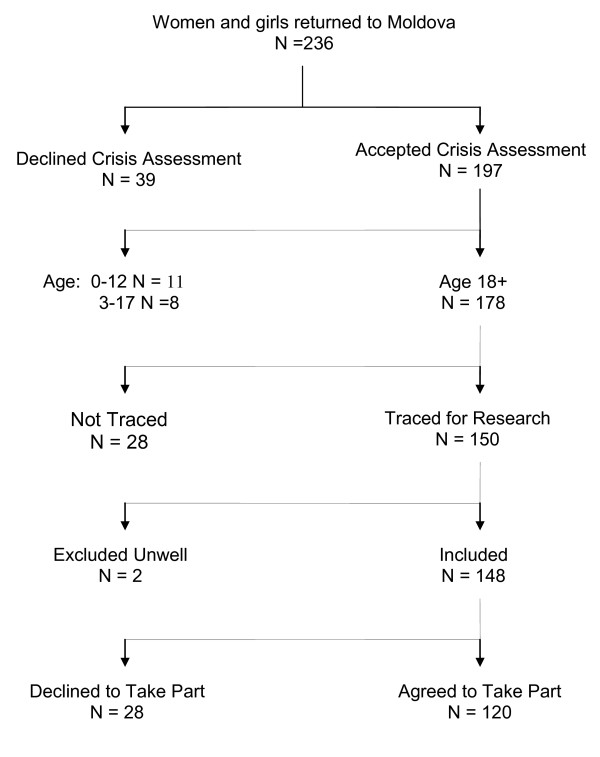
120/176 (68%) eligible women participated. At 2-12 months after their return, 54% met criteria for at least one psychiatric diagnoses comprising post-traumatic stress disorder (PTSD) alone (16%); co-morbid PTSD (20%); other anxiety or mood disorder (18%). 85% of women who had been diagnosed in the crisis phase with co-morbid PTSD or with another anxiety or mood disorder sustained a diagnosis of any psychiatric disorder when followed up during rehabilitation.
Trafficked women returning to their country of origin are likely to suffer serious psychological distress that may endure well beyond the time they return. Women found to have co-morbid PTSD or other forms of anxiety and depression immediately post-return should be offered evidenced-based mental health treatment for at least the standard 12-month period of rehabilitation.
人口贩卖是一种普遍存在的侵犯人权行为,通常与心理健康不良有关。然而,迄今为止,尚无研究使用精神病学诊断评估来确定返回原籍国的幸存者中常见的精神困扰形式。
对 2007 年 12 月至 2008 年 12 月期间,国际移民组织登记为人口贩卖幸存者并返回摩尔多瓦的 18 岁及以上女性进行了一项纵向研究。由一名受过培训的摩尔多瓦精神病学家在返回后平均 6 个月(范围 2-12 个月)使用 DSM-IV 结构化临床访谈对女性进行了精神病诊断,并与返回后 5 天内对同一女性记录的诊断进行了比较。我们描述了样本中女性的社会人口统计学特征,包括贩运前和贩运后的信息。然后,我们描述了在危机干预阶段(返回后 1-5 天)和重新融入阶段(返回后 2-12 个月)记录的心理健康诊断的分布情况。我们通过列出诊断并进行卡帕检验一致性和斯图尔特-马克斯韦尔检验边缘同质性(麦克内马尔检验到 kxk 表的扩展)来比较两个时间点的患者水平上的诊断。
176 名符合条件的女性中有 120 名参加了研究。在返回后 2-12 个月时,54%的女性符合至少一种精神诊断标准,包括单独创伤后应激障碍(PTSD)(16%);共病 PTSD(20%);其他焦虑或情绪障碍(18%)。在危机阶段被诊断为共病 PTSD 或其他焦虑或情绪障碍的 85%的女性在康复期间随访时维持任何精神障碍的诊断。
返回原籍国的被贩卖妇女可能会遭受严重的心理困扰,这种困扰可能会持续很长时间。在返回后立即发现共病 PTSD 或其他形式的焦虑和抑郁的女性,应至少接受 12 个月标准康复期的基于证据的心理健康治疗。