Graduate School of Education, The University of Tokyo, Bunkyo-ku, Tokyo, Japan.
PLoS One. 2012;7(5):e37900. doi: 10.1371/journal.pone.0037900. Epub 2012 May 30.
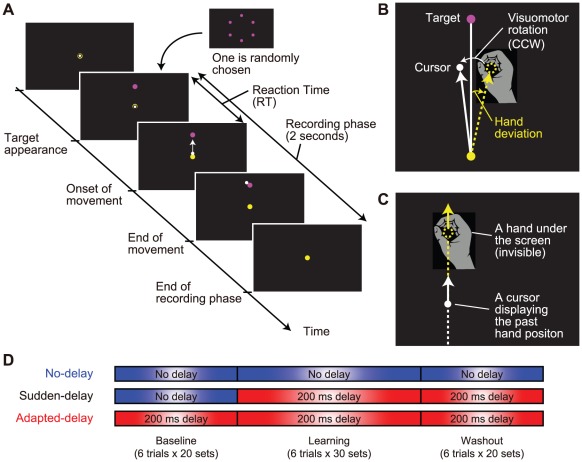
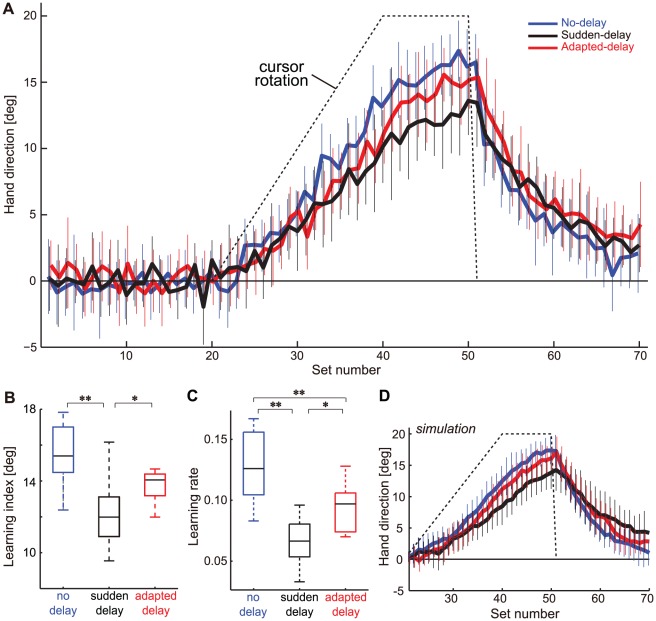
Computational theory of motor control suggests that the brain continuously monitors motor commands, to predict their sensory consequences before actual sensory feedback becomes available. Such prediction error is a driving force of motor learning, and therefore appropriate associations between motor commands and delayed sensory feedback signals are crucial. Indeed, artificially introduced delays in visual feedback have been reported to degrade motor learning. However, considering our perceptual ability to causally bind our own actions with sensory feedback, demonstrated by the decrease in the perceived time delay following repeated exposure to an artificial delay, we hypothesized that such perceptual binding might alleviate deficits of motor learning associated with delayed visual feedback. Here, we evaluated this hypothesis by investigating the ability of human participants to adapt their reaching movements in response to a novel visuomotor environment with 3 visual feedback conditions--no-delay, sudden-delay, and adapted-delay. To introduce novelty into the trials, the cursor position, which originally indicated the hand position in baseline trials, was rotated around the starting position. In contrast to the no-delay condition, a 200-ms delay was artificially introduced between the cursor and hand positions during the presence of visual rotation (sudden-delay condition), or before the application of visual rotation (adapted-delay condition). We compared the learning rate (representing how the movement error modifies the movement direction in the subsequent trial) between the 3 conditions. In comparison with the no-delay condition, the learning rate was significantly degraded for the sudden-delay condition. However, this degradation was significantly alleviated by prior exposure to the delay (adapted-delay condition). Our data indicate the importance of appropriate temporal associations between motor commands and sensory feedback in visuomotor learning. Moreover, they suggest that the brain is able to account for such temporal associations in a flexible manner.
运动控制的计算理论表明,大脑会持续监控运动指令,以便在实际感觉反馈可用之前预测其感觉后果。这种预测误差是运动学习的驱动力,因此运动指令和延迟感觉反馈信号之间的适当关联至关重要。事实上,已经有报道称,视觉反馈的人为延迟会降低运动学习的效果。然而,考虑到我们的感知能力可以使我们自己的动作与感觉反馈产生因果关系,这一点已经通过重复暴露于人为延迟后感知时间延迟的减少得到了证明,我们假设这种感知绑定可能会减轻与延迟视觉反馈相关的运动学习缺陷。在这里,我们通过研究人类参与者在 3 种视觉反馈条件下(无延迟、突然延迟和适应延迟)适应新的视觉运动环境的能力来评估这一假设。为了在试验中引入新奇性,光标位置(在基线试验中表示手的位置)在起始位置周围旋转。与无延迟条件不同,在视觉旋转存在期间(突然延迟条件)或在应用视觉旋转之前(适应延迟条件),光标和手之间人为引入了 200ms 的延迟。我们比较了 3 种条件下的学习率(表示运动误差在后续试验中如何修改运动方向)。与无延迟条件相比,突然延迟条件下的学习率显著降低。然而,通过预先暴露于延迟(适应延迟条件),这种降低得到了显著缓解。我们的数据表明,在视觉运动学习中,运动指令和感觉反馈之间适当的时间关联非常重要。此外,它们表明大脑能够以灵活的方式解释这种时间关联。