Department of Biological and Biomedical Sciences, The Aga Khan University, Karachi, Pakistan.
Parasit Vectors. 2012 Jun 7;5:112. doi: 10.1186/1756-3305-5-112.
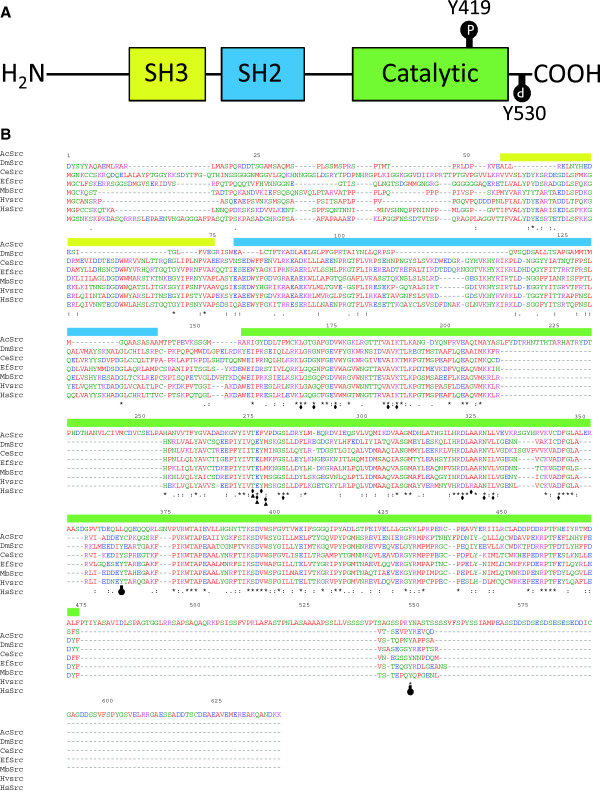
Acanthamoeba species are the causative agents of fatal granulomatous encephalitis in humans. Haematogenous spread is thought to be a primary step, followed by blood-brain barrier penetration, in the transmission of Acanthmaoeba into the central nervous system, but the associated molecular mechanisms remain unclear. Here, we evaluated the role of Src, a non-receptor protein tyrosine kinase in the biology and pathogenesis of Acanthamoeba.
Amoebistatic and amoebicidal assays were performed by incubating amoeba in the presence of Src kinase-selective inhibitor, PP2 (4-amino-5-(4-chlorophenyl)-7-(t-butyl)pyrazolo[3,4-d]pyrimidine) and its inactive analog, PP3 (4-amino-7-phenylpyrazolo[3,4-d]pyrimidine). Using this inhibitor, the role of Src kinase in A. castellanii interactions with Escherichia coli was determined. Zymographic assays were performed to study effects of Src kinase on extracellular proteolytic activities of A. castellanii. The human brain microvascular endothelial cells were used to determine the effects of Src kinase on A. castellanii adhesion to and cytotoxicity of host cells.
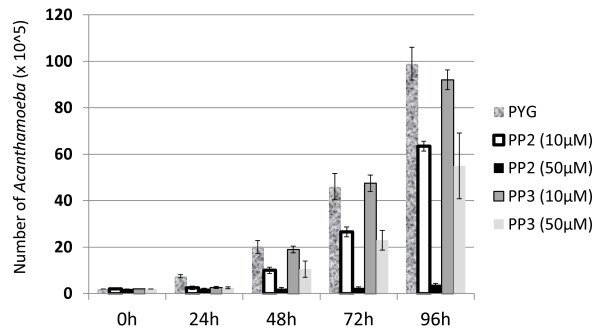
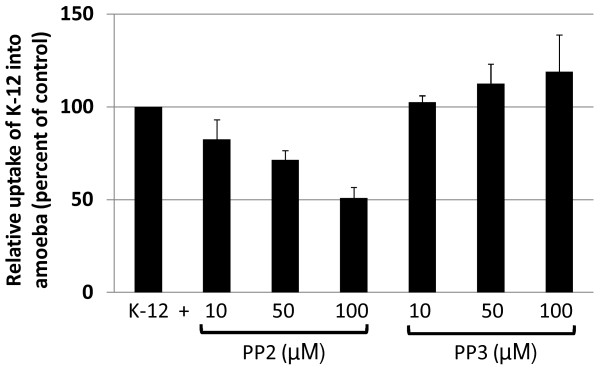
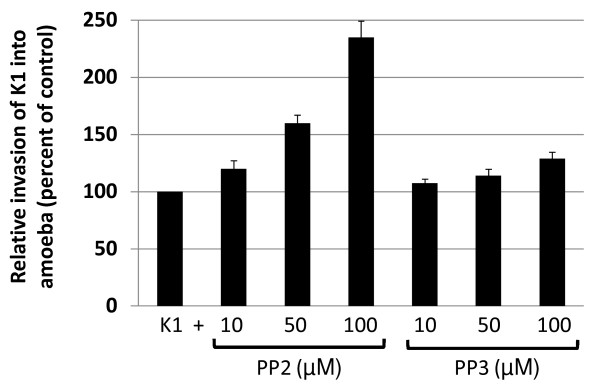
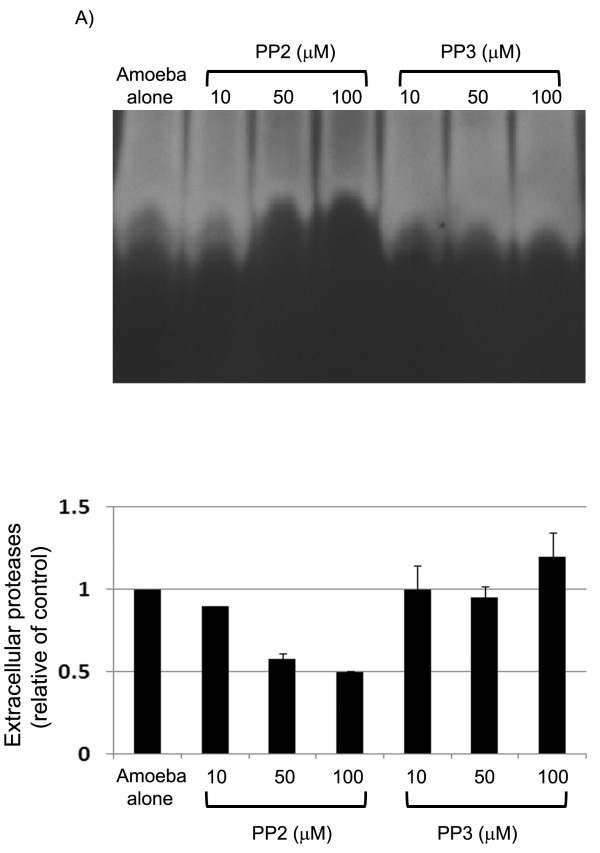
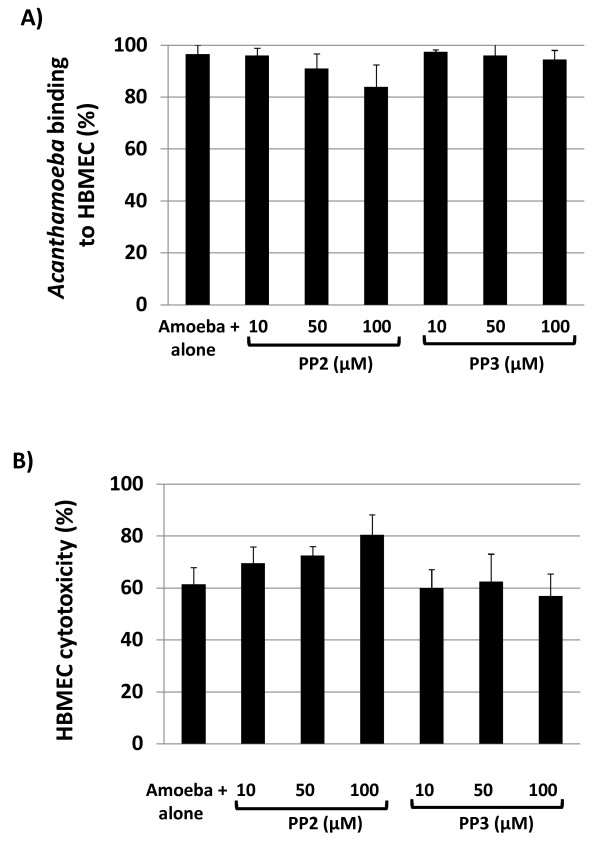
Inhibition of Src kinase using a specific inhibitor, PP2 (4-amino-5-(4 chlorophenyl)-7-(t-butyl)pyrazolo [3,4-d] pyrimidine) but not its inactive analog, PP3 (4-amino-7-phenylpyrazolo[3,4-d] pyrimidine), had detrimental effects on the growth of A. castellanii (keratitis isolate, belonging to the T4 genotype). Interestingly, inhibition of Src kinase hampered the phagocytic ability of A. castellanii, as measured by the uptake of non-invasive bacteria, but, on the contrary, invasion by pathogenic bacteria was enhanced. Zymographic assays revealed that inhibition of Src kinases reduced extracellular protease activities of A. castellanii. Src kinase inhibition had no significant effect on A. castellanii binding to and cytotoxicity of primary human brain microvascular endothelial cells, which constitute the blood-brain barrier.
For the first time, these findings demonstrated that Src kinase is involved in A. castellanii proliferation, protease secretions and phagocytic properties. Conversely, invasion of Acanthamoeba by pathogenic bacteria was stimulated by Src kinase inhibition.
棘阿米巴属是人类致命性肉芽肿性脑炎的病原体。血源性播散被认为是棘阿米巴进入中枢神经系统的第一步,随后是血脑屏障穿透,但相关的分子机制尚不清楚。在这里,我们评估了非受体蛋白酪氨酸激酶Src 在棘阿米巴的生物学和发病机制中的作用。
通过在存在 Src 激酶选择性抑制剂 PP2(4-氨基-5-(4-氯苯基)-7-(叔丁基)吡唑并[3,4-d]嘧啶)及其无活性类似物 PP3(4-氨基-7-苯基吡唑并[3,4-d]嘧啶)的情况下孵育阿米巴来进行抗阿米巴和杀阿米巴测定。使用该抑制剂,确定 Src 激酶在棘阿米巴与大肠杆菌相互作用中的作用。进行酶谱分析以研究 Src 激酶对棘阿米巴细胞外蛋白水解活性的影响。使用人脑微血管内皮细胞来确定 Src 激酶对棘阿米巴与宿主细胞粘附和细胞毒性的影响。
使用特异性抑制剂 PP2(4-氨基-5-(4-氯苯基)-7-(叔丁基)吡唑并[3,4-d]嘧啶)而不是其无活性类似物 PP3(4-氨基-7-苯基吡唑并[3,4-d]嘧啶)抑制 Src 激酶对棘阿米巴(角膜炎分离株,属于 T4 基因型)的生长有有害影响。有趣的是,抑制 Src 激酶会阻碍棘阿米巴的吞噬能力,如通过摄取非侵袭性细菌来衡量,但相反,致病性细菌的入侵增强了。酶谱分析显示,抑制 Src 激酶会降低棘阿米巴的细胞外蛋白酶活性。Src 激酶抑制对棘阿米巴与原代人脑微血管内皮细胞的结合和细胞毒性没有显著影响,原代人脑微血管内皮细胞构成血脑屏障。
这些发现首次表明,Src 激酶参与棘阿米巴的增殖、蛋白酶分泌和吞噬特性。相反,Src 激酶抑制会刺激棘阿米巴被致病性细菌入侵。