Department of Microbiology and Immunology, University of Michigan Medical School, Ann Arbor, MI 48109-0620, USA.
J Mol Biol. 2012 Sep 21;422(3):376-89. doi: 10.1016/j.jmb.2012.05.043. Epub 2012 Jun 7.
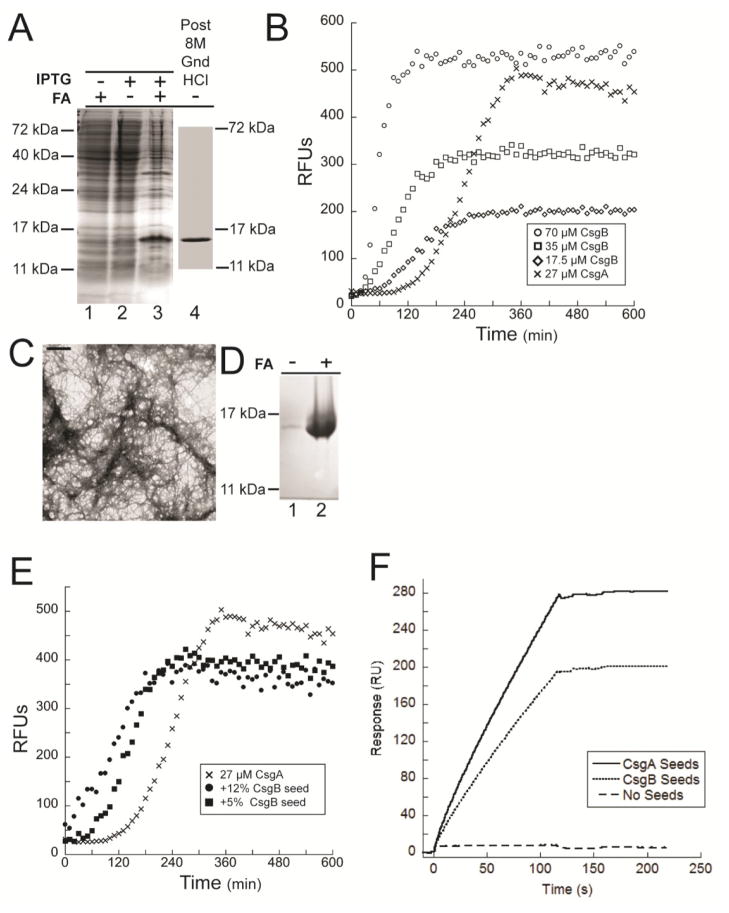
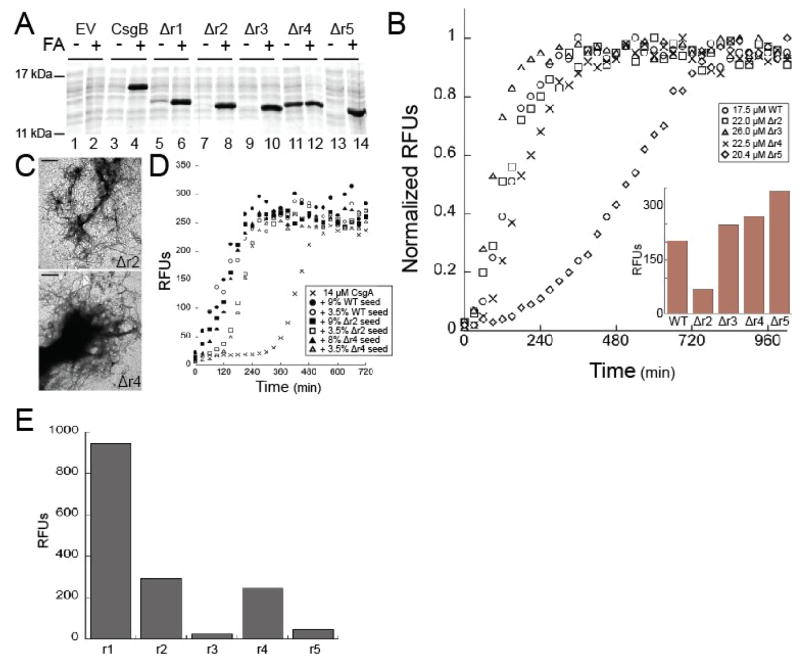
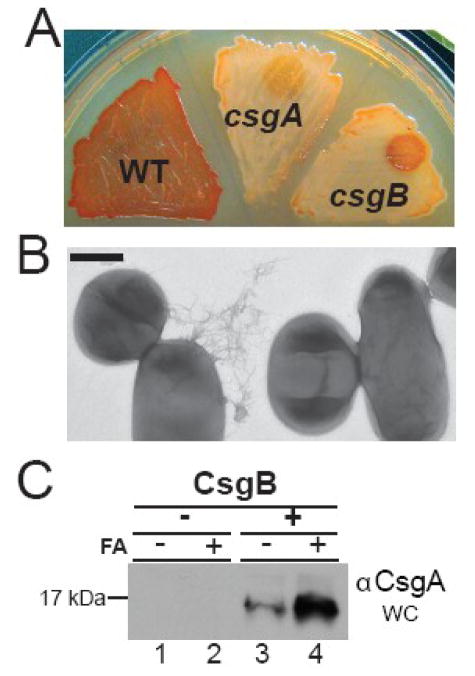
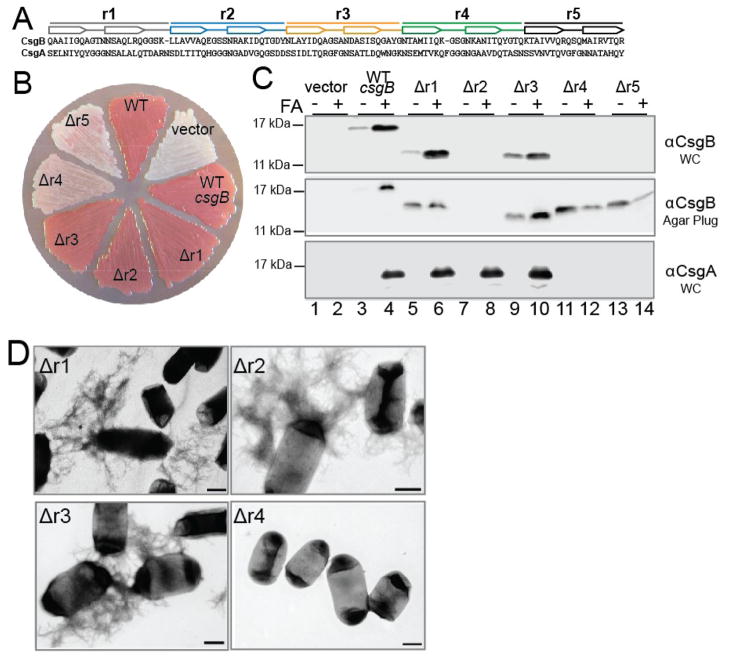
Curli are functional amyloids produced by enteric bacteria. The major curli fiber subunit, CsgA, self-assembles into an amyloid fiber in vitro. The minor curli subunit protein, CsgB, is required for CsgA polymerization on the cell surface. Both CsgA and CsgB are composed of five predicted β-strand-loop-β-strand-loop repeating units that feature conserved glutamine and asparagine residues. Because of this structural homology, we proposed that CsgB might form an amyloid template that initiates CsgA polymerization on the cell surface. To test this model, we purified wild-type CsgB and found that it self-assembled into amyloid fibers in vitro. Preformed CsgB fibers seeded CsgA polymerization as did soluble CsgB added to the surface of cells secreting soluble CsgA. To define the molecular basis of CsgB nucleation, we generated a series of mutants that removed each of the five repeating units. Each of these CsgB deletion mutants was capable of self-assembly in vitro. In vivo, membrane-localized mutants lacking the first, second, or third repeating units were able to convert CsgA into fibers. However, mutants missing either the fourth or fifth repeating units were unable to complement a csgB mutant. These mutant proteins were not localized to the outer membrane but were instead secreted into the extracellular milieu. Synthetic CsgB peptides corresponding to repeating units 1, 2, and 4 self-assembled into ordered amyloid polymers, while peptides corresponding to repeating units 3 and 5 did not, suggesting that there are redundant amyloidogenic domains in CsgB. Our results suggest a model where the rapid conversion of CsgB from unstructured protein to a β-sheet-rich amyloid template anchored to the cell surface is mediated by the C-terminal repeating units.
卷曲是肠细菌产生的功能性淀粉样蛋白。主要卷曲纤维亚基 CsgA 在体外自组装成淀粉样纤维。次要卷曲亚基蛋白 CsgB 是 CsgA 在细胞表面聚合所必需的。CsgA 和 CsgB 均由五个预测的β-链环-β-链环重复单元组成,具有保守的谷氨酰胺和天冬酰胺残基。由于这种结构同源性,我们提出 CsgB 可能形成一个淀粉样模板,从而在细胞表面引发 CsgA 聚合。为了验证该模型,我们纯化了野生型 CsgB,发现它在体外自组装成淀粉样纤维。预先形成的 CsgB 纤维启动了 CsgA 在细胞表面的聚合,就像添加到分泌可溶性 CsgA 的细胞表面的可溶性 CsgB 一样。为了定义 CsgB 成核的分子基础,我们生成了一系列去除五个重复单元中的每一个的突变体。这些 CsgB 缺失突变体中的每一个都能够在体外进行自我组装。在体内,缺乏第一个、第二个或第三个重复单元的膜定位突变体能够将 CsgA 转化为纤维。然而,缺失第四或第五个重复单元的突变体则无法补充 csgB 突变体。这些突变蛋白未定位到外膜,而是被分泌到细胞外环境中。与重复单元 1、2 和 4 对应的合成 CsgB 肽自组装成有序的淀粉样聚合物,而与重复单元 3 和 5 对应的肽则没有,这表明 CsgB 中有冗余的淀粉样形成结构域。我们的结果表明,CsgB 从无规卷曲蛋白快速转换为β-片层丰富的淀粉样模板并锚定在细胞表面的过程是由 C 末端重复单元介导的。