Department of Animals in Science and Society, Division of Animal Welfare and Laboratory Animal Science, Faculty of Veterinary Medicine, Utrecht University, Yalelaan 2, 3584 Utrecht, CM, The Netherlands.
Behav Brain Funct. 2012 Jun 11;8:30. doi: 10.1186/1744-9081-8-30.
Previous studies have demonstrated a profound lack of habituation in 129P3 mice compared to the habituating, but initially more anxious, BALB/c mice. The present study investigated whether this non-adaptive phenotype of 129P3 mice is primarily based on anxiety-related characteristics.
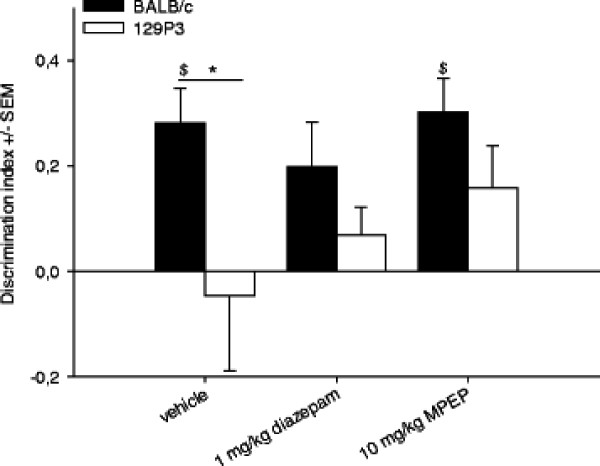
To test this hypothesis and extend our knowledge on the behavioural profile of 129P3 mice, the effects of the anxiolyticdiazepam (1, 3 and 5 mg/kg) and the putative anxiolytic metabotropic glutamate receptor 5 (mGlu5R) antagonist 2-methyl-6-(phenylethynyl)pyridine (MPEP, 3, 10 and 30 mg/kg) treatment on within-trial (intrasession) habituation, object recognition (diazepam: 1 mg/kg; MPEP 10 mg/kg) and on the central-nervous expression of the immediate early gene c-Fos (diazepam: 1 mg/kg; MPEP 10 mg/kg) were investigated.
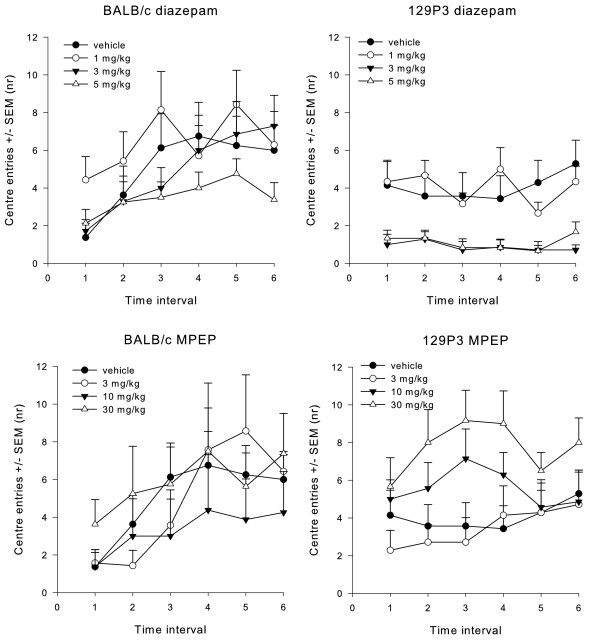
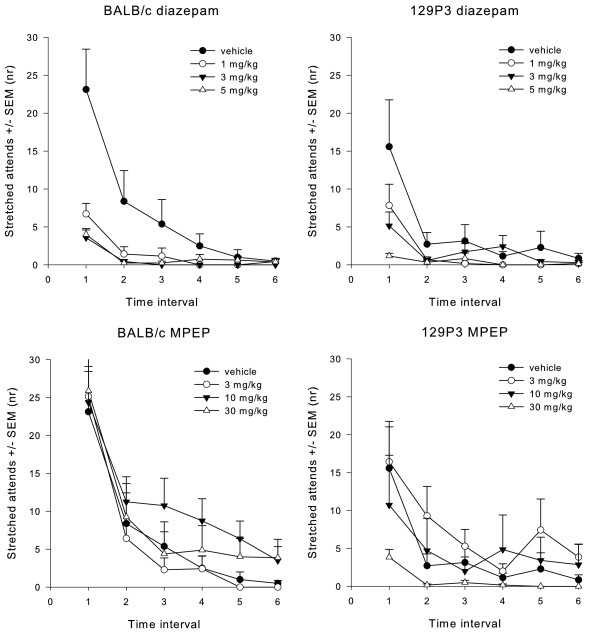
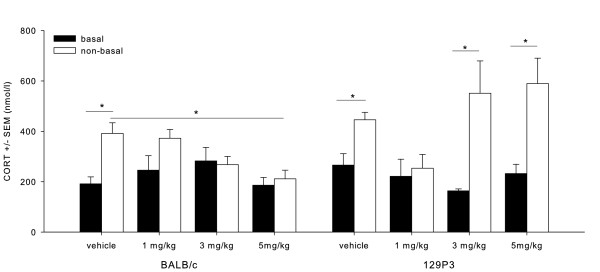
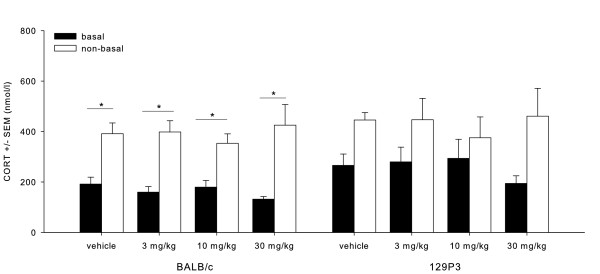
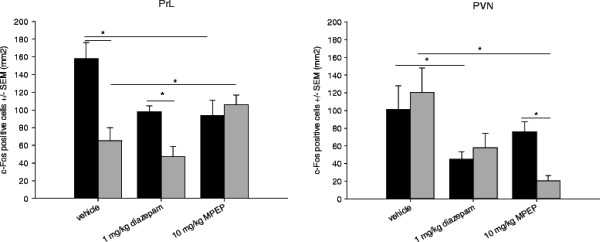
Behavioural findings validated the initially high, but habituating phenotype of BALB/c mice, while 129P3 mice were characterized by impaired intrasession habituation. Diazepam had an anxiolytic effect in BALB/c mice, while in higher doses caused behavioural inactivity in 129P3 mice. MPEP revealed almost no anxiolytic effects on behaviour in both strains, but reduced stress-induced corticosterone responses only in 129P3 mice. These results were complemented by reduced expression of c-Fos after MPEP treatment in brain areas related to emotional processes, and increased c-Fos expression in higher integrating brain areas such as the prelimbic cortex compared to vehicle-treated 129P3 mice.
These results suggest that the strain differences observed in (non)adaptive anxiety behaviour are at least in part mediated by differences in gamma-aminobutyric acid- A and mGluR5 mediated transmission.
先前的研究表明,与习惯化但最初更焦虑的 BALB/c 小鼠相比,129P3 小鼠的习惯化程度明显不足。本研究旨在探究 129P3 小鼠这种非适应性表型是否主要基于焦虑相关特征。
为了验证这一假说并扩展我们对 129P3 小鼠行为特征的了解,研究考察了苯二氮䓬类抗焦虑药地西泮(1、3 和 5mg/kg)和代谢型谷氨酸受体 5(mGlu5R)拮抗剂 2-甲基-6-(苯乙炔基)吡啶(MPEP,3、10 和 30mg/kg)对单次试验内(试验内)习惯化、物体识别(地西泮:1mg/kg;MPEP 10mg/kg)以及即刻早期基因 c-Fos 中枢神经表达(地西泮:1mg/kg;MPEP 10mg/kg)的影响。
行为学研究结果验证了 BALB/c 小鼠最初的高、但可习惯化的表型,而 129P3 小鼠的特点是试验内习惯化受损。地西泮对 BALB/c 小鼠具有抗焦虑作用,而在较高剂量下,会导致 129P3 小鼠行为不活跃。MPEP 对两种品系的行为几乎没有抗焦虑作用,但仅在 129P3 小鼠中降低了应激诱导的皮质酮反应。这些结果得到了补充,即 MPEP 治疗后,与情绪处理相关的脑区 c-Fos 表达减少,与 129P3 小鼠相比,更高整合脑区如前额皮质的 c-Fos 表达增加。
这些结果表明,在(非)适应性焦虑行为中观察到的品系差异至少部分是由γ-氨基丁酸-A 和 mGluR5 介导的传递差异介导的。